Key takeaways
- ✓A food business licence is issued under the Food Act 2006. Planning approval is decided under the Planning Act 2016. They are different things.
- ✓Both come from your council, which is exactly why operators assume one covers the other. It doesn't.
- ✓A licensable food business broadly manufactures food or sells unpackaged food by retail.
- ✓A licensable food business must nominate a food safety supervisor.
- ✓The licence attaches to the operator. The planning approval attaches to the land.
Food Business Licence vs Council Approval in QLD
You'll usually hear this called a development application, or DA — that's the formal name for council approval under the Planning Act 2016. The confusion this article exists to fix is a specific one: both a food business licence and planning approval come from your local council, so operators reasonably assume that having one means the other is sorted.
It doesn't. They are made under different Acts, they ask different questions, they're handled by different teams, and they attach to different things.
Get a council-ready planning report in 5 minutes — no planner, no waiting.
Get your report →The short answer
A food business licence is issued by your local council under the Food Act 2006 and deals with safe food handling. Planning approval is decided under the Planning Act 2016 and deals with whether the use belongs on that land. Holding one tells you nothing about the other.
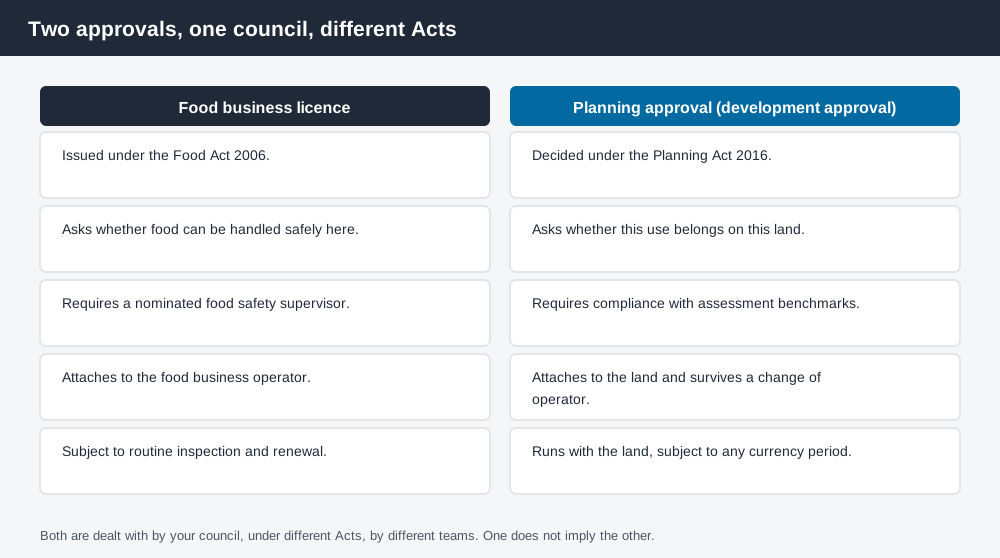
Figure 1: Same council, different Acts, different questions.
What each one is actually asking
The food business licence asks whether food can be handled safely at these premises by this operator. That means construction and finishes of food preparation areas, hand washing, temperature control, cleaning, pest management, staff practices and record keeping. It is inspected, it is renewed, and it can be conditioned or suspended if standards slip.
Planning approval asks whether a food and drink outlet belongs on this land — parking, hours, acoustics, waste, traffic, and whether the scheme anticipates the use in that zone. It never looks inside a fridge.
That distinction has a practical consequence. A council can grant you a food business licence for a tenancy whose use is unlawful under the planning scheme — the licensing team is not assessing the planning position. Operators have opened, passed food inspections, traded happily, and then received an enforcement notice about the use.
Which businesses need a licence
Spend 5 minutes, not 3 weeks
instantDA generates a council-ready planning report for Queensland development applications. No town planner. No waiting.
Get your report →Under the Food Act 2006, most food businesses in Queensland need a licence from the local council for the area where the business operates. Broadly, a licensable food business is one that manufactures food, or sells unpackaged food by retail.
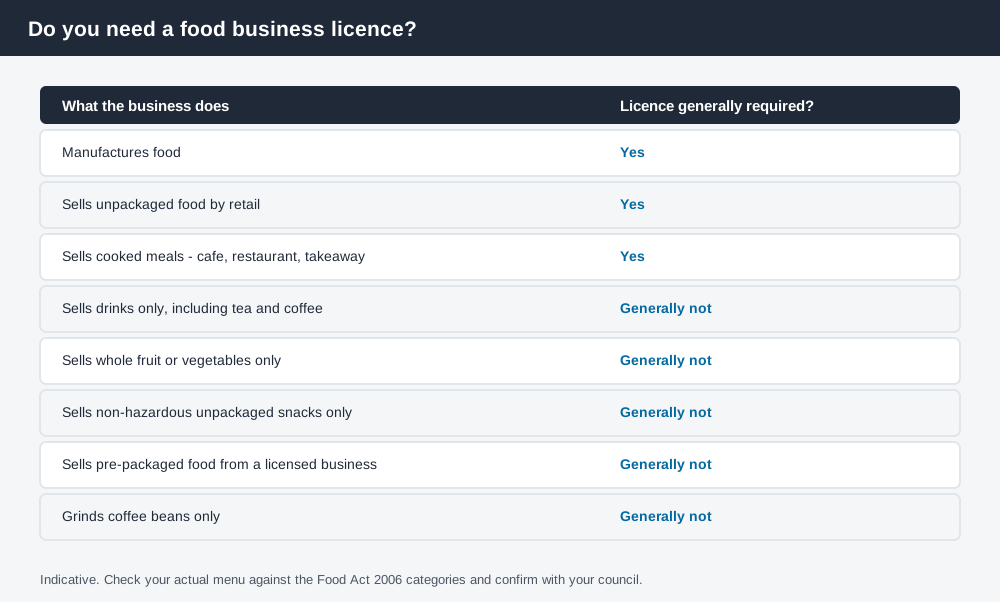
Figure 2: Indicative. Check your actual menu against the categories.
The exclusions are narrower than people hope. State guidance indicates that businesses only selling drinks such as tea, coffee and soft drinks, only selling whole fruit or vegetables, only selling certain non-hazardous unpackaged snack foods, only selling pre-packaged food prepared by a licensed food business, or only grinding coffee beans generally don't need a licence.
The word doing the work is only. Add a toastie to a coffee-only operation and the position changes. Run your actual menu against the categories rather than the description of your business.
The food safety supervisor
Licensable food businesses are required to nominate a food safety supervisor — a person with responsibility for food safety in the business who holds the required competencies. Councils check this as part of licensing and as part of ongoing compliance.
This is a recruitment and training question with a lead time, not a form you tick on the way out the door. If your nominated supervisor leaves, the obligation doesn't.
- ✓Confirm whether your menu makes you licensable
- ✓Nominate a food safety supervisor with the required competencies
- ✓Have plans of the food preparation areas ready for assessment
- ✓Allow time for the fitout inspection before opening
- ✓Keep the licence current and notify council of changes
There is a second asymmetry worth understanding. The food business licence attaches to the operator, so it does not transfer with the premises — a new operator taking over an existing cafe generally needs their own licence, and cannot rely on the outgoing tenant's. Planning approval works the other way: it attaches to the land, so an approval for a food and drink outlet survives a change of operator. That means buying a going concern can leave you with a lawful use and no licence, which is the easy problem, or a valid-looking business with no underlying planning approval, which is not.
Sequencing: which one first?
Planning first, always, where a planning approval is needed.
The reason is asymmetry of cost. If your planning position is wrong, the tenancy is unusable for your business and no amount of food licensing fixes it. If your food licensing is delayed, you open late in a tenancy you can still use. Discovering the planning problem after the fitout is the expensive order.
So: confirm the tenancy's lawful use with council before signing. Then lodge any material change of use application. Then building approval for the fitout. Then the food business licence, timed so the inspection can happen once the kitchen is built.
Queensland's planning schemes follow the Queensland Planning Provisions structure, but each council layers its own codes and overlays on top. They are not uniform, and whether a food and drink outlet needs approval in a given tenancy depends on that scheme and that tenancy's history. Changing a shop's use in QLD works through when a change triggers an application, and opening a cafe or restaurant in QLD covers the full stack of approvals for hospitality.
If you're running a food business from home, the planning question is different again — that's a home based business question, and working from home in QLD covers where councils draw the line.
Timing the licence inspection matters too. The environmental health officer needs to see the finished food preparation areas, so booking it before the fitout is complete wastes the visit, and leaving it until the week you intend to open leaves no room for a re-inspection if something needs adjusting. Ask your council how far ahead they are booking and work backwards from your opening date rather than forwards from your fitout.
What to do next
Check two things independently. For licensing, the state's guidance on whether you need a food business licence sets out the categories. For planning, check the zone and overlays for the address on your council's planning scheme mapping and on the Queensland Globe, and ask council for the tenancy's approval history.
If you'd rather see the zone, the overlays and the likely category of assessment for a tenancy's address than work through a planning scheme yourself, an instantDA planning report does that for $169 — against the $800–$1,500 a town planner typically charges for a preliminary opinion. You can start a report in a few minutes.
Then confirm both with your council. Ask the environmental health team about licensing and the planning team about the use — and be aware that they are genuinely separate conversations.
Frequently asked questions
Is a food business licence the same as council approval in Queensland?
Who issues a food business licence in Queensland?
Which food businesses need a licence in Queensland?
What is a food safety supervisor?
Can I get a food licence if my tenancy doesn't have planning approval?
Which approval should I get first?
Ready to generate your report?
Skip the writing. Get a council-ready planning report in 5 minutes.
Get your report