Key takeaways
- ✓A home based business is defined as a business activity in a dwelling or outbuilding that is subordinate to the residential use of the premises.
- ✓Ordinary desk work with no clients, staff, signage or deliveries almost never needs approval.
- ✓Councils cap floor area, non-resident staff, client visits, vehicle movements, hours and signage — and the caps vary widely.
- ✓Meet the limits and the business is commonly accepted development. Exceed one and a development application is generally required.
- ✓Businesses drift over the line gradually, which is why long-running home businesses are the ones most often found unapproved.
Working From Home in QLD — When Council Gets Involved
You'll usually hear this called a development application, or DA — that's the formal name for council approval under the Planning Act 2016. Most people working from home in Queensland need nothing at all. A laptop, a spare bedroom, no clients and no signage is not something the planning system has any interest in.
The system gets interested when the business starts producing effects a residential street can notice.
Get a council-ready planning report in 5 minutes — no planner, no waiting.
Get your report →The short answer
A home based business is a business activity in a dwelling or domestic outbuilding that is subordinate to the residential use of the premises. Where it stays subordinate and within your council's limits on floor area, staff, clients, vehicles, hours and signage, it is commonly accepted development needing no application.
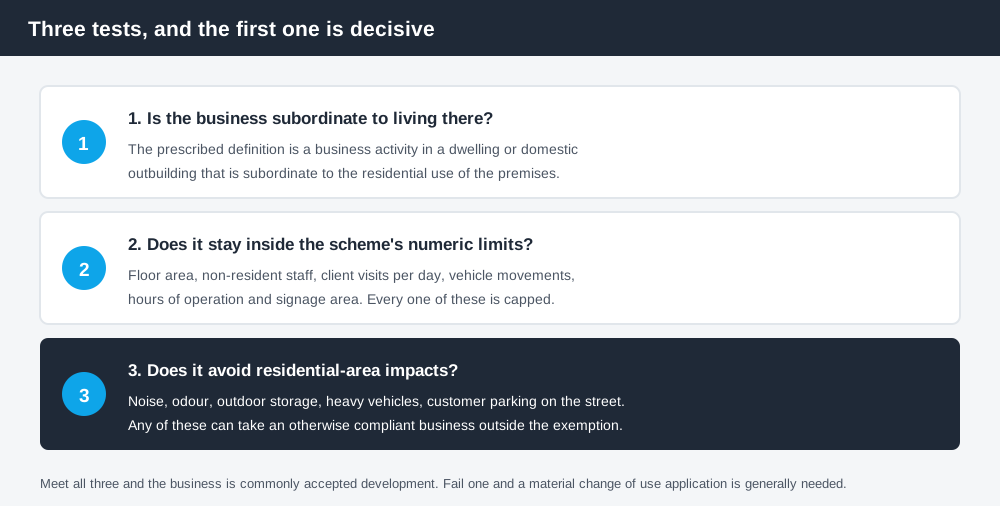
Figure 1: Three tests. The first one is the concept; the others are its measurement.
The definition, and why "subordinate" does the work
Queensland councils adopt a state-prescribed definition of home based business, which councils across the state restate in materially the same terms: the use of a dwelling or domestic outbuilding on premises for a business activity that is subordinate to the residential use of the premises.
That word is the whole test. The dwelling has to remain, in substance, somewhere people live, with a business happening in part of it. Once the business becomes the dominant activity — the thing the property is really for — it is no longer a home based business, whatever the address says.
Everything else in a home based business code is an attempt to measure that concept in numbers.
The numeric limits, and how much they vary
Spend 5 minutes, not 3 weeks
instantDA generates a council-ready planning report for Queensland development applications. No town planner. No waiting.
Get your report →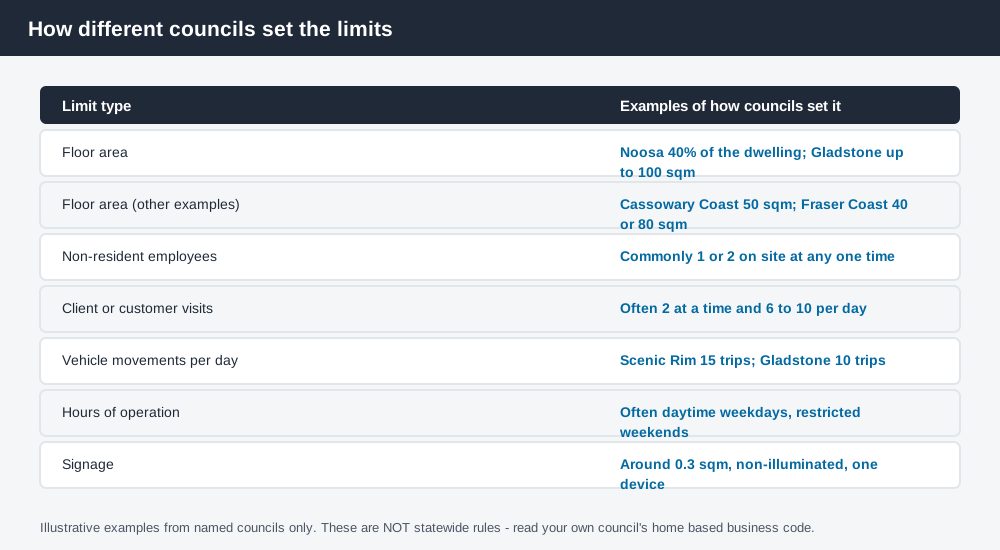
Figure 2: Illustrative examples from named councils — not statewide rules.
Queensland's planning schemes follow the Queensland Planning Provisions structure, but each council layers its own codes and overlays on top. They are not uniform, and home based business is one of the areas where they diverge most.
To give a sense of the range: Noosa's scheme limits the business to no more than 40% of the dwelling's floor area in residential zones. Cassowary Coast caps it at 50 square metres within a dwelling house. Fraser Coast sets 40 square metres on smaller lots and 80 on larger ones. Gladstone allows up to 100 square metres. Scenic Rim caps total gross floor area at 50 square metres.
Staff limits cluster tightly — commonly one or two non-resident employees on site at any one time. Client limits are usually expressed both as a number at any one time and a number per day, often around two at a time and somewhere between six and ten daily. Vehicle movement caps appear in several schemes: Scenic Rim allows 15 trips per day excluding residents and employees; Gladstone allows 10.
Signage is consistently the tightest constraint. Several schemes allow a single non-illuminated device of no more than 0.3 square metres.
Those figures are examples from those councils, not statewide rules. Read your own council's home based business code.
What reliably takes you outside the exemption
- ✓Staff attending who don't live there, beyond the scheme's cap
- ✓Clients arriving continuously rather than occasionally
- ✓Customers or staff parking in the street
- ✓Deliveries by truck rather than by van or courier
- ✓Outdoor storage of materials, stock or equipment
- ✓Noise, odour, dust or fumes audible or detectable at the boundary
- ✓Commercial signage beyond the tiny cap
- ✓Trading outside the hours the code allows
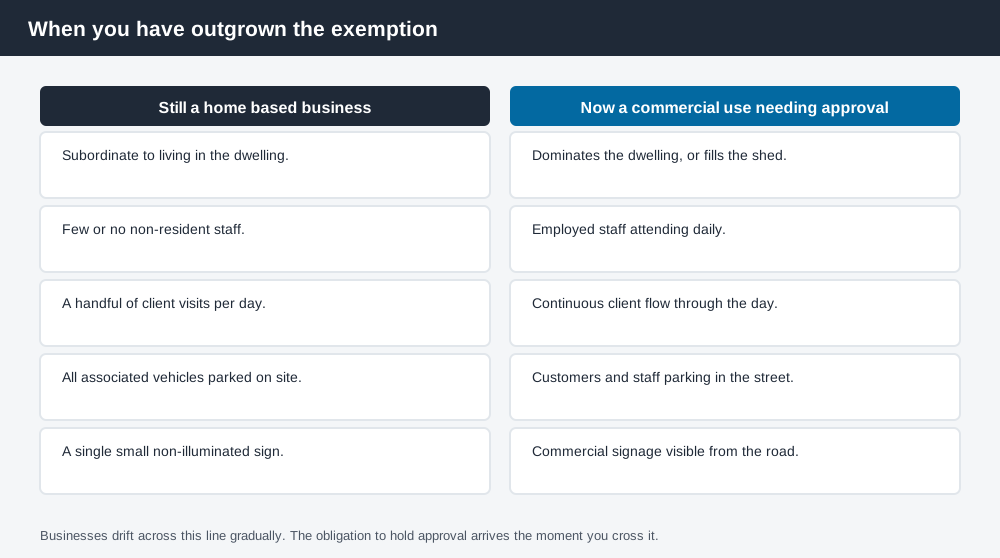
Figure 3: Businesses cross this line gradually and the obligation arrives immediately.
The pattern in enforcement is consistent: it is almost never a new business that gets a complaint. It is a business that started small and grew — one van became three, one apprentice became four, the shed filled up, customers started parking across driveways. Nobody made a decision to breach anything. The exemption simply stopped applying somewhere along the way.
Vehicles are the most visible of these. A single work van in the driveway is unremarkable; three utes, a trailer and a tipper parked across the frontage changes the character of the street, and it is the thing neighbours raise first. Several schemes deal with this directly by capping the number and size of business vehicles kept on site, and by requiring them to be parked within the property rather than on the verge.
If you've outgrown it
Exceeding the limits doesn't make the business unlawful in itself. It means the use now needs a material change of use approval, and operating without one is what's unlawful.
Depending on the zone and the scheme, a larger home business may be assessable as a home based business under a code, or it may be a different defined use entirely — a workshop, a shop, or a health care service. Material change of use in QLD covers how the change is characterised, and home business approval in QLD deals with the application path.
Signage deserves a specific mention because it's the most visible breach and the easiest one for a neighbour to photograph. Business signage approval in QLD sets out the three systems that can apply.
Worth noting too that planning approval is only one of the obligations attached to a home business. Food preparation at home is licensed separately, trades carry their own licensing, and rented properties and body corporate by-laws can restrict business use independently of anything council decides. Complying with the home based business code does not override a lease or a community management statement.
What to do next
Find your council's home based business code and read the acceptable outcomes. They're written as a list of numbers, which makes self-assessment genuinely feasible — this is one of the few areas of the planning system you can check yourself in twenty minutes.
Then be honest about the trajectory. If the business is growing, the question isn't whether you comply today but whether you'll comply in eighteen months, and it is far easier to apply from a position of compliance than after a complaint. Check your zone and any overlays on your council's planning scheme mapping and on the Queensland Globe, and the state's home business guidance covers the non-planning obligations.
If you'd rather see your zone, your overlays and your likely category of assessment set out for your address than work through a planning scheme yourself, an instantDA planning report does that for $169 — against the $800–$1,500 a town planner typically charges for a preliminary opinion. You can start a report in a few minutes.
Then confirm with your council. The home based business code is one thing duty planners will happily walk you through over the phone.
Frequently asked questions
Do I need council approval to work from home in Queensland?
What is a home based business under a Queensland planning scheme?
How many staff can I have working from home?
Can I have clients come to my house for a home business?
What sort of sign can I have for a home business in Queensland?
What happens if my home business has outgrown the limits?
Ready to generate your report?
Skip the writing. Get a council-ready planning report in 5 minutes.
Get your report