Key takeaways
- ✓Medical and allied health premises are generally a 'health care service' or 'medical centre' use — patients attend but don't reside there.
- ✓A hospital is a different use again, because it involves inpatient accommodation.
- ✓A practitioner working from home may be a home based business, but only while the practice stays clearly secondary to living there.
- ✓Parking is usually set per consulting room, which is why adding a room can trigger a new application.
- ✓Private hospitals and day hospitals need a licence under the Private Health Facilities Act 1999 — ordinary GP and allied health clinics generally don't.
Opening a Medical Centre in QLD — Approvals
You'll usually hear this called a development application, or DA — that's the formal name for council approval under the Planning Act 2016. For health practices, the whole approval question turns on a definitional one: which use are you actually proposing? Queensland schemes distinguish between a home based business, a health care service, and a hospital, and each sits in a different place in the table of assessment.
Getting that wrong is how a practice ends up operating unlawfully for years without knowing it.
Get a council-ready planning report in 5 minutes — no planner, no waiting.
Get your report →The short answer
Medical and allied health premises where patients attend but don't reside on site are generally a "health care service" or "medical centre" use, needing a material change of use approval unless the tenancy is already approved for it. A hospital, involving inpatient accommodation, is a separate use.
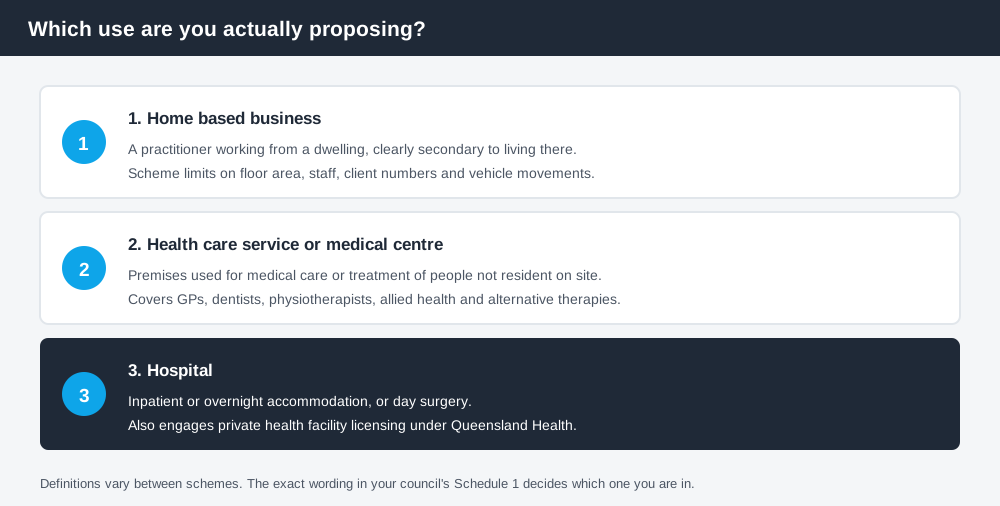
Figure 1: Three categories. Only one of them will be yours.
The health care service definition
Queensland scheme definitions of a health care service or medical centre typically describe premises used for the medical care or treatment of persons not resident on the site, and then list the professions covered — commonly medical practitioners, dentists, physiotherapists, chiropractors, optometrists, pathologists, radiologists and practitioners of alternative therapies, plus things like nursing services and clinics.
Those definitions also usually say what the use doesn't include: home based business, hospital, and residential aged care. That exclusion list is doing real work, because it's the mechanism that keeps the three categories separate.
Queensland's planning schemes follow the Queensland Planning Provisions structure, but each council layers its own codes and overlays on top. They are not uniform — some use "health care service", others "medical centre", and the boundaries differ. Read the definition in your own scheme's Schedule 1.
Where home practice ends
Spend 5 minutes, not 3 weeks
instantDA generates a council-ready planning report for Queensland development applications. No town planner. No waiting.
Get your report →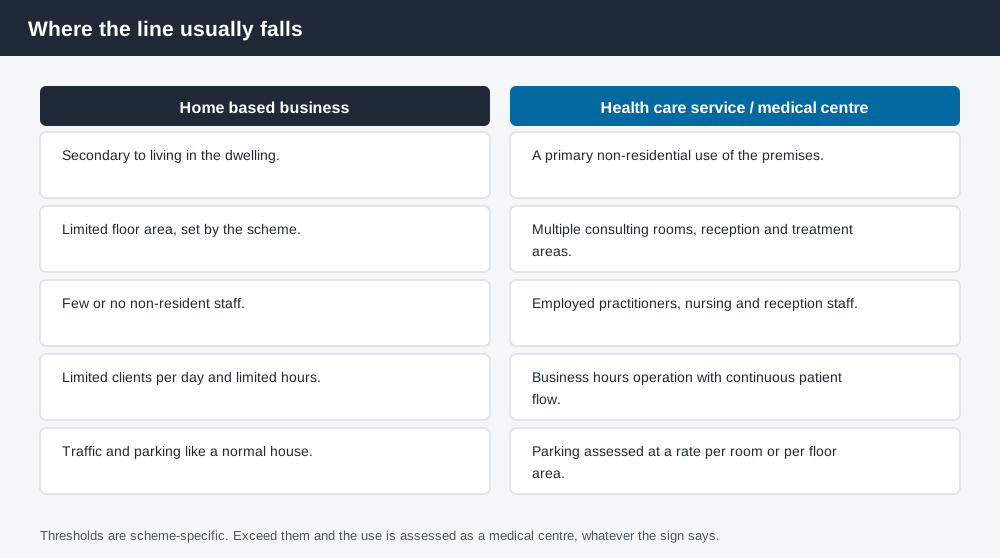
Figure 2: The tests are about scale and secondariness, not profession.
A doctor, physiotherapist or psychologist consulting from home may be operating a home based business — a secondary use of a dwelling for an occupation or profession. Schemes set limits to keep it secondary: a maximum floor area given over to the business, limits on non-resident staff, limits on clients on site at any one time and per day, hours, and a requirement that traffic and parking demand stay comparable to a normal dwelling.
Exceed those limits and the use is no longer a home based business. It is a health care service, in a residential zone, needing an application — and often an impact assessable one. That transition is gradual in practice and abrupt in law, which is why practices drift across it without noticing. Working from home in QLD sets out where councils typically draw the line.
What the assessment turns on
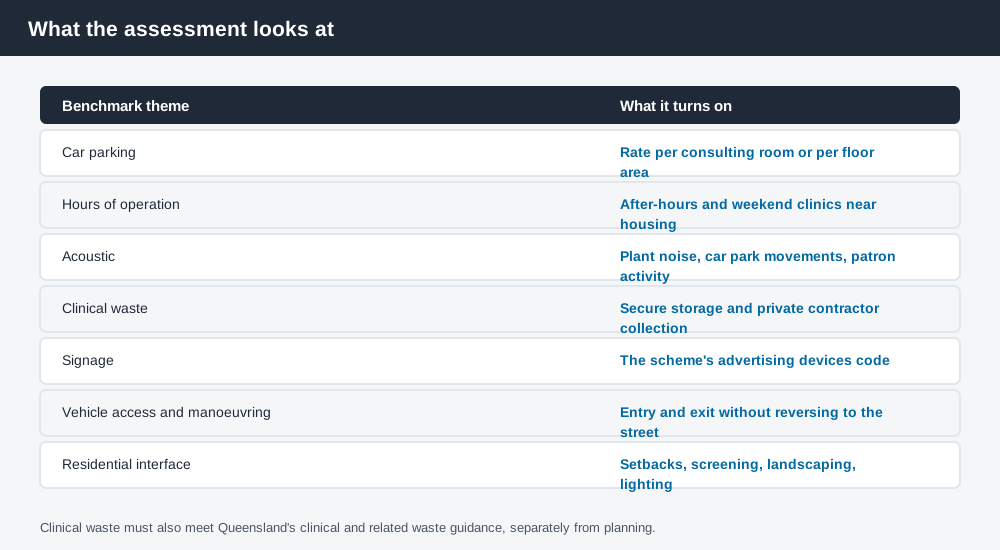
Figure 3: Parking is usually the binding constraint.
Car parking is the one that shapes medical centre proposals more than any other. Schemes typically set a rate per consulting room or per unit of floor area, and health care services are treated as relatively high-demand uses — patients arrive, wait, and leave individually rather than in a steady flow. That's why adding a fourth consulting room to a three-room practice can genuinely trigger a new application: it's a material increase in the intensity of the use.
Hours attract attention where the practice is near housing, particularly for after-hours or weekend clinics.
Clinical waste is specific to this use. Beyond ordinary council waste requirements, medical waste needs secure storage and is typically collected by a private contractor under Queensland's clinical and related waste guidance. Councils will want to see where it's stored and how the collection vehicle reaches it.
- ✓Parking at the rate for consulting rooms or floor area
- ✓Vehicle access allowing entry and exit without reversing to the street
- ✓Hours of operation, especially after-hours clinics
- ✓Secure clinical waste storage with contractor access
- ✓Acoustic management of plant and car park movements
- ✓Signage under the scheme's advertising devices code
- ✓Setbacks, screening and lighting at the residential interface
There is also a zone-intent question that sits above all the individual benchmarks. Schemes often encourage small local health services near centres or on collector roads, while discouraging them inside quiet residential streets. A proposal that reads as a neighbourhood-scale service on a road built to carry traffic is a much easier application than the same building mid-block, however well designed.
When health facility licensing applies
Separately from planning, the Private Health Facilities Act 1999 regulates private health facilities — private hospitals and day hospitals. That regime is administered by Queensland Health, with the Chief Health Officer responsible for licensing and the Private Health Regulation Unit managing applications.
It works in two steps: an approval to be an authority holder for the proposed facility, sought before building work or fitout begins, and then a licence to operate once the works are substantially complete. Operating a private health facility without a licence is an offence.
The good news for most readers: ordinary GP clinics, dental practices and allied health consulting rooms without inpatient beds or prescribed procedure classes generally don't meet the definition of a private health facility, and need planning and building approval only. If you're contemplating day surgery, that changes, and the health licensing lead time is long enough that it belongs at the front of your programme rather than the end.
What to do next
Establish the use first. Read the health care service definition in your scheme, work out honestly whether your practice fits it or a home based business, and then read the table of assessment for that use in your zone. Check the zone and overlays on your council's planning scheme mapping and on the Queensland Globe. If a facility licence may apply, Queensland Health's private health facility licensing pages set out the process.
If you're taking over an existing tenancy, changing a shop's use in QLD covers when the change triggers an application and how to get the approval history from council before you sign.
If you'd rather see the zone, the overlays and the likely category of assessment for an address than work through a planning scheme yourself, an instantDA planning report does that for $169 — against the $800–$1,500 a town planner typically charges for a preliminary opinion. You can start a report in a few minutes.
Then confirm with your council before you commit to a site. Parking rates for consulting rooms are unforgiving, and they are far easier to design around than to argue against.
Frequently asked questions
Do I need council approval to open a medical centre in Queensland?
What use class is a medical centre in a Queensland planning scheme?
Can I run a medical practice from my house in Queensland?
How much parking does a medical centre need in Queensland?
Does a medical centre need a private health facility licence?
What are the rules for clinical waste at a Queensland medical centre?
Ready to generate your report?
Skip the writing. Get a council-ready planning report in 5 minutes.
Get your report