Key takeaways
- ✓A transport noise corridor is land designated under chapter 8B of the Building Act 1975, not a planning scheme zone.
- ✓The requirements sit in Queensland Development Code Mandatory Part 4.4, and they apply to habitable rooms in class 1, 2, 3 and 4 buildings.
- ✓Properties are given a noise category from 0 to 4. Category 0 carries no specific requirement; category 4 is the most demanding.
- ✓Compliance is a building matter, assessed by your building certifier, not usually a development application question.
- ✓The state search tool only covers state-designated corridors. Councils can designate their own, so check with the council as well.
Transport Noise Corridors in QLD: What They Mean for Building
You'll usually hear council approval called a development application, or DA — that's the formal name for it under the Planning Act 2016. A transport noise corridor is a different animal. It is a building requirement, designated under the Building Act 1975 and enforced through the Queensland Development Code, and for most homeowners it never touches the planning system at all.
Get a council-ready planning report in 5 minutes — no planner, no waiting.
Get your report →The short answer
A transport noise corridor is land designated under chapter 8B of the Building Act 1975 because of noise from a state road or railway. If your property is in one, habitable rooms in new class 1 to 4 buildings must be designed and built to reduce transport noise, under Queensland Development Code MP4.4.
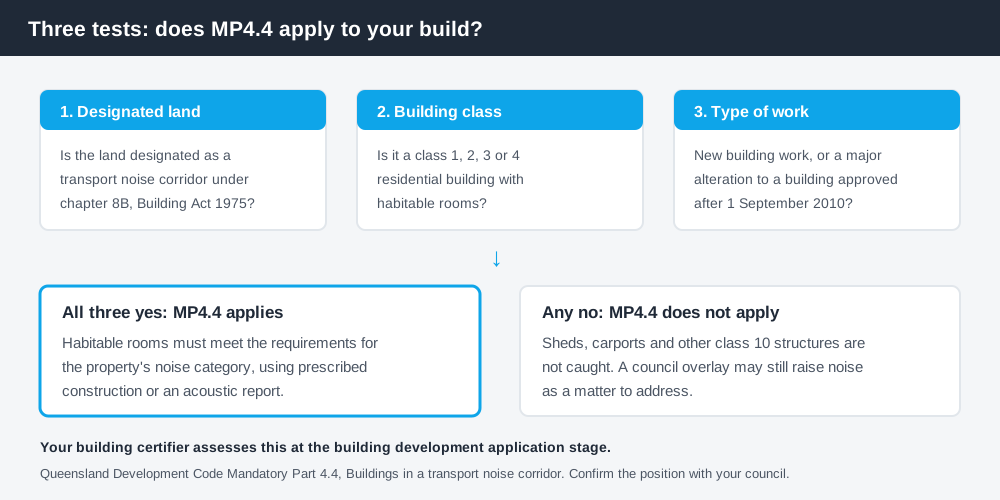
Figure 1: Whether MP4.4 applies to your build.
Where the requirement comes from
Two instruments do the work, and it helps to keep them apart.
The Building Act 1975 is what creates the corridors. Chapter 8B of that Act, headed "Transport noise corridors", provides for the designation of land as a transport noise corridor for particular building assessment work. Designation is the legal act; the map follows from it.
The Queensland Development Code Mandatory Part 4.4, titled "Buildings in a transport noise corridor", is what sets the standard once land is designated. You can read MP4.4 itself on the Queensland Government site. Its stated purpose is to ensure habitable rooms of class 1, 2, 3 and 4 buildings located in a transport noise corridor are designed and constructed to reduce transport noise.
- ✓Class 1 — houses and townhouses
- ✓Class 2 — units and apartments
- ✓Class 3 — boarding houses, hotels, motels
- ✓Class 4 — a dwelling within an otherwise non-residential building
Note what is not on that list. A shed, a carport, a garage, a patio — class 10 structures — are not habitable rooms and are not what MP4.4 is aimed at. Neither is a commercial building.
Noise categories, and what changes
Spend 5 minutes, not 3 weeks
instantDA generates a council-ready planning report for Queensland development applications. No town planner. No waiting.
Get your report →Land in a designated corridor is assigned a noise category from 0 to 4. Category 0 carries no specific construction requirement. Categories 1 through 4 escalate, with category 4 the most demanding.
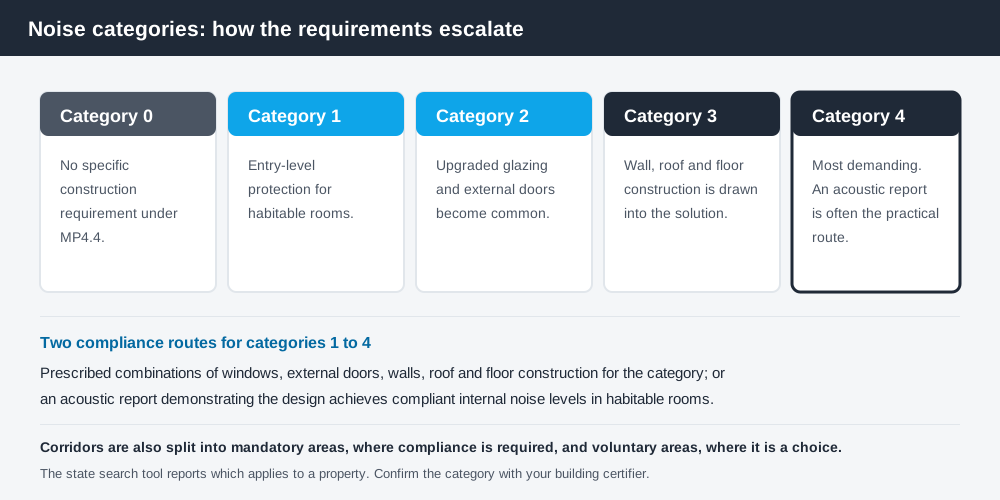
Figure 2: How the categories escalate.
For categories 1 to 4, habitable rooms have to be protected so internal noise levels stay within the limits the code sets. There are two ways to get there.
- ✓Build using the prescribed combinations of building envelope elements — windows, external doors, walls, roof and floor construction — that satisfy the category
- ✓Or provide an acoustic report demonstrating the design achieves compliant internal noise levels
In practice, the first route suits standard project homes and the second suits anything unusual: a large window wall facing a motorway, an existing dwelling being altered, or a design that wants to depart from the deemed-to-satisfy combinations.
Designated corridors are also split into mandatory and voluntary areas. In a mandatory area, building work has to comply with the measures for the relevant noise category. In a voluntary area, an owner can choose to adopt them but is not compelled to. The search tool tells you which you are in, and it matters — voluntary areas are where owners most often decide to spend the money anyway, because the noise is real even where the obligation is not.
New builds, renovations and the timing rules
MP4.4 attaches to building work. The two dates that come up repeatedly are these.
The current version of MP4.4 applies to building work that is the subject of a building development application lodged on or after 17 August 2015 for a relevant residential building. Separately, residential buildings approved after 1 September 2010 and located in a designated corridor are required to comply.
For a renovation, the practical consequence is that a major alteration, addition or relocation of an existing residential building in a corridor generally has to comply within the area covered by the renovation where the building was approved after 1 September 2010. An older house is usually not dragged into compliance by a modest extension, but the certifier makes that call against the code rather than a rule of thumb, so ask before you design. Where you are already working through what an extension triggers, council approval for an extension in QLD sets out the broader picture.
Because this is a building matter, the person who assesses it is your building certifier at the building development application stage — not a council planner. If the difference between those two roles is unfamiliar, private certifier versus council in QLD explains who decides what.
How to check your address
The Queensland Government publishes a free search for state-designated corridors. Business Queensland's page on searching for transport noise corridors sets out the steps, which run through the State Planning Policy Interactive Mapping System.
- ✓Open the State Planning Policy Interactive Mapping System from the Queensland planning maps page
- ✓Accept the disclaimer and start
- ✓Under information purposes, select transport infrastructure and turn on the transport noise corridor layers
- ✓Search for your land parcel by address or lot on plan
- ✓Read the map and report, including whether the area is mandatory or voluntary
There is one limitation that catches people out, and the Queensland Government states it plainly: the tool searches only properties affected by state-designated transport noise corridors. It does not include corridors designated by a local government, and it does not include noise requirements sitting in a council planning scheme.
That gap is not theoretical. Councils can and do designate their own corridors — Logan City Council is the well-known example, where the local designation brings affected properties under MP4.4 and replaces the transport noise provisions that previously sat in the council's own scheme.
What council overlays add, and what they do not
Many planning schemes carry a transport noise corridor overlay, and they behave differently from one another.
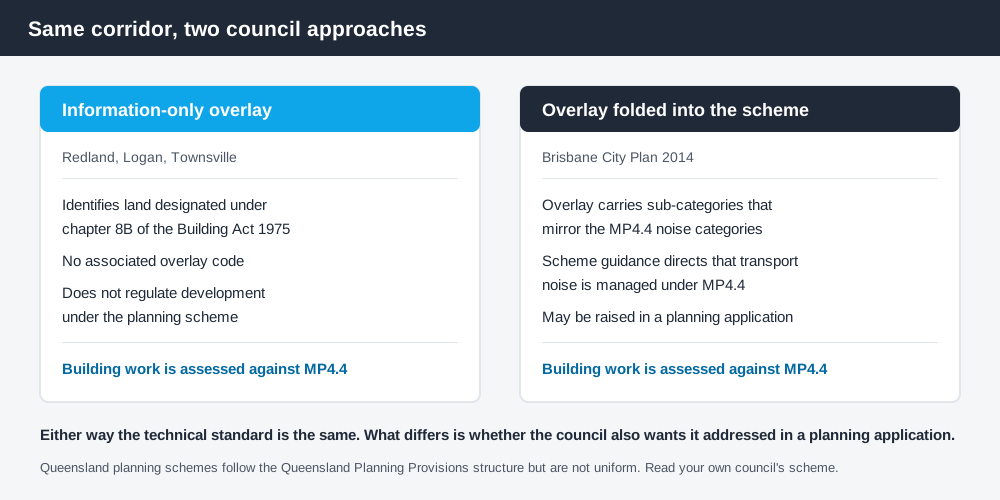
Figure 3: Two ways councils handle the same corridor.
Some are information only. Redland City Plan's transport noise corridor overlay has no associated overlay code; it simply identifies land designated under chapter 8B of the Building Act 1975 and flags that certain building work will be assessable against MP4.4. Logan's overlay map carries an editor's note to the same effect — it is for information and does not regulate development under the planning scheme. Townsville's infrastructure noise corridors overlay says much the same.
Others fold the categories into the scheme. Brisbane City Plan 2014's transport noise corridor overlay includes sub-categories that mirror the MP4.4 noise categories, and Brisbane's guidance confirms that where development is covered by that overlay, transport noise is managed under MP4.4.
Either way, the technical standard is MP4.4. What varies is whether your council also wants to see the question addressed in a planning application. Queensland's planning schemes follow the Queensland Planning Provisions structure, but each council layers its own overlays and notes on top. They are not uniform, so read your own scheme rather than a neighbouring council's.
What to do next
Run the state search first, because it is free and takes minutes. Then ring the council and ask two questions: whether the council has designated any corridors of its own, and whether the scheme carries a transport noise overlay that affects your application. If the answer to either is yes, get your certifier and, if needed, an acoustic consultant involved before the windows are specified — glazing is where most of the cost sits, and it is expensive to change late.
If you'd rather see your zone, your overlays and your likely category of assessment set out in one document than work through a planning scheme yourself, an instantDA planning report does that for your address for $169 — against the $800–$1,500 a town planner typically charges for a preliminary opinion. You can start a report in a few minutes.
Noise mapping rarely arrives alone, so how to check which overlays apply to your property is worth reading next to catch anything else sitting over the same land. And if you are still establishing what you are allowed to build at all, how to check zoning in QLD is the right starting point.
Where the position is marginal, confirm it with your council in writing.
Frequently asked questions
What is a transport noise corridor in Queensland?
What does QDC MP4.4 require?
How do I check if my property is in a transport noise corridor?
Does the state search show every noise corridor?
Does a transport noise corridor stop me building?
Do the rules apply to a renovation?
Ready to generate your report?
Skip the writing. Get a council-ready planning report in 5 minutes.
Get your report