Key takeaways
- ✓SARA is the state's single point for development assessment referrals — one front door to every state agency with an interest.
- ✓Referral triggers are set by the Planning Regulation 2017, with Schedule 10 setting out referral agencies and their jurisdiction.
- ✓Referred applications are assessed against the State Development Assessment Provisions, a performance-based set of state codes.
- ✓A concurrence agency response can direct the assessment manager to refuse or to impose conditions. An advice agency response is advice only.
- ✓It is the applicant's job to refer the application. A missed referral can cost you the application.
When the State Gets Involved: SARA Referrals in Queensland
Most development applications are a conversation between you and your council. Some are not, and the moment your land touches a state interest — a state-controlled road, a waterway, regulated vegetation, a rail corridor — a second decision-maker joins the process with powers your council cannot override.
That second decision-maker is SARA, the State Assessment and Referral Agency. The good news is that it is genuinely one front door rather than a queue of separate agencies. The bad news is that referral is not optional, it is your job rather than council's, and getting it wrong can cost you the application.
Get a council-ready planning report in 5 minutes — no planner, no waiting.
Get your report →The short answer
SARA is Queensland's single state point for development assessment referrals, run by the state planning department. Referral triggers are set by the Planning Regulation 2017. Referred applications are assessed against the State Development Assessment Provisions. A concurrence agency response can direct the assessment manager to refuse or condition; an advice agency response is advice only.
What SARA is
SARA coordinates the state's role in development assessment so that applicants deal with one agency rather than several. Where the state has jurisdiction over a development application under the Planning Act 2016, SARA is the first and only point of contact — the shopfront to the technical agencies behind it, whether that is transport, fisheries, environment or vegetation management.
In some cases SARA acts as a referral agency alongside your council. In others the state is the assessment manager itself, and the application goes to SARA rather than to the council. Which applies is determined by the regulation, not by choice.
The department publishes SARA's own page on the Queensland planning website, which is the right starting point for current forms, contacts and pathways.
What triggers a referral
Spend 5 minutes, not 3 weeks
instantDA generates a council-ready planning report for Queensland development applications. No town planner. No waiting.
Get your report →Referral triggers are set by the Planning Regulation 2017, with Schedule 10 setting out referral agencies and their jurisdiction — that is, which agency, for which development, in which circumstances.
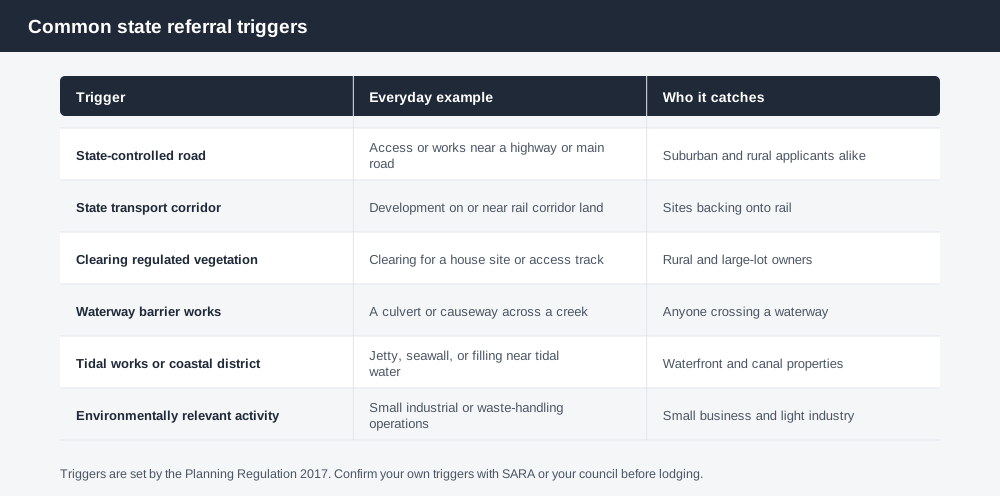
Figure 1: Common triggers, and the everyday situations that hit them.
The ones ordinary applicants meet most often are geographic rather than exotic.
State-controlled roads. Development on, adjacent to or near a state-controlled road or state transport corridor, including works within specified distances of an intersection. This is far and away the most common trigger for suburban and rural applicants, and it catches a lot of people who assume a highway two blocks away is irrelevant.
State transport corridors and railway land. Development on or near rail corridors and other state transport infrastructure.
Clearing native vegetation. Operational work that is clearing regulated vegetation, including where clearing is ancillary to a change of use. This regularly catches rural and large-lot applicants clearing for a house site or an access track.
Waterway barrier works. Culverts, causeways, weirs and similar works in waterways used by fish, and works in declared fish habitat areas.
Tidal works and the coastal management district. Jetties, seawalls, revetments, and filling or excavation near tidal water.
Environmentally relevant activities. Certain activities under the environmental protection framework, which can catch small industrial and waste-handling operations.
- ✓Check whether any boundary of the land adjoins a state-controlled road
- ✓Check for rail or transport corridors nearby
- ✓Check vegetation mapping before any clearing
- ✓Check whether any waterway crosses the land
- ✓Check coastal and tidal mapping if near the water
- ✓Ask your council whether it expects a referral
Queensland Globe and your council's mapping will show most of these. Where a trigger is even possible, confirm it before lodging rather than discovering it at the confirmation notice.
What your application is assessed against
Not your council's planning scheme. Referred applications are assessed against the State Development Assessment Provisions, usually shortened to SDAP.
SDAP is a set of state codes in performance-based format: each code sets performance outcomes describing what the development must achieve to manage impacts on a state interest, with acceptable outcomes underneath as ways of meeting them. If that structure sounds familiar, it is the same logic your council's codes use, applied to state interests instead of local ones. SDAP is versioned and updated periodically — version 3.1 was current at the time of writing — and SARA assesses an application against the version current when it was properly made. Check the current version before relying on any code.
Concurrence or advice: the distinction that matters
Referral agencies are not all the same, and the difference determines what happens to your approval.
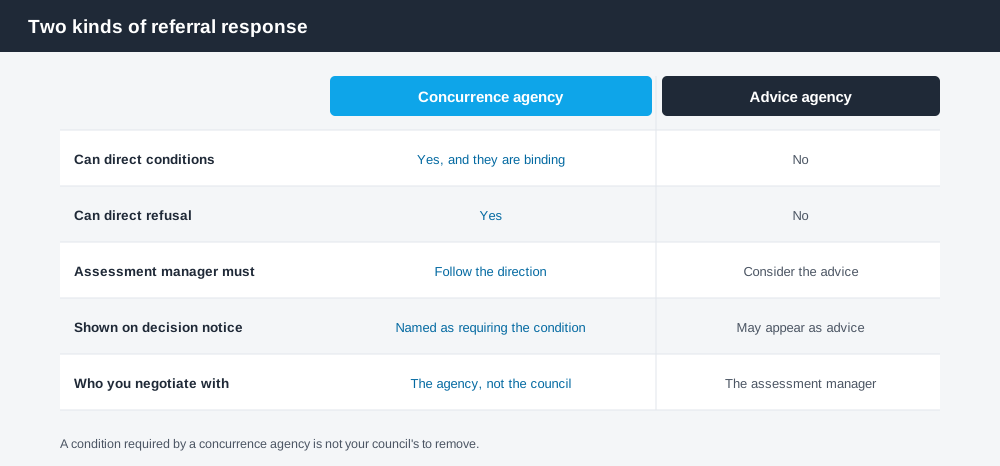
Figure 2: What each type of referral response can actually do.
A concurrence agency response can direct the assessment manager — to impose stated conditions, to approve only part of the application, or to refuse it. Those directions are binding. Your decision notice must state, for each condition, whether it was required under a referral agency's response and name the agency, which is how you can tell them apart. Your decision notice explained covers how to read that.
An advice agency response is advice. The assessment manager must consider it but is not bound to follow it.
The practical consequence: a condition imposed at the direction of a concurrence agency is not your council's to remove. Negotiating with the council about it wastes time. The conversation has to be with the agency that required it.
How the referral runs
The applicant refers, not the council. This surprises people every time. Once the application is with the assessment manager and the confirmation stage has run, it is the applicant's responsibility to refer the application to each referral agency within the period the Development Assessment Rules allow.
Miss that, and the consequences are serious — a missed referral puts the application at risk, and the rules include their own notice procedure for dealing with one. Do not rely on the council to catch it for you.
The referral agency then runs its own process, and it has its own information request power. That means an application with a referral can receive two separate information requests from two different bodies on two separate clocks, which is a large part of why referred applications take longer. How long council approval takes sets out the timeline, and responding to an information request covers the response.
At the end, the agency gives a referral agency response, which the assessment manager must consider — and must follow, where it comes from a concurrence agency.
Reducing the pain
Two things help. First, find the trigger before you design, not after. A driveway relocated ten metres can be the difference between a referral and none.
Second, prepare the state-facing material as its own package. SDAP codes are separate benchmarks and an application that addresses only the council's codes will attract a state information request as reliably as night follows day. How to lodge a DA in QLD sets out where the referral sits in the wider process.
Confirm any suspected trigger with SARA or your council before lodging. Both would rather tell you now.
What to do next
An instantDA planning report covers the council-side planning assessment — your zone, your overlays and your council's applicable codes — for $169, against $800–$1,500 for a town planner preparing the same document. Where a state referral is triggered, get advice on the SDAP codes as well.
Start with a planning report, or go straight to creating your report.
Frequently asked questions
What is SARA in Queensland planning?
What triggers a SARA referral?
What is SDAP?
Who refers the application to SARA?
What is the difference between a concurrence agency and an advice agency?
Can my council remove a condition SARA required?
Ready to generate your report?
Skip the writing. Get a council-ready planning report in 5 minutes.
Get your report