Key takeaways
- ✓Queensland codes are two-tier: a performance outcome states the objective, an acceptable outcome is one prescribed way of meeting it.
- ✓Failing an acceptable outcome is not a refusal — you can demonstrate the performance outcome instead.
- ✓Planning schemes say performance outcome and acceptable outcome; the Queensland Development Code says performance requirement and acceptable solution.
- ✓Code assessment is bounded — it is carried out against the assessment benchmarks rather than against general merit.
- ✓Evidence beats assertion. A performance argument works when it shows the objective is achieved, not that the number is unreasonable.
Acceptable Outcomes vs Performance Outcomes — QLD Codes
Somewhere in every Queensland approval conversation, someone says "it doesn't comply". Almost always, what they mean is that the design does not meet an acceptable outcome — a specific number in a code. And almost always, the person hearing it assumes that is the end of the matter.
It is not. Understanding how Queensland codes are structured is the difference between abandoning a design and getting it approved with a page of supporting material.
Get a council-ready planning report in 5 minutes — no planner, no waiting.
Get your report →The short answer
Queensland codes are two-tier. A performance outcome states what the code is trying to achieve; an acceptable outcome is one prescribed way of achieving it. Meeting the acceptable outcome is the simple route, but not the only one — you can instead demonstrate that your design achieves the performance outcome.
That structure is deliberate. It exists so a code can set a standard without ruling out every design that meets the standard differently.
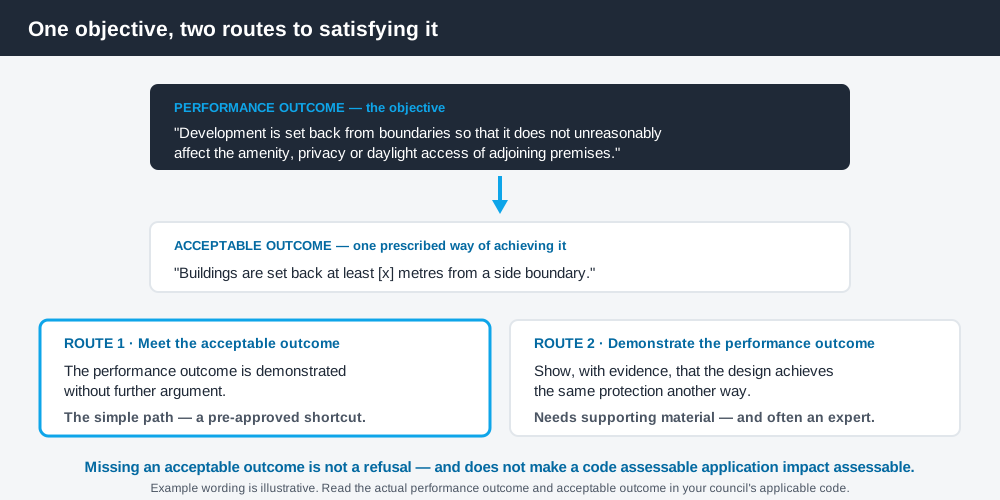
Figure 1: One objective, two routes to satisfying it.
How the two tiers work
A performance outcome is written in terms of the effect the code wants. Something like: development is set back from boundaries so that it does not unreasonably affect the amenity, privacy or daylight access of adjoining premises. It states an objective, not a measurement.
An acceptable outcome sits beneath it and converts that objective into something you can measure with a tape. Something like: buildings are set back at least a specified distance from a side boundary.
Meeting the acceptable outcome means you have demonstrated the performance outcome without further argument. That is the whole point of it — it is a shortcut, prepared in advance, for the ordinary case.
The terminology changes — and it matters
Spend 5 minutes, not 3 weeks
instantDA generates a council-ready planning report for Queensland development applications. No town planner. No waiting.
Get your report →This is the detail that causes the most confusion, and it is worth getting straight.
In a planning scheme, made under the Planning Act 2016 using the Queensland Planning Provisions structure, the terms are performance outcome and acceptable outcome, usually numbered PO1, PO2 and AO1, AO2.
In the Queensland Development Code, established by section 13 ("Queensland Development Code") of the Building Act 1975, the equivalent terms are performance requirement and acceptable solution, usually numbered P1, P2 and A1, A2. Some code material also uses the label performance criteria.
Same logic, different words, different documents, different decision-makers. If someone tells you a design "fails A2", check which document they are reading from — it determines whether you are dealing with your certifier or your council. The Queensland Development Code, explained sets out that split.
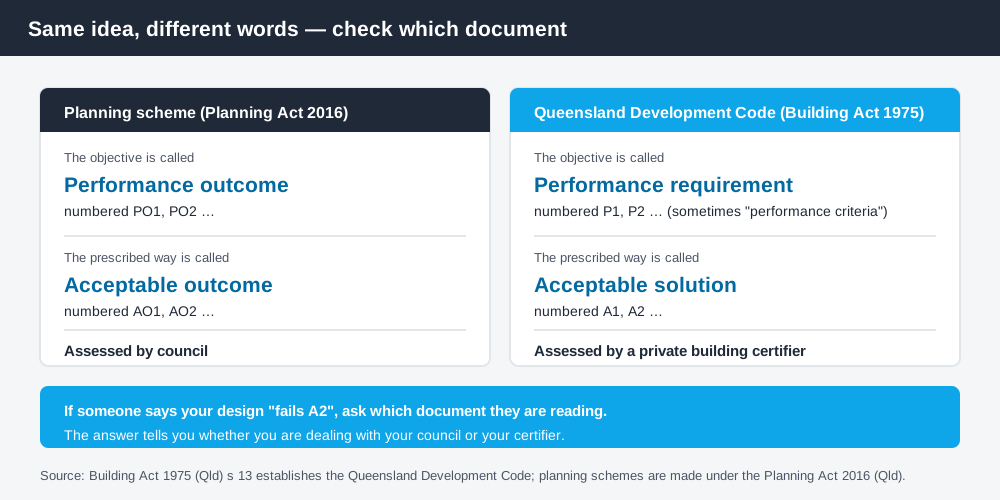
Figure 2: The same idea, named differently in the two documents.
What happens legally when you miss one
For code assessment, missing an acceptable outcome does not put you in conflict with the code and does not convert the application into impact assessment. The category of assessment is fixed by the categorising instrument — under the Planning Act 2016, section 45 ("Categories of assessment") establishes that assessable development is subject to either code assessment or impact assessment, and which one applies is set by the instrument, not by whether you happen to comply.
Code assessment is a bounded exercise. It is carried out against the assessment benchmarks rather than against general planning merit, which is what makes it faster and more predictable than impact assessment. Within those bounds, the assessment manager must approve to the extent the development complies with the benchmarks, and retains a discretion to approve even where there is non-compliance.
That discretion is real and it is exercised regularly. But it is exercised on the strength of what you put in front of the assessment manager. For the wider picture of what each category of assessment involves, accepted versus assessable development in QLD covers it.
What a good performance argument looks like
The arguments that succeed share a structure, and it is not the one most people reach for instinctively.
- ✓Quote the performance outcome in full and address it directly, clause by clause
- ✓Identify precisely which acceptable outcome is not met and by how much
- ✓Explain what the performance outcome is protecting — amenity, privacy, daylight, safety, traffic
- ✓Show, with evidence, that the design achieves that protection another way
- ✓Support it with the right expert where one exists — a traffic engineer, an acoustic consultant, a bushfire practitioner
And the argument that fails, reliably: asserting that the acceptable outcome is unreasonable, or that a neighbouring property got away with something similar, or that the difference is only small. None of those engage the performance outcome, which is the only thing the code actually asks you to satisfy.
Being specific about the shortfall helps rather than hurts. An assessment manager who has to work out for themselves how far off you are will assume the worst. Common DA refusal reasons in QLD covers the wider set of things that sink applications, and inadequate justification of non-compliance is high on it.
Where this comes up most
Setbacks. By far the most common. Building closer to a boundary than the acceptable outcome allows, and demonstrating the performance requirement instead, is a routine application in Queensland — siting variations in QLD sets out that specific process.
Site cover and height. Where a design exceeds the numeric limit but the bulk and amenity effects are demonstrably comparable.
Car parking. Where a traffic engineer's parking demand assessment shows actual demand is lower than the scheme rate.
Private open space. Where a differently configured space delivers better usable outdoor amenity than a compliant but poorly oriented one.
A note on how much detail to give
There is a persistent instinct to say as little as possible about a non-compliance, on the theory that drawing attention to it invites scrutiny. That instinct is wrong here, and expensively so.
An assessor who cannot tell from your material exactly what the shortfall is has two options: request more information, which stops the clock and adds weeks, or assume the worst and assess accordingly. Neither helps you. Stating the shortfall plainly — this wall sits 1.2 metres from the boundary where the acceptable outcome seeks 1.5 metres — and then addressing the performance outcome directly is both faster and more persuasive. It signals that you have read the code rather than hoping nobody else would.
Check your own position
Find the applicable code in your council's planning scheme, read the performance outcome above every acceptable outcome you cannot meet, and work out what it is protecting. You can check your zone and overlays on your council's planning scheme mapping and on the Queensland Globe, the state's free property and spatial mapping tool.
If you would rather see your zone, your overlays and your likely category of assessment in one document before you commission a design, an instantDA planning report does that for your address for $169 — against the $800–$1,500 a town planner typically charges for a preliminary opinion. You can start a report in a few minutes.
Because codes and benchmarks differ between councils and are amended, confirm the applicable provisions with your council before you rely on them.
Frequently asked questions
What is the difference between a performance outcome and an acceptable outcome?
Does failing an acceptable outcome mean my application will be refused?
Why does the Queensland Development Code use different words?
Does missing an acceptable outcome make my application impact assessable?
What evidence do I need for a performance argument?
Can I just argue the standard is unreasonable?
Ready to generate your report?
Skip the writing. Get a council-ready planning report in 5 minutes.
Get your report