Key takeaways
- ✓Most of the rules here are local laws, not the planning scheme. That is why the answer changes completely at a council boundary.
- ✓Councils commonly allow short, time-limited caravan occupation without approval, then require a temporary home permit beyond that.
- ✓Moreton Bay's local law allows up to 42 days in a 52-week period without approval, and up to 6 months with approval while building.
- ✓A caravan on wheels that is not a building or dwelling is regulated as a caravan, not as a structure.
- ✓Waste and greywater rules are strict: councils generally require containment and lawful disposal, not disposal on site.
Living in a Caravan on Your Own Land in QLD
You'll usually hear this called a development application, or DA — that's the formal name for council approval under the Planning Act 2016. Here, though, the planning scheme is often not the instrument that decides. Living in a caravan on your own land is regulated in most of Queensland by local laws, and that is exactly why the answer people find online is so inconsistent.
It changes at a council boundary. It changes depending on whether you are building a house on the site. It changes depending on how long you intend to stay.
Get a council-ready planning report in 5 minutes — no planner, no waiting.
Get your report →The short answer
Caravans on private land in Queensland are regulated mainly by council local laws rather than by the planning scheme. Councils commonly allow short, time-limited occupation without approval and require a temporary home permit beyond that, particularly while a permanent dwelling is being built.
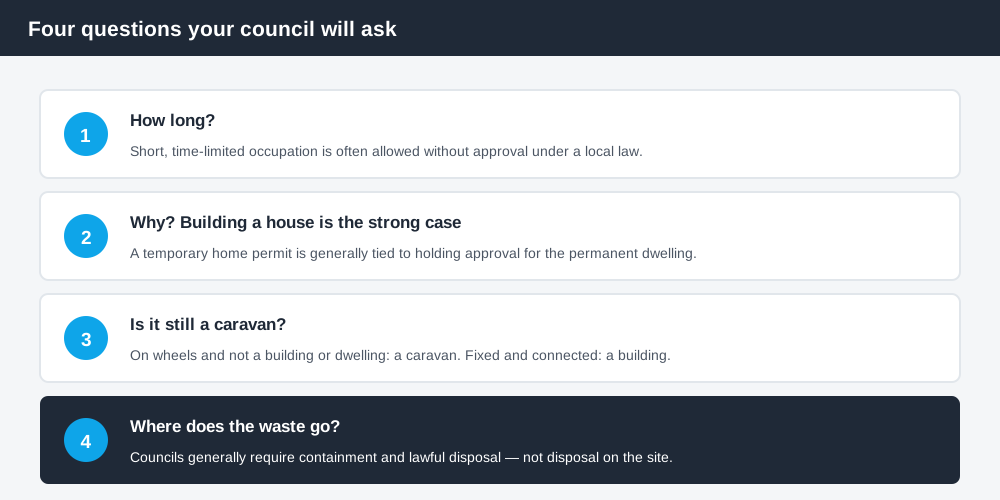
Figure 1: Three questions decide it: how long, why, and which council.
Which system applies
The state planning department's position is that caravans are regulated under the Transport Operations (Road Use Management) Act 1995 and may also be regulated by local government local laws made under the Local Government Act 2009.
Planning approval can still be required under the planning scheme, but only where the activity is more than temporary or is not ancillary to an existing lawful use. South Burnett Regional Council's published guidance puts it directly: where caravanning or camping is temporary, or ancillary to an existing lawful use of the land, it is likely not development at all and does not need planning approval.
That is the pivot. Temporary and ancillary is the safe zone. Permanent and standalone is where you leave it, and once you are living permanently in a caravan on a vacant lot, you are effectively occupying the land for residential purposes without an approved dwelling.
What the time limits look like
Spend 5 minutes, not 3 weeks
instantDA generates a council-ready planning report for Queensland development applications. No town planner. No waiting.
Get your report →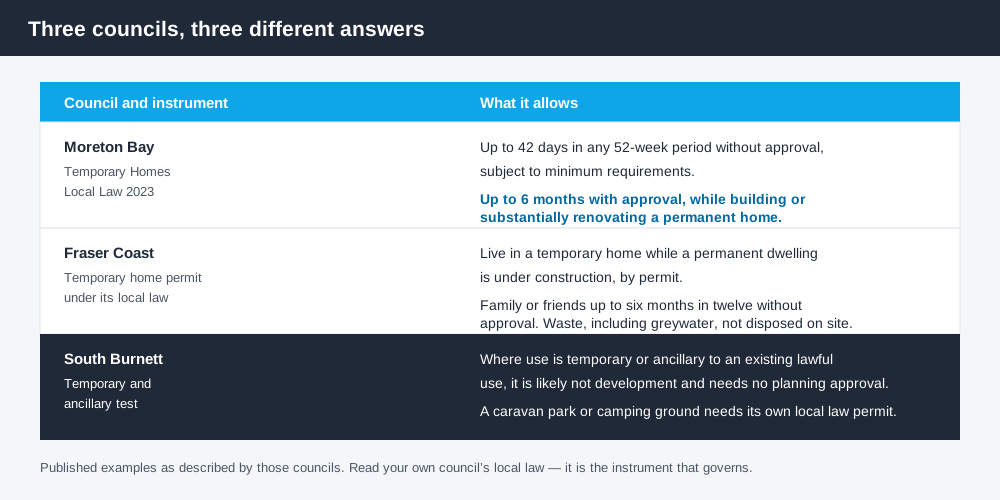
Figure 2: Published examples. Your council's local law is the one that governs.
Moreton Bay Regional Council made a Temporary Homes Local Law 2023. Its explanatory material describes allowing occupation of a caravan as a temporary residence for up to 42 days in any 52-week period without approval, subject to minimum requirements, and up to 6 months with council approval where the person is building or substantially renovating a permanent home.
Fraser Coast Regional Council allows a landowner to live in a temporary home while a permanent dwelling is under construction, through an establishment or occupation of a temporary home permit issued under its administration subordinate local law. It also allows family or friends to stay in a caravan or recreational vehicle on the property for up to six months in a twelve-month period without approval, provided conditions are met.
South Burnett Regional Council approaches it through the temporary and ancillary test above, and separately requires a local law permit to operate a caravan park or camping ground.
Note how different those three are, from councils that are not far apart. Take your rules from your own council's local laws register, not from an article or a forum.
- ✓How long do you intend to occupy the caravan?
- ✓Are you building a permanent dwelling on the same land?
- ✓Is there already a lawful dwelling on the lot?
- ✓Does your council have a temporary homes local law?
- ✓How will wastewater and greywater be handled?
The building-a-house pathway
This is the most common legitimate reason to live on site, and it is the one councils are most willing to accommodate.
The permit is created by the council's local law and its subordinate local law schedule, not by state planning legislation. Fraser Coast identifies its instrument as Subordinate Local Law No. 1 (Administration) 2011 and grants approval through an establishment or occupation of a temporary home permit. Moreton Bay's temporary homes local law contemplates up to six months with approval for building or substantial renovation.
Two things follow from that. First, the permit is generally tied to you holding an approval to build the permanent dwelling — it is not a standalone right to live on vacant land. Second, it is time-limited, and extensions are a decision for council rather than an entitlement.
If your plan is to live on site indefinitely while building slowly, that mismatch is worth resolving before you move the caravan on.
When is it a caravan and when is it a dwelling?
The state's tiny homes guidance draws the line usefully: where a structure does not meet the definitions of building or dwelling, and it is on wheels, it is regulated as a caravan under the transport legislation.
Take the wheels off, put it on footings, connect it permanently to power, water and wastewater, and it starts looking like a building — at which point building approval and possibly a development approval come into play, and the structure has to meet the standards for a dwelling. Tiny houses and council approval in QLD covers where that line falls in practice.
Councils also look at permanence, connection to services, and whether the caravan is ancillary to another lawful use on the lot. A caravan beside an occupied house used by visiting family reads very differently from a caravan alone on a vacant block with a septic trench dug next to it.
When more than one caravan becomes a caravan park
There is no statewide number that turns caravans into a caravan park. South Burnett's guidance makes the point that the trigger is the nature of the use — an organised caravan park or camping ground operation, as opposed to periodic stays by family, friends or invited guests for short non-consecutive periods, or a stock camp associated with rural activities.
Operating a caravan park or camping ground requires a local law permit in its own right, on top of any planning approval for the use.
Waste and greywater
This is where councils are least flexible, and it is the issue that generates most complaints.
South Burnett's guidance treats a caravan as ancillary to a dwelling house where it uses the house's water supply, electricity connection, wastewater and effluent disposal systems and rubbish disposal. Fraser Coast states that waste, including greywater, must not be disposed of on the site, and that where the caravan has its own sanitary facilities all waste must be contained within the vehicle and disposed of appropriately.
On a rural block with no house and no approved on-site sewerage system, that is a genuine constraint rather than a formality. Building on rural land in QLD covers on-site wastewater as part of servicing a rural dwelling.
What to do next
Search your council's website for "temporary home", "caravan" and "local laws" together, and read the actual local law rather than the summary page. Then call the local laws team, not the planning team — in most councils this is their file, not planning's.
If you are already living on site without approval, deal with it before a complaint does. Retrospective approval in QLD covers how councils handle work and uses that have already started.
If you'd rather see the zone, the overlays and the likely category of assessment for an address than work through a planning scheme yourself, an instantDA planning report does that for $169 — against the $800–$1,500 a town planner typically charges for a preliminary opinion. You can start a report in a few minutes.
Then confirm with your council, because on this question more than most, the council is the answer.
Frequently asked questions
Can I live in a caravan on my own land in Queensland?
How long can I live in a caravan on my property?
Is a caravan on my land regulated as a building?
Can I live on site while I build my house?
Does more than one caravan make my land a caravan park?
What are the rules about wastewater and greywater?
Ready to generate your report?
Skip the writing. Get a council-ready planning report in 5 minutes.
Get your report