Key takeaways
- ✓Most Queensland schemes allow at least one dwelling house on a lawfully created rural lot, often as accepted development subject to requirements.
- ✓Minimum lot sizes in the Rural zone control subdivision, not your right to build on a lot that already exists.
- ✓The Rural zone protects production. The Rural residential zone is for low-density living. They are different zones with different expectations.
- ✓Overlays usually decide the outcome: vegetation, koala habitat, bushfire, flood and agricultural land constraints all bite on rural sites.
- ✓Rural lots are typically unsewered. On-site wastewater and a water supply have to be demonstrated, not assumed.
Building on Rural Land in QLD — What's Allowed
You'll usually hear this called a development application, or DA — that's the formal name for council approval under the Planning Act 2016. On rural land in Queensland, the surprising part is often how little of the difficulty comes from the zone itself, and how much comes from the overlays sitting on top of it.
People assume rural land means fewer rules. In practice a rural lot commonly carries more mapped constraints than a suburban one: regulated vegetation, bushfire hazard, koala habitat in the south east, agricultural land protection, and a regional plan that treats the whole area as somewhere urban development should not go.
Get a council-ready planning report in 5 minutes — no planner, no waiting.
Get your report →The short answer
Most Queensland planning schemes allow at least one dwelling house on a lawfully created rural lot, commonly as accepted development subject to requirements. Minimum lot sizes in the Rural zone control subdivision rather than your right to build. Overlays usually decide where the house can go.
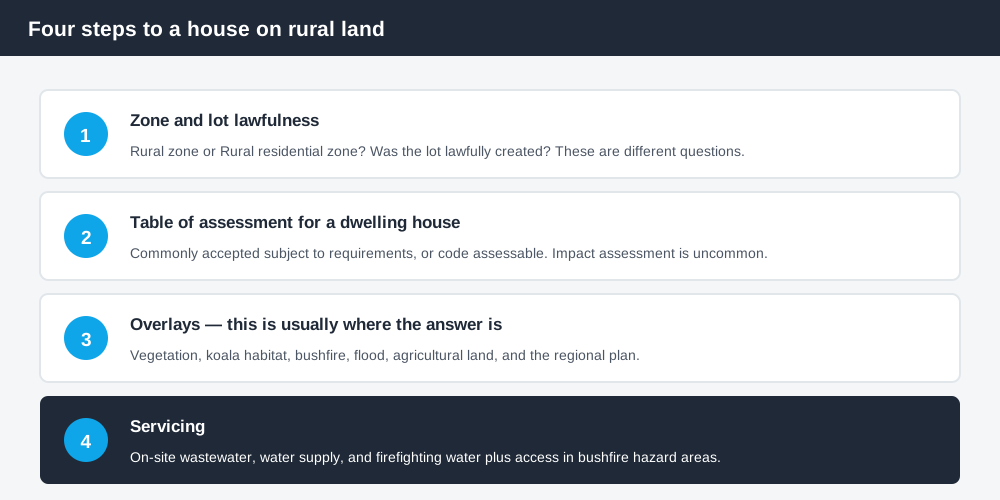
Figure 1: The zone rarely stops you. The overlays and the servicing often do.
Rural zone and Rural residential zone are not the same
The Planning Regulation 2017 sets a standard list of zones that most Queensland schemes adopt, including a Rural zone and a Rural residential zone. They have different purposes and it is worth being precise about which one your land is in.
The Rural zone exists to provide for rural uses and to protect land with capacity for rural production. Cropping, grazing, animal keeping, intensive horticulture, intensive animal industries and the ancillary buildings that support them are the anticipated uses. A dwelling house is contemplated, but generally at very low density and as something that sits alongside rural use rather than the reason for the lot's existence. Urban land uses are generally not supported.
The Rural residential zone is the opposite emphasis: very low density residential living on larger lots in a semi-rural setting, usually on the fringe of an urban area. Lot sizes in south east Queensland examples commonly range from around 3,000 square metres to a couple of hectares, and reticulated sewerage is typically absent.
One house per lawful lot
Spend 5 minutes, not 3 weeks
instantDA generates a council-ready planning report for Queensland development applications. No town planner. No waiting.
Get your report →For a single dwelling house on an existing lawful rural lot, most schemes make it accepted development subject to requirements, or code assessable, provided it meets the zone code and any overlay benchmarks. Toowoomba's published guidance is a clear example: one house is generally permitted on each rural lot, provided the lot has access to a constructed road and wastewater is appropriately treated and disposed of on site.
Some councils go further. Townsville's City Plan contemplates that two dwellings — a house plus a caretaker's accommodation or a community residence — can be allowed in most circumstances on a rural property.
Impact assessment for a single rural dwelling is uncommon, but it does happen: highly constrained sites, sites in mapped hazard areas, or proposals that do not meet the acceptable outcomes in the code. Accepted versus assessable development in QLD explains what each category means for time, cost and appeal rights.
Minimum lot size is a subdivision rule
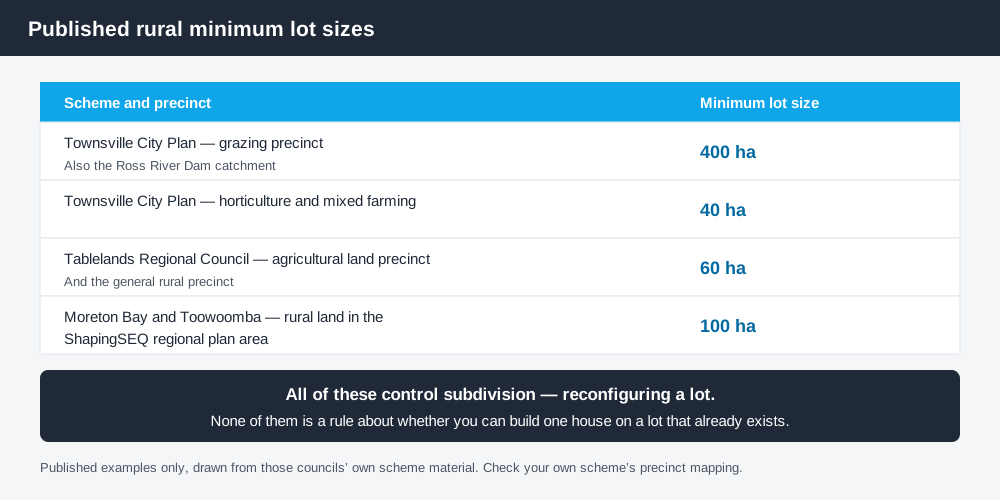
Figure 2: Published examples only. Check your own scheme's precinct mapping.
This is the single most common misunderstanding. Rural minimum lot sizes are large — Townsville's grazing precinct uses 400 hectares, its horticulture and mixed farming precincts 40 hectares, Tablelands Regional Council's agricultural land precinct 60 hectares, and in the ShapingSEQ regional plan area councils such as Moreton Bay and Toowoomba apply a 100 hectare minimum for rural subdivision.
Those numbers control reconfiguring a lot. They are there to stop rural land being fragmented into hobby blocks. They are not a rule that you need 100 hectares before you can build a house.
If your lot was lawfully created and sits below the minimum, you can generally still build one dwelling on it, subject to the zone code and overlays. What you usually cannot do is split it. Subdivision in QLD covers the reconfiguring a lot process and where the regional plan constraints apply.
The overlays that decide siting
Vegetation. The Vegetation Management Act 1999 regulates clearing of native vegetation across all tenures, and the regulated vegetation management map categorises your land. Where the building envelope requires clearing regulated vegetation, that becomes its own approval problem. Vegetation clearing laws in QLD sets out the categories and the exemptions.
Koala habitat. In south east Queensland, mapped koala habitat areas carry state-level controls, and inside koala priority areas interfering with koala habitat is prohibited unless an exemption applies. Koala habitat areas and QLD development covers how that framework works.
Bushfire. Councils map bushfire hazard in a bushfire hazard overlay and assess siting, defendable space, access and on-site firefighting water supply against the overlay code. Bushfire hazard overlays in QLD covers the Queensland framework.
Agricultural land. Schemes protect high-value agricultural land from fragmentation and from uses that would conflict with farming, which is why boundary realignments on productive land get scrutinised.
Regional plan. In south east Queensland, land in the Regional Landscape and Rural Production Area under ShapingSEQ is not somewhere urban development is supported, which shapes both subdivision and any proposal to intensify use.
- ✓Is the lot lawfully created?
- ✓What does the table of assessment say for a dwelling house in this zone?
- ✓What is the regulated vegetation category?
- ✓Is the site in mapped bushfire, flood or koala habitat?
- ✓Can on-site wastewater and water supply be demonstrated?
Servicing is a real constraint
Most rural and rural residential land is outside reticulated sewer, and often outside reticulated water. Councils generally require you to show that wastewater can be treated and disposed of on site to the applicable plumbing and drainage standards, and that there is a reliable water supply — rainwater tanks, a bore, or surface water, with licensing where that applies.
In bushfire hazard areas there is usually a dedicated firefighting water requirement on top of domestic supply, plus all-weather access for emergency vehicles.
None of this is exotic, but it is not free, and it belongs in your feasibility before you buy. Buying land to build on in QLD covers the wider pre-purchase check.
What to do next
Confirm the zone, then pull the overlay mapping for the lot on your council's planning scheme mapping and on the Queensland Globe. Download a free vegetation management property report for the lot on plan so you know your regulated vegetation categories before you pick a house site.
If you'd rather see the zone, the overlays and the likely category of assessment for an address than work through a planning scheme yourself, an instantDA planning report does that for $169 — against the $800–$1,500 a town planner typically charges for a preliminary opinion. You can start a report in a few minutes.
Then confirm with your council. Rural assessment is overlay-driven and site-specific, and a duty planner can tell you quickly whether the envelope you have in mind is realistic.
Frequently asked questions
Can I build a house on rural land in Queensland?
Do I need the minimum lot size before I can build?
What is the difference between the Rural zone and the Rural residential zone?
Can I clear trees to build the house?
Does rural land need a sewer connection?
Can I put a second house on my rural block?
Ready to generate your report?
Skip the writing. Get a council-ready planning report in 5 minutes.
Get your report