Key takeaways
- ✓The koala framework applies to mapped land in south east Queensland. The mapping decides, not the council boundary.
- ✓Inside a koala priority area, interfering with mapped koala habitat is prohibited unless the development is exempt.
- ✓Outside a priority area but inside mapped koala habitat, interference is assessable, and the state assesses it.
- ✓Exemptions exist for emergency works, dangerous trees, firebreaks and a once-off area allowance — with conditions.
- ✓Koala spotter and sequential clearing requirements can still apply even when the clearing itself is exempt.
Koala Habitat Areas and QLD Development
You'll usually hear this called a development application, or DA — that's the formal name for council approval under the Planning Act 2016. In south east Queensland there is a control that sits above the ordinary planning question, and on mapped land it can take an option off the table entirely rather than just making it harder.
The koala framework is not a council overlay. It is state-level, mapped at state level, and assessed at state level. A landowner can satisfy their council completely and still be unable to do what they proposed.
Get a council-ready planning report in 5 minutes — no planner, no waiting.
Get your report →The short answer
In south east Queensland, interfering with mapped koala habitat inside a koala priority area is prohibited unless the development is exempt. Interfering with mapped koala habitat outside a priority area is assessable, and the state assesses it against a state code. The mapping decides which applies.
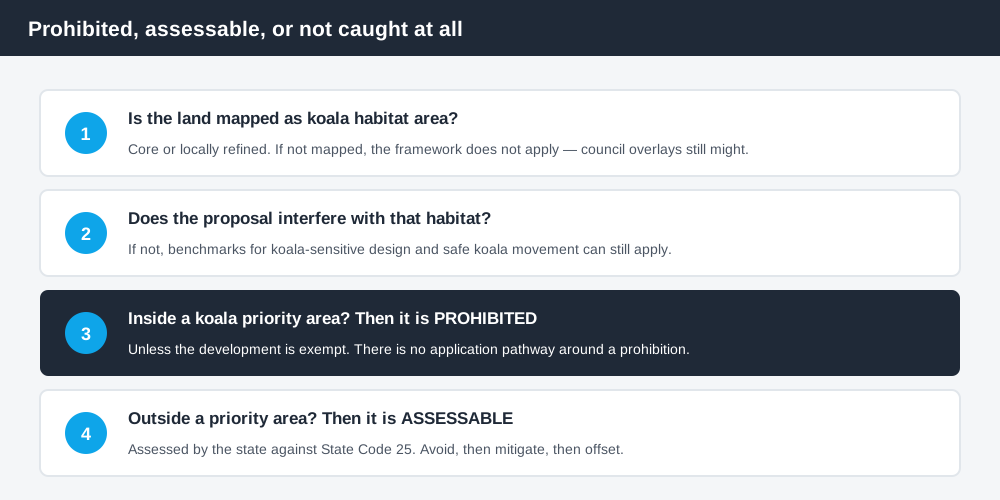
Figure 1: Two mapped layers, two very different outcomes.
What the mapping identifies
The framework works off two spatial concepts.
Koala habitat areas — including core koala habitat area and locally refined koala habitat area — identify the vegetation the controls attach to.
Koala priority areas are large, connected areas in south east Queensland where habitat protection, restoration and threat mitigation are focused, because those are the places with the highest likelihood of safeguarding koala populations.
The two layers overlap, and the combination is what matters. Habitat inside a priority area is treated very differently from the same habitat outside one.
What the 2020 reforms did
Spend 5 minutes, not 3 weeks
instantDA generates a council-ready planning report for Queensland development applications. No town planner. No waiting.
Get your report →The Queensland Government describes the 2020 changes as the strongest koala protections the state has had. Three things changed in substance:
Interfering with koala habitat inside a koala priority area became prohibited, subject to exemptions. Prohibited means no application can succeed — it is not a high bar to clear, it is a closed door.
Interfering with koala habitat outside a priority area became regulated as assessable development, assessed by the state against a state code rather than by the council.
The mapped area expanded substantially — the state describes an additional 385,606 hectares of koala habitat area being brought under regulation across south east Queensland.
The regulatory spine is the Planning Act 2016 and the Planning Regulation 2017, working with the Nature Conservation (Koala) Conservation Plan 2017 and State Code 25: Development in South East Queensland koala habitat areas. Offsets, where they are required, run through the Environmental Offsets Act 2014.
Prohibited, assessable, exempt
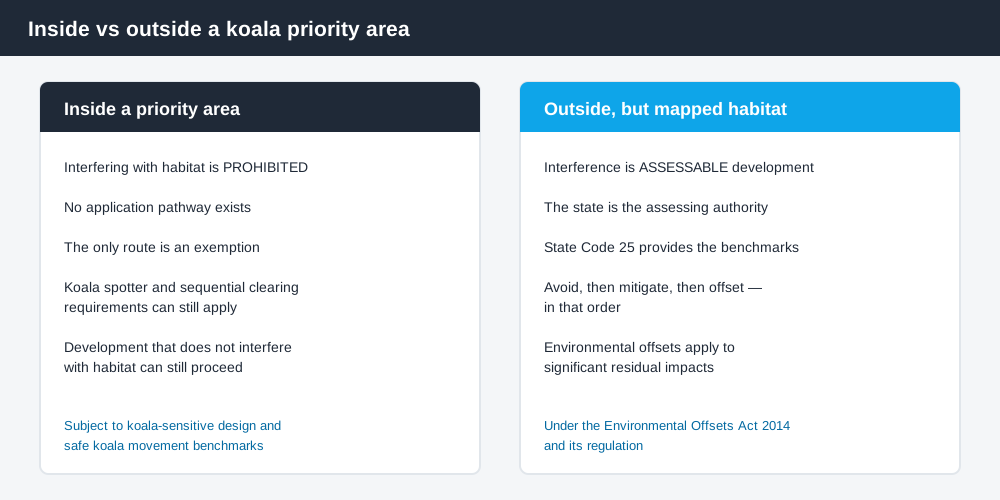
Figure 2: Inside a priority area the question is whether you are exempt. Outside, it is whether you can meet the code.
Inside a koala priority area. Development that interferes with a koala habitat area is prohibited unless it is exempted development. There is no application pathway. If an exemption applies, the work can proceed, but operational requirements under the Koala Conservation Plan — sequential clearing and koala spotter protocols — can still apply.
Development inside a priority area that does not involve clearing koala habitat is a different matter. It can be approved, but assessment benchmarks apply directed at koala-sensitive design, threat mitigation and safe koala movement — fencing, road design, lighting and the like.
Outside a koala priority area, inside mapped habitat. Interference is assessable rather than prohibited, and the state is the assessing authority, applying State Code 25. Proposals must work through the hierarchy: avoid impacts, then mitigate what cannot be avoided, then offset the significant residual impact that remains.
The exemptions
Exemptions are set out in the Planning Regulation 2017. The categories that matter most in practice are:
- ✓emergency response activities
- ✓removal of dangerous trees
- ✓creation or maintenance of firebreaks adjacent to infrastructure
- ✓a once-off area allowance per premises — the state describes a 500 square metre allowance for interfering with koala habitat area for any purpose
- ✓clearing carried out in accordance with an applicable assessable development vegetation clearing code under the Vegetation Management Act 1999
That last one is the bridge between the two regimes. Clearing done properly under a vegetation clearing code can be exempt for koala purposes as well — which is a strong reason to get the vegetation position right first. Vegetation clearing laws in QLD covers those categories and codes.
Amendments to the koala framework were under consideration during 2026, including changes to the area allowances and to how partial exemptions are treated. Because this is a moving area, confirm the current exemptions before relying on any of them.
- ✓Is the lot in mapped koala habitat area?
- ✓Is it inside a koala priority area?
- ✓Does the proposal interfere with habitat, or just sit near it?
- ✓Does an exemption genuinely cover the work?
- ✓Have you priced offsets if residual impact is likely?
Offsets
Where significant residual impacts on koala habitat cannot be avoided or mitigated, environmental offsets are required. These run under the Environmental Offsets Act 2014 and the Environmental Offsets Regulation 2014, alongside the Planning Act 2016 and Planning Regulation 2017, and are directed at establishing, protecting and rehabilitating koala habitat.
Offsets are a real cost and a real timeline. On a development of any scale they belong in the feasibility at the start, not as a condition discovered at decision stage.
How to check your land
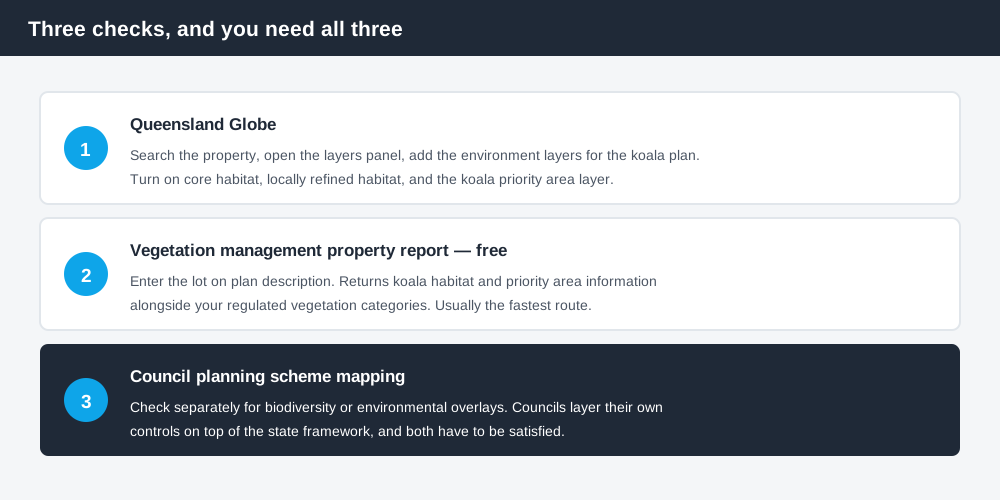
Figure 3: State mapping and council overlays are separate checks.
The state publishes the mapping and it is free to view.
On the Queensland Globe, search your property, then open the layers panel and add the environment layers for the koala plan. Turn on core koala habitat area, locally refined koala habitat area and the koala priority area layer.
You can also download a free vegetation management property report for your lot on plan, which includes koala habitat area and koala priority area information alongside your regulated vegetation categories. That is usually the faster route for a landholder.
Then check your council's planning scheme mapping separately for biodiversity or environmental overlays. Councils layer their own controls on top of the state framework, and both have to be satisfied. Biodiversity overlays in QLD covers that layer, and how to check overlays in QLD covers the mapping process generally.
What to do next
Pull the mapping before you design anything. Where a lot is partly mapped, the design question is usually whether the building envelope, driveway and services can be arranged to avoid interference entirely — because avoiding it is dramatically cheaper than the alternatives, and inside a priority area it may be the only option.
If you'd rather see the zone, the overlays and the likely category of assessment for an address than work through a planning scheme yourself, an instantDA planning report does that for $169 — against the $800–$1,500 a town planner typically charges for a preliminary opinion. You can start a report in a few minutes.
Then confirm with your council and, where the state is the assessing authority, with the state. This framework has changed repeatedly and is worth checking rather than assuming.
Frequently asked questions
Where do the Queensland koala rules apply?
Can I clear trees in a koala priority area?
What if my land is mapped as koala habitat but outside a priority area?
What exemptions are available?
Do koala spotter requirements still apply if I am exempt?
How do I check if my property is mapped?
Ready to generate your report?
Skip the writing. Get a council-ready planning report in 5 minutes.
Get your report