Key takeaways
- ✓There is no single Queensland tree rule — four separate regimes can each catch the same tree.
- ✓Council protection usually comes through a local law permit or a scheme overlay, not a development application.
- ✓Brisbane's Natural Assets Local Law is Brisbane's instrument only; other councils use different triggers.
- ✓In South East Queensland, interfering with a koala habitat area inside a koala priority area is prohibited unless exempt.
- ✓You can cut a neighbour's overhanging branches back to the boundary at your own cost, but you cannot remove their tree.
Do You Need Council Approval to Remove a Tree in QLD?
You'll usually hear council approval called a development application, or DA — that's the formal name for council approval under the Planning Act 2016. Trees are the one common topic where a DA is often not the instrument at all. More often you need a permit under a council local law, or you are caught by a state clearing framework your council does not administer.
Get a council-ready planning report in 5 minutes — no planner, no waiting.
Get your report →The short answer
Often, yes. Four separate regimes can each catch a tree — a council local law or planning scheme overlay, the state vegetation management framework, koala habitat protections in South East Queensland, and the neighbour tree law. Only your own council's mapping tells you which of them apply.
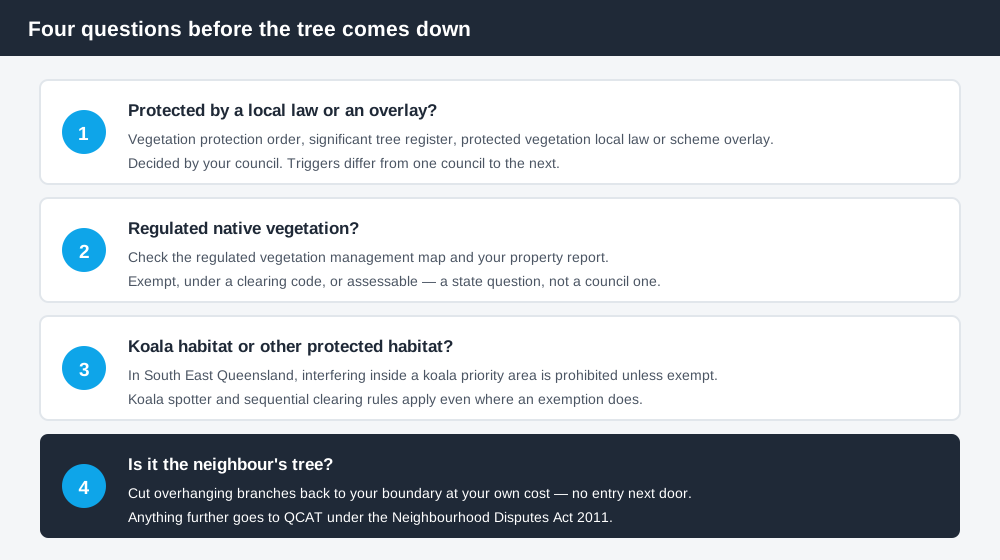
Figure 1: Four questions, four different decision-makers.
Question one — is it protected by a local law or an overlay?
This is the layer most people mean by "council approval", and the most variable thing in Queensland planning. Councils protect trees through several mechanisms, sometimes more than one at once — a vegetation protection order, a significant landscape tree register, a protected vegetation local law, or a biodiversity overlay in the scheme.
Brisbane's Natural Assets Local Law 2003 is the best-known example. Under the NALL, protected vegetation includes plants and trees in bushland areas, wetlands, waterway corridors and urban or rural areas, and it is an offence to interfere with it without permission even where it is on your own property. Permits are free, in three forms — short-term for one-off work such as removing a tree, long-term for ongoing maintenance, and minor pruning of a council street tree. Exemptions apply only within your own boundaries.
That is Brisbane's instrument, not the state's, and it applies nowhere else. Other councils use different triggers — trunk circumference or diameter at a stated height, canopy spread, a species list, or a mapped area. Queensland's schemes follow the Queensland Planning Provisions structure with council-specific codes layered on, so there is no state-wide threshold to quote.
- ✓Is the tree named in a vegetation protection order or on a significant tree register
- ✓Does a biodiversity or vegetation overlay cover the land
- ✓Does a protected vegetation local law apply to the area or species
- ✓Does the tree exceed a trunk or canopy trigger in the scheme
Question two — is it regulated native vegetation?
Spend 5 minutes, not 3 weeks
instantDA generates a council-ready planning report for Queensland development applications. No town planner. No waiting.
Get your report →Separately from anything your council does, clearing native vegetation on freehold and leasehold land is regulated by the state under the Vegetation Management Act 1999 alongside the Planning Act 2016 framework. What is regulated on your land is shown on the regulated vegetation management map, and you can request a property report.
Within that framework, many routine and lower-risk activities are dealt with under an accepted development vegetation clearing code rather than by application, some purposes are exempt clearing work, and anything else falls to development assessment — with the state assessment and referral agency assessing, not your council. Administration sits with the state department responsible for natural resources.
This layer bites hardest on rural and large lots and on remnant or regrowth vegetation. It often does not reach a planted tree in a suburban backyard — but "often" is not "never", and the map answers it, not the size of the block. Our guide to vegetation management in QLD explains the categories.
Question three — is it koala habitat or other protected habitat?
In South East Queensland a further layer overrides much of the above. Development regulations introduced in 2020 and carried in the Planning Regulation 2017 prohibit interfering with koala habitat in a koala habitat area inside a koala priority area, and regulate it through development approvals in koala habitat areas elsewhere. "Interfering" is broad — removing, cutting down, ringbarking, poisoning or destroying native vegetation — though it does not extend to lopping a tree.
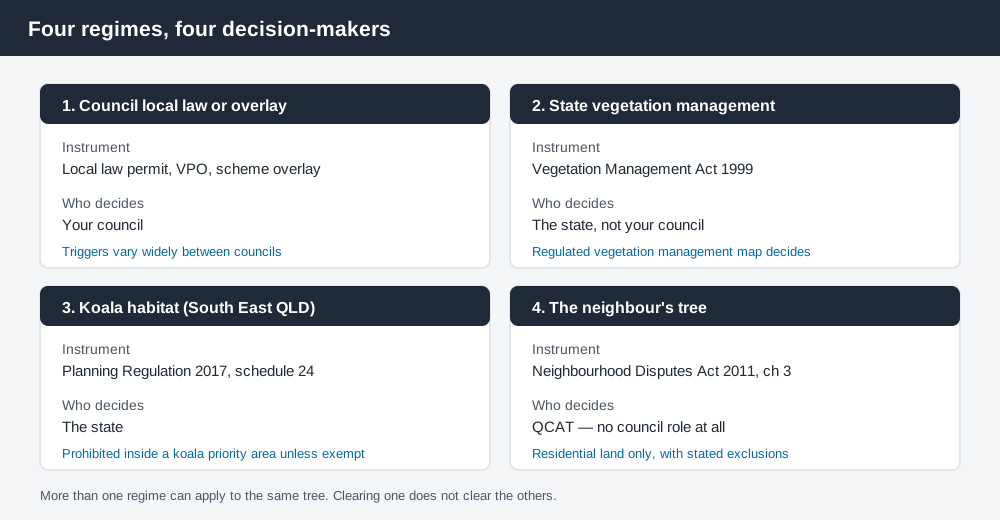
Figure 2: Four regimes, four instruments, four decision-makers.
Exemptions sit in schedule 24 of the Planning Regulation 2017 and include emergency response, removal of dangerous trees, and firebreaks adjacent to infrastructure. Even where one applies, the sequential clearing and koala spotter requirements in the Nature Conservation (Koala) Conservation Plan 2017 still have to be met.
Koala habitat is also a matter of national environmental significance under the Commonwealth Environment Protection and Biodiversity Conservation Act 1999, aimed at actions likely to have a significant impact on a listed species. It rarely turns on one backyard tree, but it sits above everything else. If your land carries habitat mapping, read koala habitat rules in QLD.
Question four — is it your neighbour's tree?
None of the above governs this. Trees between neighbours fall under chapter 3 of the Neighbourhood Disputes (Dividing Fences and Trees) Act 2011. The tree-keeper — usually the registered owner of the land the tree grows on — is responsible for its care and maintenance.
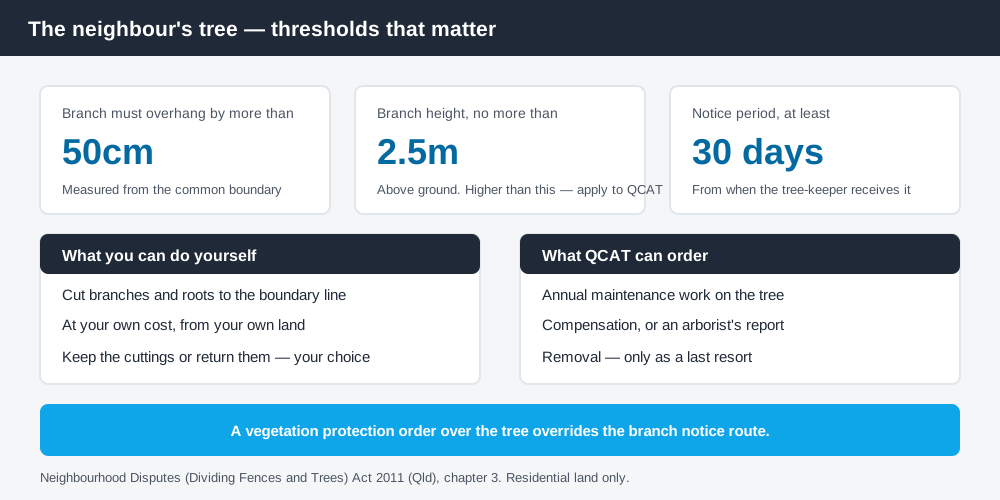
Figure 3: What you can do yourself, and where QCAT starts.
You may exercise the common law right of abatement — cutting overhanging branches and roots back to your boundary line, at your own cost, without entering the neighbour's land. If that is not enough, you can give the tree-keeper a Form 3 notice for removal of particular overhanging branches. It applies only where branches overhang by more than 50cm and sit 2.5m or less above the ground, and not to trees under a vegetation protection order. The notice must allow at least 30 days and include a written quote and a copy of the relevant part of the Act. If the tree-keeper does not act, the work can be done at their expense up to a capped annual amount.
Beyond that, it is QCAT, which can make orders where a tree has caused, is causing or is likely to cause serious injury, serious damage to land or property, or substantial ongoing unreasonable interference with the use and enjoyment of the land. Orders can require maintenance, compensation, an arborist's report, or removal — removal only where nothing else will do. The jurisdiction excludes trees in council parks and reserves, land over four hectares or rural land, and commercial plantings.
Dangerous trees, and making room for a building
Most of these regimes carry an exemption for a genuinely dangerous tree and for emergency works. That is the right thing to rely on when a tree is an immediate threat, but it is not a shortcut. Expect to evidence the risk — commonly an arborist's report, dated photographs, and a record of the condition that made removal necessary — and expect an after-the-fact notification or compliance declaration.
Wanting the tree gone to make room for a building is not an exemption anywhere. If a proposed structure sits under a protected canopy or in a root zone, the tree becomes part of the approval for that structure.
Street trees, and what happens if you get it wrong
Trees in the road reserve — verge, footpath, nature strip — are council property, and one standing in front of your house gives you no right to prune or remove it. Councils run their own permit process for street trees. Remove a protected tree anyway and consequences run from an infringement notice through to prosecution, and councils can also require replanting. Failing to comply with a QCAT tree order without reasonable excuse carries a substantial penalty too.
What to do next
Work through the four questions in order, and treat the last step as a real instruction rather than a disclaimer. Check your council's local laws register and scheme overlays, request a vegetation property report if the block is large or vegetated, check the koala mapping if you are in the south-east, and settle the tree-keeper question before touching anything near a boundary. Brisbane residents can start with the council's protected vegetation permits page; for a neighbour's tree, the Queensland Government's guidance on what to do if a neighbour's tree is affecting you sets out the notice process.
If you would rather see your zone, overlays and likely category of assessment in one document than work through a scheme and three registers yourself, an instantDA planning report does that for your address for $169 — against the $800–$1,500 a town planner typically charges for a preliminary opinion. You can start a report in a few minutes, and how to check overlays in QLD shows where the mapping lives.
Then confirm with your council in writing, naming the tree and the address.
Frequently asked questions
Do I need council approval to remove a tree on my own property in QLD?
What size tree can I remove without a permit in Queensland?
Can I cut branches from my neighbour's tree that hang over my fence?
What about a dangerous tree that could fall?
Ready to generate your report?
Skip the writing. Get a council-ready planning report in 5 minutes.
Get your report