Key takeaways
- ✓Check first. A great deal of building work that looks unapproved is accepted development and needs no application at all.
- ✓Your council's development enquiry portal and its planning scheme maps will answer most questions in ten minutes.
- ✓Councils are generally reactive. A written, specific, evidenced complaint is treated very differently from a phone call.
- ✓Council enforces planning and building law. It does not resolve boundary, fence, tree or nuisance disputes for you.
- ✓Enforcement runs on the council's timetable and you are not a party to it, so expect limited updates.
Neighbour Building Without Approval in QLD: What You Can Do
You'll usually hear this called a development application, or DA — that's the formal name for council approval under the Planning Act 2016. When something large goes up next door and no notice ever arrived in your letterbox, the natural conclusion is that it must be unapproved. Often it is not, and the difference matters — both to how you should proceed and to whether you have anything worth complaining about.
Get a council-ready planning report in 5 minutes — no planner, no waiting.
Get your report →The short answer
Check before you complain. Search your council's development enquiry portal and its planning scheme maps to see what was approved and whether the work needed approval at all. If it genuinely did not, report it in writing with dates, photographs and the address. Council enforces planning law, not neighbour disputes.
No notification does not mean no approval
This trips up almost everyone, and it is worth understanding before you reach for the complaint form.
Public notification is only required where an application involves impact assessment, or where it includes a variation request. Code assessable applications are not publicly notified, and there are no submitter appeal rights against the decision. So a neighbour can obtain a perfectly valid development approval for a substantial project without you ever being told, simply because the scheme categorised it as code assessable.
Beyond that, a great deal of work needs no development approval at all. Accepted development requires none. Accepted development subject to requirements requires none either, provided the proposal complies with the stated requirements the neighbour self-assesses against. And on the building side, small class 10 structures, fences up to 2 m and retaining walls under 1 m commonly need no building approval.
Accepted vs code vs impact assessable in QLD sets out how those categories work and why the same structure can be treated differently one street away.
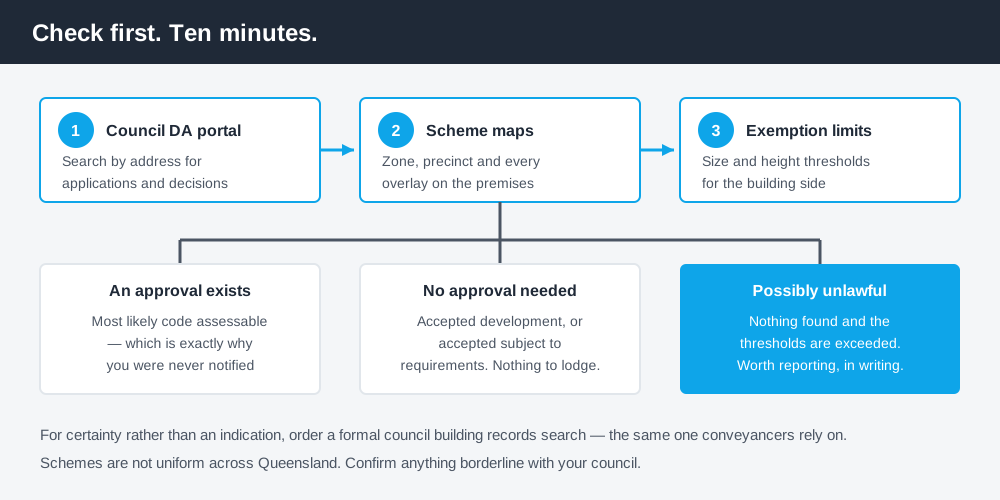
Figure 1: Three checks, about ten minutes, before you contact anyone.
How to check, in about ten minutes
Spend 5 minutes, not 3 weeks
instantDA generates a council-ready planning report for Queensland development applications. No town planner. No waiting.
Get your report →Your council's development enquiry portal. Most Queensland councils publish a development.i or equivalent tool where you can search applications by address and see what has been applied for, what was decided and the approved plans. If there is a live or recent approval for the property, you will usually see it here.
Your council's planning scheme maps. Find the zone, any precinct or local plan, and every overlay affecting the property. This tells you what category the work is likely to sit in.
Queensland Globe for lot and plan details and a range of state-mapped layers.
A council building records search if you need certainty rather than an indication. This is a paid, formal search listing the building approvals held for a property. It is what conveyancers rely on.
- ✓Search the council development enquiry portal by address
- ✓Check zone and overlays on the scheme maps
- ✓Check the building exemption thresholds for size and height
- ✓Note dates and take photographs from your own property
- ✓Only then decide whether to report
Making a complaint that gets acted on
Councils are generally reactive on unlawful development. They have limited compliance resources and prioritise by risk. What you send determines what happens.
Put it in writing, to the council's compliance or development compliance team. Include the property address, a description of the work in plain terms, when it started and whether it is continuing, photographs taken from your own property or from the street, and what you have already checked — that you searched the development portal and found no approval, for instance. Say plainly what you believe the issue is: no approval, or work that does not match an approval you can see.
Two things lift a complaint above the pile. Specificity — "a two-storey structure within about half a metre of the shared boundary, commenced 3 June" beats "they are building something huge". And safety or damage — where work is affecting drainage onto your land, undermining a retaining wall, or creating a hazard, say so explicitly, because that changes the priority.
Do not photograph inside the neighbour's home, do not enter their land, and keep the correspondence factual. Anything that reads as a campaign tends to be treated as one.
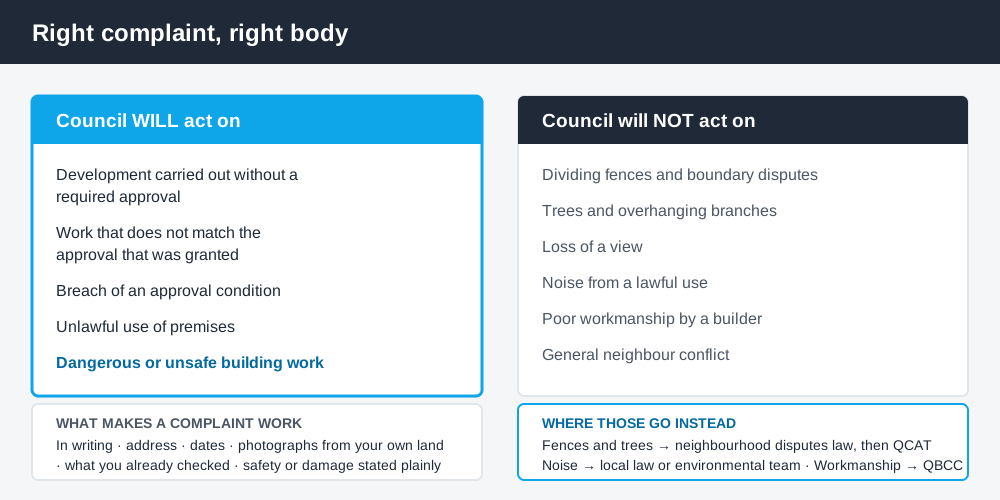
Figure 2: Send it to the right place, or it goes nowhere.
What happens next, and what does not
If the council forms a reasonable belief that a development offence has been or is being committed, the process is the one set out in the Planning Act 2016: a show cause notice, then if unresolved an enforcement notice which can require the work to stop, be remedied, or in some cases be removed. Show cause and enforcement notices in QLD explains what each stage involves.
Three realities to set your expectations against.
You are not a party. The matter is between the council and the owner. Councils are generally limited in what they can tell you, and you will not receive copies of the notices. Ask for a reference number and a contact officer, and follow up in writing.
It is slow. Investigation, notice periods, response periods and appeal periods all take weeks, and the owner may have appeal rights that extend the timeline further.
The outcome may be approval, not demolition. If the work could have been approved, the most likely result is that it gets approved retrospectively. Complaining does not entitle you to a particular outcome, and it does not create a right of objection where the scheme gave you none.
When the real issue is something else
Councils enforce planning and building law. A lot of neighbour grief is not that.
Dividing fences, overhanging branches and trees causing damage are dealt with under Queensland's neighbourhood disputes legislation and, if unresolved, through the Queensland Civil and Administrative Tribunal, not by your council. Loss of a view is generally not protected. Noise from a lawful use is usually an environmental or local law matter rather than a development one. Poor workmanship by a builder is a QBCC matter.
Sending the right complaint to the right body is most of the battle. If your concern is genuinely about siting, height, overlooking or drainage from a new structure, it is a planning matter and the council is the right recipient.
If you'd rather read the zone, the overlays and what the scheme actually allows on a nearby property in one document than work through a planning scheme yourself, an instantDA planning report does that for an address for $169, against the $800–$1,500 a town planner typically charges for a preliminary opinion. You can start a report in a few minutes.
And if you are on the other side of this — the one who built something and has now had a visit — building without council approval in QLD sets out your options. Confirm anything you rely on with your council, because schemes are not uniform across Queensland.
Frequently asked questions
How do I find out if my neighbour's building work is approved in Queensland?
Why wasn't I notified about my neighbour's development application?
How do I report unapproved building work to a Queensland council?
Will the council tell me what happens to my complaint?
Can the council make my neighbour demolish the structure?
What if the dispute is about a fence or a tree?
Ready to generate your report?
Skip the writing. Get a council-ready planning report in 5 minutes.
Get your report