Key takeaways
- ✓"Dual living" is a marketing label, not a planning term. Queensland schemes recognise dwelling house, secondary dwelling, dual occupancy and multiple dwelling.
- ✓A secondary dwelling is subordinate to the main dwelling and sits on the same lot. A dual occupancy is two dwellings for two separate households.
- ✓Since a 2022 change to the Planning Regulation 2017, a secondary dwelling can be rented to people unrelated to the main household anywhere in Queensland.
- ✓A secondary dwelling is not a route to two separate titles. If separate titles are the goal, the use class you need is dual occupancy or higher.
- ✓Two rents does not mean two approvals were given. Check the property's approval history before you buy, not after.
Dual Living Investments in QLD — Approval Rules
You'll usually hear this called a development application, or DA — that's the formal name for council approval under the Planning Act 2016. "Dual living" is not that. It is a term agents and builders use for a house arranged so two households can live in it, and Queensland planning schemes have never heard of it.
That gap is where investors get into trouble. The listing says dual living. The scheme says dwelling house, secondary dwelling, dual occupancy or multiple dwelling — and those four have very different rules, very different assessment pathways, and very different resale positions.
Get a council-ready planning report in 5 minutes — no planner, no waiting.
Get your report →The short answer
"Dual living" is a marketing description, not a planning use. Queensland schemes classify the property as a dwelling house with a secondary dwelling, a dual occupancy, or multiple dwellings. Which one applies depends on how many dwellings, how many households, and whether one dwelling is subordinate to the other.
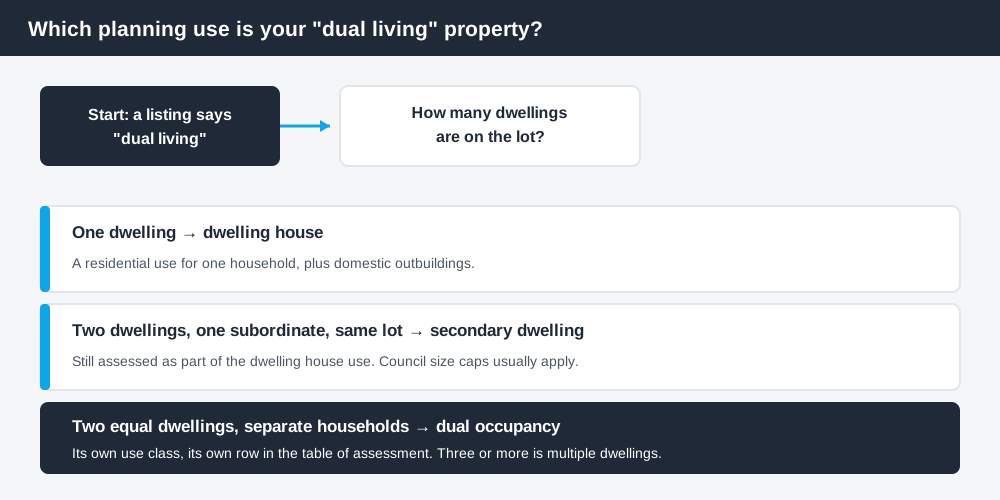
Figure 1: The label on the listing does not decide this. The scheme's use definitions do.
The four uses that matter
The Planning Regulation 2017 and the Queensland Planning Provisions set the use definitions that most councils adopt or closely follow, usually restated in Schedule 1 of the local planning scheme.
A dwelling house is a residential use for one household containing a single dwelling, together with domestic outbuildings — and it may include a secondary dwelling. That last part surprises people. A house with a granny flat is still, in planning terms, a dwelling house.
A secondary dwelling is a dwelling used in conjunction with, but subordinate to, another dwelling on the same lot. It can be attached, built underneath, or free-standing. The two defining features are that it is on the same lot and that it is subordinate in size and scale.
A dual occupancy is premises containing two dwellings on one lot for separate households, whether or not they are attached — a duplex is the archetype. It is expressly not a dwelling house and not a secondary dwelling. It is its own use class, with its own row in the table of assessment.
Multiple dwellings covers three or more, and sits higher again.
Secondary dwelling versus dual occupancy
Spend 5 minutes, not 3 weeks
instantDA generates a council-ready planning report for Queensland development applications. No town planner. No waiting.
Get your report →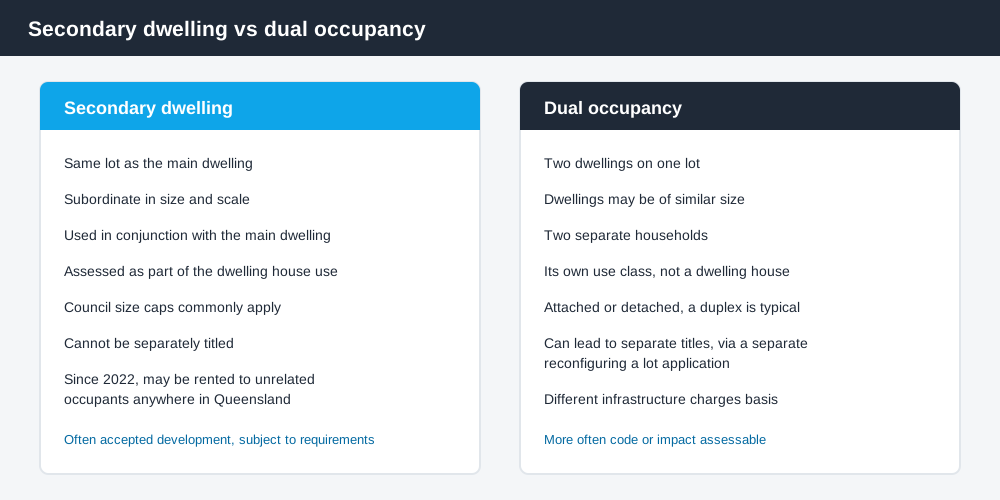
Figure 2: Same building footprint, very different planning position.
The practical difference is subordination. A secondary dwelling must be smaller in scale and clearly ancillary to the main house. Many councils layer their own maximum floor area on top of the state definition — Cairns, Logan and Douglas all publish scheme-specific caps, and they do not agree with each other. Queensland schemes follow the Queensland Planning Provisions structure, but each council adds its own codes over the top. They are not uniform, and a number that applies in one local government area tells you nothing about the next one.
Two dwellings of roughly equal size, each serving a separate household, is the fact pattern that pushes a proposal out of dwelling house territory and into dual occupancy. Secondary dwelling versus dual occupancy in QLD works through where that line typically falls.
- ✓How many dwellings are on the lot?
- ✓Are they on one lot or two?
- ✓Is one clearly subordinate in size and scale?
- ✓Are they occupied by one household or two?
- ✓Does the scheme cap secondary dwelling floor area in this zone?
What the 2022 change did — and what it didn't
Before 2022, many Queensland schemes only allowed a secondary dwelling to be occupied by a member of the main household. That made granny flats close to useless as rental stock.
The Planning (Secondary Dwellings) Amendment Regulation 2022 amended the definition of secondary dwelling in the Planning Regulation 2017 so that it applies whether or not the occupants are related to, or associated with, the household of the other dwelling. State guidance published by the planning department describes the change as taking effect from 26 September 2022 and as removing restrictions on who can live in a secondary dwelling across Queensland.
It is a real and useful change. But note what it did not touch:
- ✓The same lot requirement stands.
- ✓The subordinate requirement stands.
- ✓Council-specific size caps and design standards in the scheme still apply.
- ✓It did not create any right to a second title.
If your investment case depends on renting the second dwelling out separately, renting out a granny flat in QLD covers the tenancy and compliance layer that sits alongside the planning position.
Can you get two titles?
Usually not from a secondary dwelling. The definition ties it to the same lot as the main dwelling, and nothing about approving a secondary dwelling creates a path to splitting the land.
Where separate titles are genuinely the objective, the use class you need is dual occupancy — or multiple dwellings — approved as such, and then a separate reconfiguring a lot application to create the second title. That is two applications, two sets of assessment benchmarks, and infrastructure charges calculated on a different basis. It is a materially different project from adding a granny flat, and it should be priced that way at the outset rather than discovered at the end.
What to check before you buy
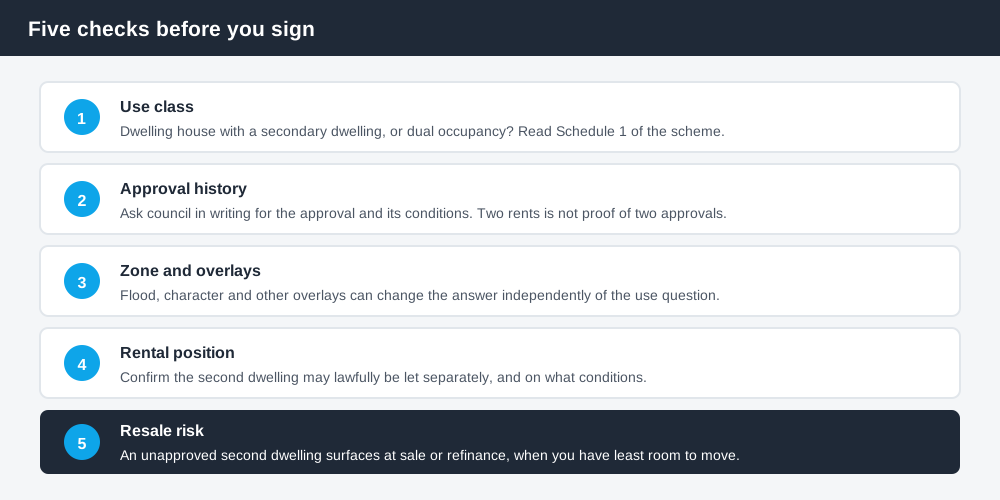
Figure 3: Every one of these is cheaper to answer before the contract than after.
The single most valuable thing you can do is ask the council in writing for the property's development approval history and any conditions attached. Two kitchens and two rents does not prove two dwellings were ever approved. Unapproved second dwellings are common, and they surface at the worst possible moment — at sale, at refinance, or when a neighbour complains.
Then check the zone and overlays for the address on your council's planning scheme mapping and on the Queensland Globe. A flood or character overlay can change the answer entirely, independent of the use question.
If the property is in Brisbane, dual occupancy in Brisbane covers the City Plan 2014 position specifically, and dual key versus duplex in QLD explains why two front doors under one roof is not automatically two dwellings.
What to do next
Work out which of the four uses your target property actually is, get the approval history in writing from council, and confirm the zone and any overlays before you commit.
If you'd rather see the zone, the overlays and the likely category of assessment for an address than work through a planning scheme yourself, an instantDA planning report does that for $169 — against the $800–$1,500 a town planner typically charges for a preliminary opinion. You can start a report in a few minutes.
Then confirm with your council. Duty planners answer the secondary dwelling question constantly, and the answer turns on your scheme, your zone and your lot.
Frequently asked questions
Is "dual living" a legal term in Queensland?
Can I rent out a granny flat to a stranger in Queensland?
What is the difference between a secondary dwelling and a dual occupancy?
Can a secondary dwelling be sold separately?
Does a dual living house need a development application?
How do I find out what was actually approved on a property?
Ready to generate your report?
Skip the writing. Get a council-ready planning report in 5 minutes.
Get your report