Key takeaways
- ✓A duplex is a built form; in planning language it is normally a dual occupancy, which is two dwellings on one lot with neither subordinate to the other.
- ✓A dual-key is marketed as one dwelling with a lockable internal division — but if the scheme reads it as two dwellings in substance, it is a dual occupancy and needs that approval.
- ✓Councils test separate entries, kitchens, bathrooms, metering, addresses and whether the internal connection is real or notional.
- ✓Being treated as a dual occupancy changes the level of assessment, the infrastructure charges, the parking required and the titling options.
- ✓Building approval under the Building Act 1975 through a private certifier is always separate from any development approval.
- ✓A dual occupancy stays one property until a separate reconfiguring a lot approval is granted and the plan is sealed and registered.
Duplex and Dual-Key in QLD — Council Approval Explained
Builders and investors use "duplex", "dual-key" and "dual occupancy" as though they were three words for the same product. In Queensland planning terms they are not, and the one that matters to council is the one nobody puts on the brochure. You'll usually hear the approval itself called a development application, or DA — that's the formal name for council approval in Queensland, and which DA you need depends on which of these three things you are actually building.
Get a council-ready planning report in 5 minutes — no planner, no waiting.
Get your report →The short answer
A duplex is a built form: two attached dwellings on one lot, which in planning terms is normally a dual occupancy. A dual-key is marketed as one dwelling with a lockable internal division, but if the scheme reads it as two dwellings, it is a dual occupancy and needs that approval whatever the label.
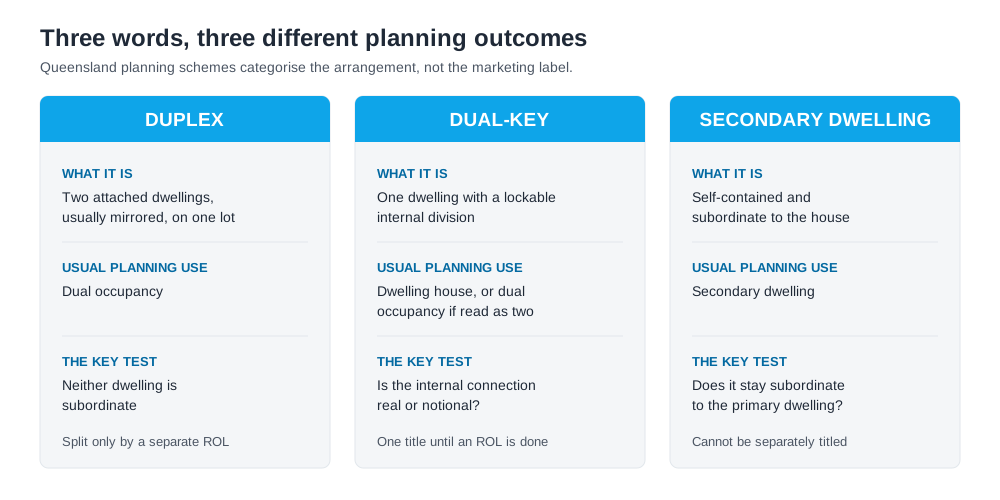
Figure 1: How a duplex, a dual-key and a secondary dwelling differ in planning terms.
Duplex, dual-key and secondary dwelling: what each one means
A duplex describes a building, not a use. It is two attached dwellings, usually mirrored across a party wall, on a single lot. When a Queensland planning scheme categorises it, the use it lands in is normally dual occupancy — two dwellings on one lot with neither subordinate to the other. That categorisation drives the assessment, not the word on the plans.
A dual-key is a single dwelling designed so part of it can be locked off and occupied separately, typically a studio or one-bedroom wing with its own external door. It is marketed on rental yield: two income streams, one build. The planning question is whether it is genuinely one dwelling or, in substance, two. If council reads it as two, it is a dual occupancy and needs that approval — the marketing description carries no weight.
A secondary dwelling is a third thing entirely. It is self-contained, sits on the same lot as the primary dwelling, is used in conjunction with it and is subordinate to it. Same lot, same title, and it cannot be separately titled. Councils commonly require it to share an address and services with the house and to sit within a set distance of it, and most allow only one per lot. Subordination is the whole point — lose it and the proposal tips into dual occupancy territory, a boundary covered in detail in secondary dwelling vs dual occupancy in QLD.
How councils test whether it is one dwelling or two
Spend 5 minutes, not 3 weeks
instantDA generates a council-ready planning report for Queensland development applications. No town planner. No waiting.
Get your report →There is no state-wide checklist and no council publishes a formula. Assessment officers look at the physical and administrative reality of the building and ask whether two households could live there independently of each other.
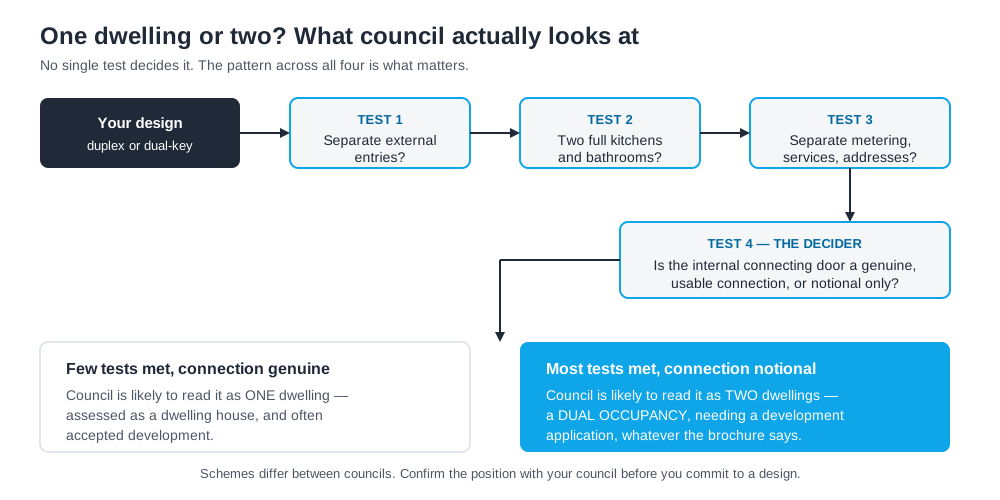
Figure 2: The practical tests that decide whether council reads your building as one dwelling or two.
- ✓Separate external entries that don't pass through the other household's space
- ✓A second full kitchen rather than a kitchenette or bar sink
- ✓A second full bathroom and laundry
- ✓Separate metering for power and water, and separate service connections
- ✓Separate street addresses or unit numbering
- ✓Whether the internal connecting door is a genuine, usable connection or a notional one that will be locked and furniture-blocked on day one
None of these is decisive alone — a house with a second bathroom is still one house. The pattern is what matters: the more boxes a design ticks, the harder it is to argue the building is a single dwelling used by a single household. The internal-connection test catches most dual-key designs. A door that exists only to satisfy a definition, between two otherwise sealed halves, is a weak argument in front of an assessment officer.
Schemes are not uniform, so the same floor plan can be assessed differently across council boundaries. Queensland's schemes follow the Queensland Planning Provisions structure, but every council layers its own definitions, codes and overlays on top. Confirm the position with your council before you commit to a design.
What changes once it is treated as a dual occupancy
Quite a lot, and none of it is cosmetic.
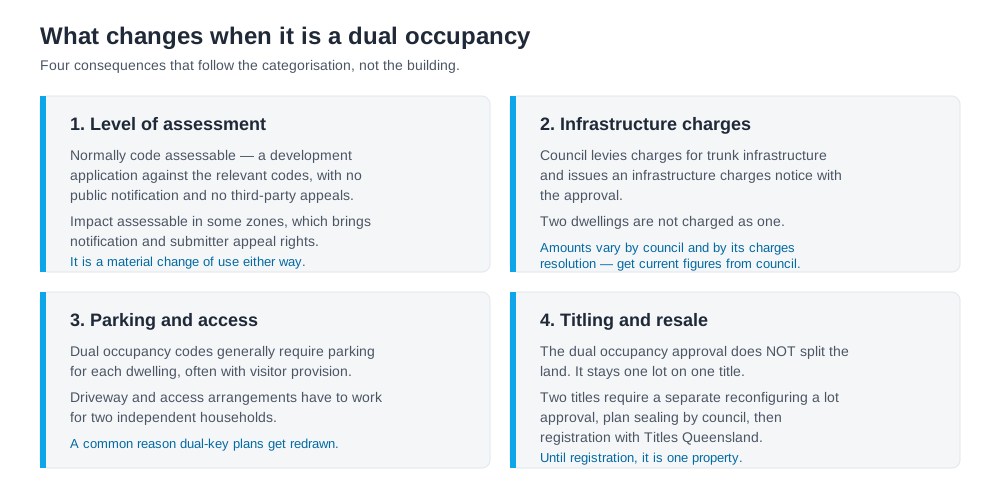
Figure 3: Four things that change when your proposal is assessed as a dual occupancy.
Level of assessment. A dual occupancy is normally code assessable — a development application assessed against the relevant codes, without public notification or third-party appeal rights. In some zones it can be impact assessable instead, which brings notification and submitter appeal rights. A dwelling house, by contrast, is frequently accepted development. Establishing a dual occupancy is a material change of use: the dictionary in Schedule 2 of the Planning Act 2016 defines that as the start of a new use, the re-establishment of an abandoned use, or a material increase in the intensity or scale of a use.
Infrastructure charges. Councils levy charges for trunk infrastructure and issue an infrastructure charges notice with the approval. Two dwellings are not charged as one, and amounts vary by council, so get current figures from council rather than from a builder's estimate.
Parking. Dual occupancy codes generally require parking for each dwelling, often with visitor provision, and access that works for two households — a common reason a dual-key design is redrawn late.
Titling. The one people misunderstand most, and it deserves its own section.
Building approval is always a separate requirement
Whatever the planning outcome, building approval under the Building Act 1975 is a different approval granted by a different person, usually a private building certifier. It deals with structure, fire separation between the two halves, sound and siting. Approval of the material change of use does not give you it, and being accepted development on the planning side does not remove it. The distinction is set out in building approval vs development approval in QLD.
Selling the halves: one title until a plan is registered
A dual occupancy sits on one lot with one title, and cannot be sold as two properties on the dual occupancy approval alone. Splitting it requires a separate reconfiguring a lot (ROL) approval, a survey plan in a registrable format, plan sealing by council once conditions are met and charges paid, then registration with Titles Queensland. Only at registration do two titles exist. Until then a dual-key is one property, financed and sold as one. The full sequence is set out in reconfiguring a lot in QLD.
When a build is marketed as "no DA needed"
Treat that as the seller's reading of one council's scheme, at one point in time, for one zone. It does not travel. A design that was accepted development in one local government area can be assessable on the next one over, and scheme amendments change the answer without warning.
Brisbane shows why timing matters. Brisbane City Plan 2014 contains a stand-alone dual occupancy code, and council material describes dual occupancy as supported in the Low density residential, Low-medium density residential and Character residential (Infill housing zone precinct) zones. Practitioners report it is generally code assessable in Low-medium density residential and in the Character residential infill precinct where height and character criteria are met, and generally impact assessable in Low density residential — check the current table of assessment rather than rely on that. Council is also running a "More Homes, Sooner" City Plan amendment process contemplating changes to how dual occupancies are assessed, but that is amendment material, not settled law. Confirm the current position on Brisbane City Council's dual occupancy page.
If you want your own site checked rather than a general answer, an instantDA planning report sets out the zone, the overlays and the likely category of assessment for your address for $169 — against the $800–$1,500 a town planner typically charges for a preliminary opinion. You can start a report in a few minutes, then take the result to your council.
Frequently asked questions
Is a duplex the same as a dual occupancy in Queensland?
Do I need a DA for a dual-key house in QLD?
Can I sell the two halves of a duplex separately?
Is a dual-key cheaper to get approved than a duplex?
What is the difference between a secondary dwelling and a dual occupancy?
Do I still need building approval if no DA is required?
Ready to generate your report?
Skip the writing. Get a council-ready planning report in 5 minutes.
Get your report