Key takeaways
- ✓Since 26 September 2022 a secondary dwelling in Queensland can be rented to people unrelated to the household of the main house.
- ✓The change was made by the Planning (Secondary Dwellings) Amendment Regulation 2022 and applies across the State.
- ✓Renting it out does not change the planning classification by itself — but the flat must stay subordinate to the main house.
- ✓An individual development approval can still carry its own occupancy conditions, so read your approval before you advertise.
- ✓The flat must have been lawfully approved in the first place; an unapproved granny flat with a tenant in it is a much larger problem.
- ✓Short-stay letting, body corporate by-laws and metering are separate questions with separate rules.
Can You Rent Out a Granny Flat in QLD?
You'll usually hear the granny flat called a secondary dwelling — that's the term Queensland planning schemes actually use, and it's the word your council will search on. The question of who is allowed to live in one used to have a restrictive answer. It doesn't any more, and the date that changed it is worth knowing.
Get a council-ready planning report in 5 minutes — no planner, no waiting.
Get your report →The short answer
Yes. Since 26 September 2022, a secondary dwelling in Queensland can be rented to someone unrelated to the household of the main house. But the flat must have been lawfully approved, must stay subordinate to the main dwelling, and must comply with any conditions on its own approval. Confirm with your council.
Three qualifications on one yes. Each one is where people come unstuck.
What changed on 26 September 2022
Before that date, secondary dwellings across Queensland carried a restriction on who could lawfully occupy them: the permitted occupants were limited to people related to, or otherwise associated with, the household of the primary dwelling. That is the origin of the "granny flat" name, and it is why so many owners still believe the flat can only house a parent, an adult child or a live-in carer.
The Planning (Secondary Dwellings) Amendment Regulation 2022, SL 2022 No. 133, removed that occupancy restriction with effect from 26 September 2022. The intent was straightforward — a large stock of self-contained dwellings already existed and was sitting empty because of who was not allowed to live in them.
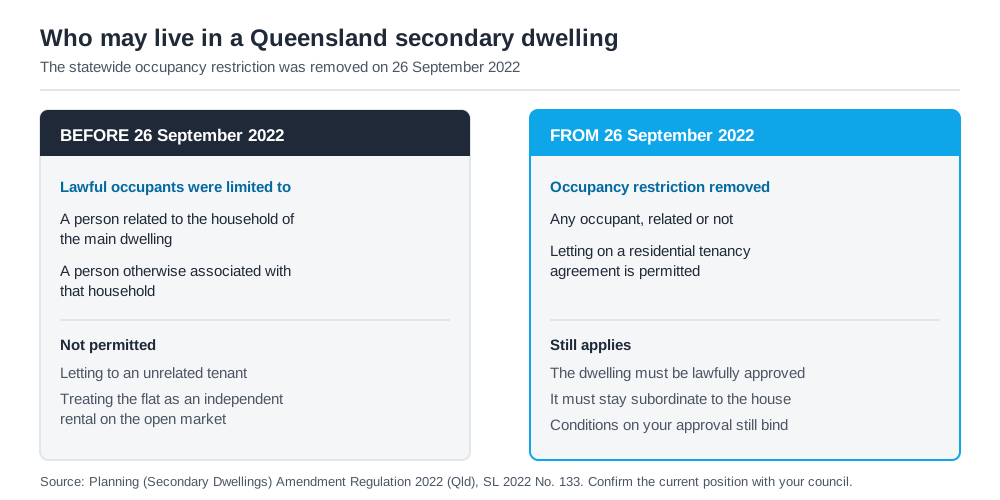
Figure 1: Who could lawfully occupy a Queensland secondary dwelling, before and after 26 September 2022.
No later amendment reinstating the old restriction was found at the time of writing, so treat the change as current. Because councils implement the State framework through their own planning schemes and update them at different times, it is still worth confirming the current position with your council before you sign a tenancy.
Does renting it out change the planning classification?
Spend 5 minutes, not 3 weeks
instantDA generates a council-ready planning report for Queensland development applications. No town planner. No waiting.
Get your report →Not by itself, no. The dictionary in Schedule 2 of the Planning Act 2016 defines a material change of use as starting a new use, re-establishing an abandoned use, or materially increasing the intensity or scale of a use. Putting a paying tenant in a lawfully approved secondary dwelling does not, on its own, do any of those things. The use is residential before and after.
What can change the classification is the character of the building, not the tenancy. A secondary dwelling has to remain subordinate to the primary dwelling — smaller, ancillary, used in conjunction with the main house, sharing the lot and usually the address and services. If it stops being subordinate, it stops being a secondary dwelling and starts looking like a dual occupancy: a different, generally code assessable form of development with higher infrastructure charges and stricter parking and access standards.
Enclosing the yard to give the flat its own private curtilage, extending it, adding a second driveway crossover, or splitting the services so the two dwellings function as independent households are the moves that attract attention. Where the line sits is explained in secondary dwelling versus dual occupancy.
Read your own approval before you advertise
This is the qualification most often missed. The 2022 change removed a statewide restriction. It did not sweep away conditions attached to individual development approvals granted before it.
If your granny flat was approved through a development application, the decision notice may carry its own conditions — including, on some older approvals, an express occupancy condition limiting who may live there. A condition on a live approval binds the land, and is not overridden by the fact the general restriction has gone. Read the conditions, and if there is an occupancy condition, ask your council whether it still stands or whether a change application is needed to remove it.
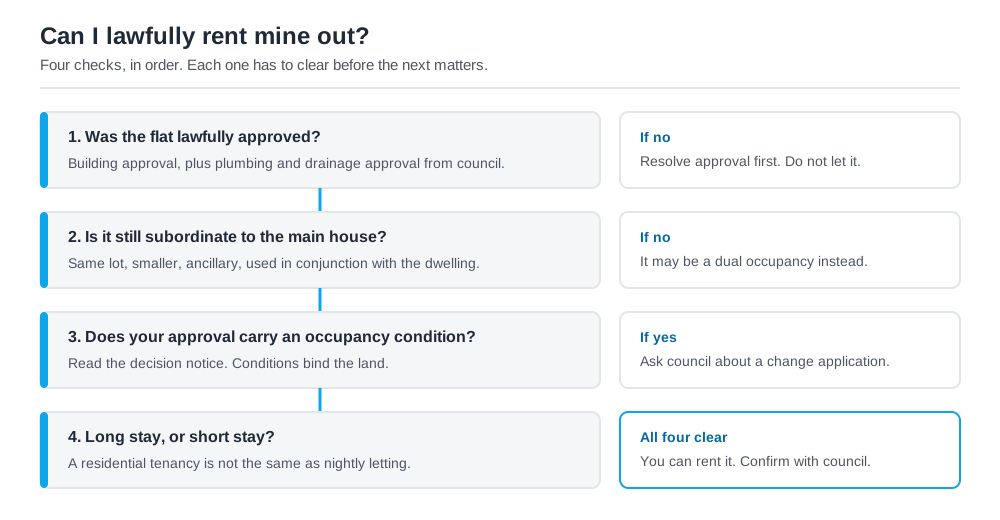
Figure 2: Working out whether your secondary dwelling can lawfully be rented.
It has to have been lawfully approved in the first place
A secondary dwelling needs building approval under the Building Act 1975, usually from a private building certifier, and generally a plumbing and drainage approval from council — even where the planning side is accepted development and no development application was required. Plenty of Queensland granny flats were built as sheds or studios and quietly fitted with a kitchen later.
Renting one of those out raises the stakes. You have an unapproved habitable building, occupied, generating income, and visible to a tenant who may complain, an insurer who may decline a claim, and eventually a buyer's solicitor doing searches. Unapproved building work surfaces on sale and is a routine deal-breaker. If you are in that position, what to do about a granny flat with no approval sets out the options before you put anyone in it.
Long-term tenancy is not the same as short-stay letting
Renting the flat to a tenant under a residential tenancy agreement is one thing. Listing it for nightly or weekly stays is a different question with a different answer, and it is answered locally rather than by the 2022 regulation.
Short-stay accommodation is treated by many Queensland councils as its own defined use, and it can require a material change of use approval, sit under a local law, or attract registration and a differential rating category. Some councils are permissive, some are not. Do not read the statewide occupancy change as permission to run a short-let — the rules for that are set out separately in short-stay accommodation in Queensland.
Body corporate by-laws are a separate legal issue
If your lot sits in a community titles scheme, the body corporate's by-laws operate alongside the planning scheme, not underneath it. By-laws can restrict letting arrangements, occupant numbers, parking allocation and the use of common property. A body corporate cannot grant you planning approval, and a council approval does not override a by-law. If you are in a scheme, check both before committing.
The practical side: metering, parking and one title
Three things follow from putting a tenant in rather than a relative.
- ✓Separate metering — most secondary dwellings share a single water and electricity connection with the main house, so decide how utilities will be apportioned and record it in the tenancy agreement before the first bill arrives
- ✓Parking — schemes commonly require a space for the secondary dwelling, and an unrelated tenant will actually use it; on-street overflow is the most common source of neighbour complaints
- ✓One lot, one title, one rates notice — a secondary dwelling cannot be separately titled, so the flat cannot be sold off, separately mortgaged or separately rated
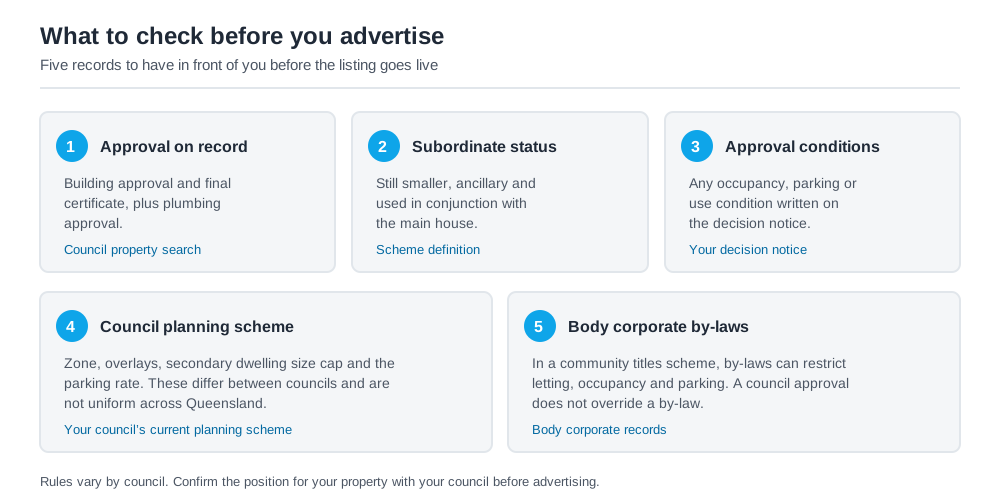
Figure 3: The five checks to clear before you advertise.
The State's code for a dwelling house that is a secondary dwelling is a useful starting point for design and siting expectations, though your council's scheme governs your lot. Queensland schemes follow the Queensland Planning Provisions structure, but each council layers its own codes and overlays on top — they are not uniform, and size caps, setbacks and parking rates differ meaningfully between them.
If you would rather see the zone, the overlays and the likely level of assessment for your actual address, an instantDA planning report sets that out for $169, against the $800–$1,500 a town planner typically charges for a preliminary opinion. You can start a report in a few minutes.
The unapproved granny flat problem
The 2022 change has an awkward side effect: it made renting attractive to a group of owners whose granny flats were never approved in the first place.
An unapproved secondary dwelling doesn't become lawful because the occupancy rules relaxed. It remains unapproved building work, or an unlawful use, or both — enforceable by council, problematic for insurance, and a disclosed or discoverable issue when you sell. Putting a paying tenant in it increases the chances of it coming to council's attention rather than reducing them.
If that describes your situation, the route is retrospective approval rather than quiet renting. Granny flats without approval in QLD sets out where that sits.
Older approvals are worth checking for a related reason. Some secondary dwellings approved before the change carry conditions written when the occupancy restriction still applied — a condition requiring occupation by a member of the household of the primary dwelling, for instance. A condition on an approval is enforceable in its own right, independently of the regulation that prompted it, so if such a condition is on your approval it may need to be changed rather than simply treated as superseded. Read the decision notice rather than assuming.
Frequently asked questions
Can I rent my granny flat to a stranger in Queensland?
Does renting out a granny flat need a new development application?
Can a granny flat have its own address and meters?
Can I sell the granny flat separately?
What if my approval says only family can live there?
Does the body corporate have to agree?
Ready to generate your report?
Skip the writing. Get a council-ready planning report in 5 minutes.
Get your report