Key takeaways
- ✓A secondary dwelling always needs building approval. Whether it also needs a development approval depends on your council's scheme.
- ✓Since 26 September 2022 a lawful secondary dwelling in Queensland can be rented to anyone. That change did not make unapproved ones lawful.
- ✓Buyers' solicitors order building records searches. An unapproved granny flat is one of the most reliably discovered problems in Queensland conveyancing.
- ✓Advertising unapproved space as a self-contained dwelling is where sellers create genuine legal exposure.
- ✓Fire separation, sewerage capacity, setbacks and car parking are what usually block retrospective approval.
Selling a Home With an Unapproved Granny Flat in QLD
You'll usually hear this called a development application, or DA — that's the formal name for council approval under the Planning Act 2016. Secondary dwellings are the structure most likely to have been built without one in Queensland, because they so often started as something else: a shed with a bathroom added, a garage converted, an under-house area that quietly gained a kitchen.
Get a council-ready planning report in 5 minutes — no planner, no waiting.
Get your report →The short answer
A secondary dwelling always needs building approval, and often a material change of use approval as well. If yours has neither, it is unlawful work, buyers' searches will find it, and advertising it as a self-contained dwelling is where sellers create real exposure. Fix it, disclose carefully, or price it out.
What a secondary dwelling actually needs
Two approvals, answering two different questions.
Building approval is required for the building work, without exception. Residential building work is assessable building work under the Building Act 1975 unless a regulation makes it accepted, and a habitable secondary dwelling never falls into that gap. This covers structure, fire separation, smoke alarms, egress and sound transmission. Plumbing and drainage work needs its own approval again under the Plumbing and Drainage Act 2018.
Development approval — a material change of use — depends entirely on your council's planning scheme. Many Queensland schemes treat a compliant secondary dwelling as accepted development, meaning no DA is needed provided it satisfies stated requirements. Those requirements typically cover the zone, a maximum gross floor area, siting behind or close to the primary dwelling, setbacks, car parking, and that the secondary dwelling remains subordinate to the main one. Fail any of them and it becomes assessable development, and in some cases the use is reclassified as a dual occupancy, which is a different and often harder proposition.
Schemes are not uniform across Queensland, so the thresholds in a neighbouring council's fact sheet are not your thresholds. Granny flat rules in QLD covers the common requirements in more detail.
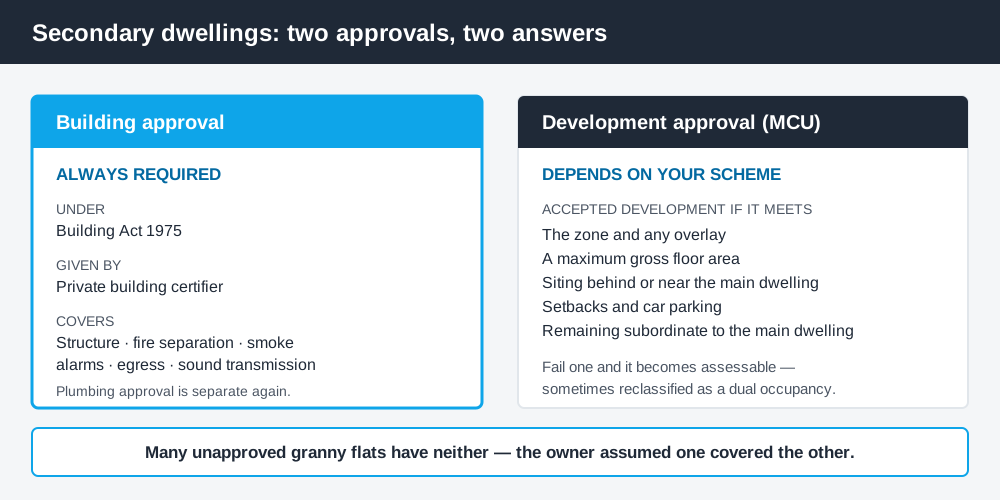
Figure 1: One is always required. The other depends on your scheme.
The 2022 change, and what it did not do
Spend 5 minutes, not 3 weeks
instantDA generates a council-ready planning report for Queensland development applications. No town planner. No waiting.
Get your report →On 26 September 2022 the Planning Regulation 2017 was amended to remove restrictions on who may live in a secondary dwelling in Queensland. Before that change, many schemes effectively limited occupation to a member of the household. Afterwards, a lawful secondary dwelling may be rented to anyone, and the relationship between occupants is not a matter for planning assessment.
This is genuinely useful, and it is widely misunderstood. It changed who may occupy a lawful secondary dwelling. It did not change whether you need approval to build one, and it did not retrospectively legitimise anything. Queensland Government's own guidance on the changes to secondary dwellings is explicit that development and building approvals are still required.
There is a second-order trap here. Moving a secondary dwelling from family occupation to tenanted use can itself trigger additional Building Code requirements for fire separation and sound transmission. If an old development approval carries an occupancy condition, removing it needs a change application, not just a new tenant.
How buyers find it
Almost every time, the same way. The buyer's solicitor orders a council building records search and copies of the approved plans. The approvals list a dwelling house and a detached garage. The property has a dwelling house and a one-bedroom flat with a kitchen. The gap is obvious on the first read.
Queensland's seller disclosure scheme, in force since 1 August 2025 under the Property Law Act 2023, does not close this for you in either direction. The disclosure statement and prescribed certificates cover title, encumbrances, zoning, certain registers and specified notices — but Queensland Government guidance confirms the statement does not require disclosure of previous building or development approvals. So there is no box that outs you, and equally no box that protects you from a buyer who searches and finds a problem you marketed around.
Where sellers get into trouble is not silence. It is the listing. Describing unapproved space as a "self-contained granny flat", quoting a rental return on it, or presenting it as dual living is a representation about the lawful use of the property. If that representation is wrong, misleading conduct and contract remedies both come into play, and an inability to obtain retrospective approval can be a substantial enough breach to give a buyer the right to walk.
- ✓Order your own building records search before you list
- ✓Compare the approvals against what is physically there
- ✓Get a certifier's view on whether it can be certified
- ✓Get a planning view on whether the use can be approved
- ✓Then decide what the listing says
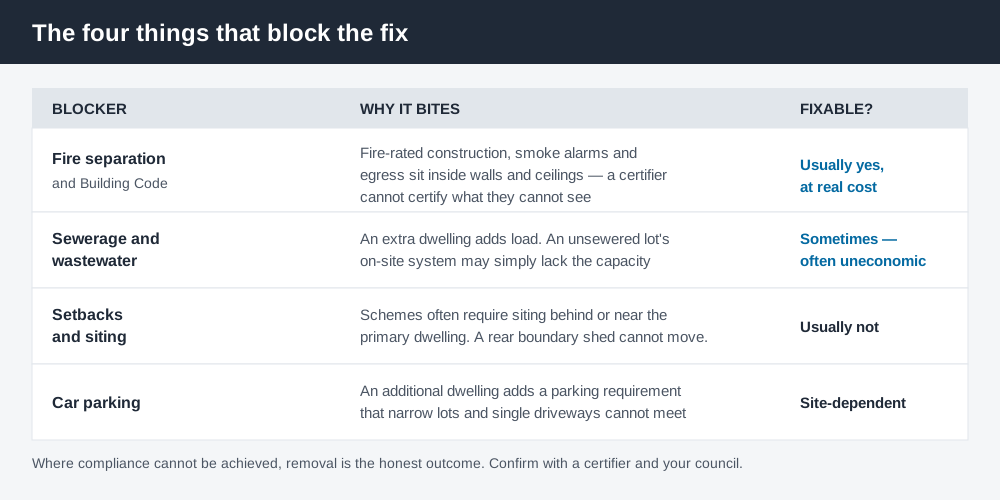
Figure 2: What actually stops these being made lawful.
What usually blocks the fix
Retrospective approval of a secondary dwelling is genuinely available, but it is harder than for a shed or a deck because the standards are higher and the evidence is buried.
Fire separation and Building Code compliance. A secondary dwelling occupied separately attracts requirements for fire-rated construction, smoke alarms and egress. Those elements are inside walls and ceilings. A certifier cannot certify what they cannot see, so expect surfaces to be opened up.
Sewerage and on-site wastewater. An additional dwelling adds load. On an unsewered lot, the existing on-site system may simply lack the capacity, and upgrading it can cost more than the flat is worth.
Setbacks and siting. Many schemes require a secondary dwelling to sit behind the primary dwelling, or within a set distance of it. A converted rear shed on a back boundary can fail this permanently, because you cannot move it into compliance.
Car parking. Adding a dwelling adds a parking requirement. Narrow lots and single driveways often cannot accommodate it.
Where the structure cannot be brought into compliance, the honest outcome is removal. Retrospective building approval in QLD sets out the process and what it realistically costs.
Your options before listing
Regularise it. Engage a certifier and, if a change of use is needed, a planner. This takes months rather than weeks and runs on the council's timetable, so start well before you want to be on the market.
Sell it as what it is. Advertise the improvement honestly — "studio", "rumpus", "storage", with no claim of lawful separate occupation — price accordingly, and let the buyer's searches confirm what you have already said. This is slower and cheaper than the alternative and it removes the misrepresentation risk entirely.
Remove it. Rare, but if the structure is unsalvageable and is actively deterring buyers or lenders, it can be the cleanest answer.
Before you choose, you need to know whether the use could be approved at all — which turns on the zone, the overlays and the secondary dwelling requirements in your council's scheme. If you'd rather read that for your address in one document than work through a planning scheme yourself, an instantDA planning report does it for $169, against the $800–$1,500 a town planner typically charges for a preliminary opinion. You can start a report in a few minutes.
Check your council's scheme maps and use Queensland Globe for lot and plan details. And take your own legal advice on the listing wording — that is the part of this that carries the real risk, and a Queensland property lawyer will cost far less than a rescinded contract.
Frequently asked questions
Can I sell a house with an unapproved granny flat in Queensland?
Do I have to tell the buyer the granny flat is unapproved?
Does a granny flat need council approval in Queensland?
Can I rent out a granny flat in Queensland?
Will an unapproved granny flat affect the sale price?
Can an unapproved secondary dwelling get retrospective approval?
Ready to generate your report?
Skip the writing. Get a council-ready planning report in 5 minutes.
Get your report