Key takeaways
- ✓Two separate rulebooks apply: your council's planning scheme, and the council's local laws, permits and registration. You can be compliant on one and not the other.
- ✓Queensland schemes generally treat short-term accommodation as a use in its own right, distinct from a dwelling house — so whole-house letting can be a material change of use.
- ✓Whether a development application is needed depends on the zone, how the scheme defines and categorises the use, and how intensively you let.
- ✓Letting a room while you live there is a different proposition from letting the whole house year-round, and schemes look at intensity and character.
- ✓For units and townhouses, body corporate by-laws are a third, separate layer on top of both rulebooks.
Airbnb in QLD — Do You Need Council Approval?
You'll usually hear this called a development application, or DA — that's the formal name for council approval in Queensland. But Airbnb is the topic where that framing is only half the story, because short-stay letting is regulated by two separate systems running alongside each other. Owners get caught out because they research one, find they're fine, and never discover the other.
Get a council-ready planning report in 5 minutes — no planner, no waiting.
Get your report →The short answer
It depends, and two separate rulebooks apply. Under your council's planning scheme, letting a whole house short-stay can be a material change of use needing a development application — depending on the zone, the use definition and how intensively you let. Separately, local laws, permits and registration may apply.
Neither rulebook substitutes for the other. Clearing the planning question does not clear the local law question, and holding a local law permit does not make an unlawful use lawful.
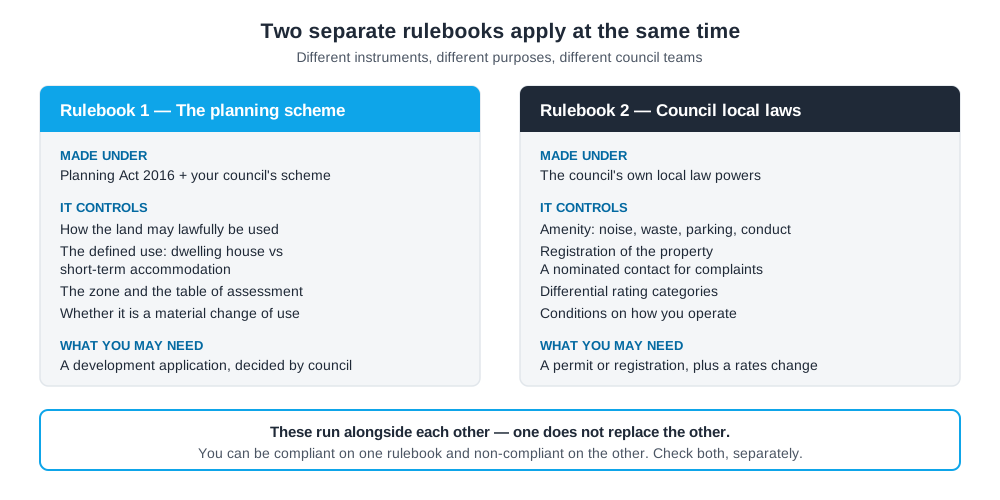
Figure 1: The two rulebooks that govern short-stay letting, and what each one controls.
Rulebook one: the planning scheme and the use definition
Queensland planning schemes are built on defined uses. A dwelling house is one defined use. Short-term accommodation is generally a separate defined use in its own right — premises used to provide accommodation to guests for short periods. The two are not interchangeable, and that is the crux of the question.
The dictionary in Schedule 2 of the Planning Act 2016 defines a material change of use of premises as the start of a new use, the re-establishment of a use that has been abandoned, or a material increase in the intensity or scale of the use. If letting your whole house short-stay amounts to starting the short-term accommodation use on premises approved as a dwelling house, that can be a material change of use — and a material change of use needs a development approval unless the scheme categorises it as accepted development.
Note the wording: can be, not is. Three things decide it. First, the zone — some schemes anticipate short-term accommodation in tourist, centre or mixed-use zones and treat it as inconsistent in low density residential. Second, how the scheme defines and categorises the use in its tables of assessment. Third, how intensively you let. If you're new to how the categories work, accepted versus assessable development explains what each one requires of you, and material change of use in Queensland covers when a change in how you use a building crosses the line.
Queensland's schemes follow the Queensland Planning Provisions structure, but each council layers its own use definitions, codes and overlays on top. They are not uniform. Confirm the definition and the category in your own scheme.
Rulebook two: local laws, permits and registration
Spend 5 minutes, not 3 weeks
instantDA generates a council-ready planning report for Queensland development applications. No town planner. No waiting.
Get your report →Separately from the planning scheme, councils are increasingly regulating short-stay accommodation through local laws, permits, registration schemes and differential rating. This is a genuinely different legal instrument with a different purpose — managing amenity, noise, waste, parking and complaints — and it sits alongside the planning scheme rather than replacing it.
Differential rating is the quietest of these. A council can adopt a separate rating category for properties used predominantly for short-stay accommodation, which changes what you pay without changing whether you're allowed to operate. Registration and permit schemes are more visible: they can require you to identify the property, nominate a contact who responds to complaints, and meet conditions about guest conduct.
Brisbane City Council has applied a rates differential for properties used predominantly for short-stay accommodation, and in 2025 published a Short Stay Accommodation Local Law 2025 introducing a permit requirement. Brisbane has moved to a permit-based local law — but commencement and current operation could not be confirmed, so check the current position with council before you list. Coastal and tourism councils have generally been the most active in this space; some publish a dedicated page, such as Redland City Council's short-term accommodation and Airbnb guidance. Your own council's position is the one that governs.
Letting a room versus letting the whole house
These are not the same proposition, and schemes tend to treat intensity and character as what matters.
Letting a room or two while you live in the house keeps the residential use dominant. The house is still occupied as a dwelling house; guests are incidental to that. Many schemes accommodate this — sometimes within the dwelling house use, sometimes through a bed and breakfast or home hosted accommodation definition with its own limits.
Letting the whole house, with no resident owner, year-round, to a rotating series of guests is a different thing. There is no residential occupation left to be dominant. That is the scenario most likely to be characterised as the short-term accommodation use, and most likely to need a development application.
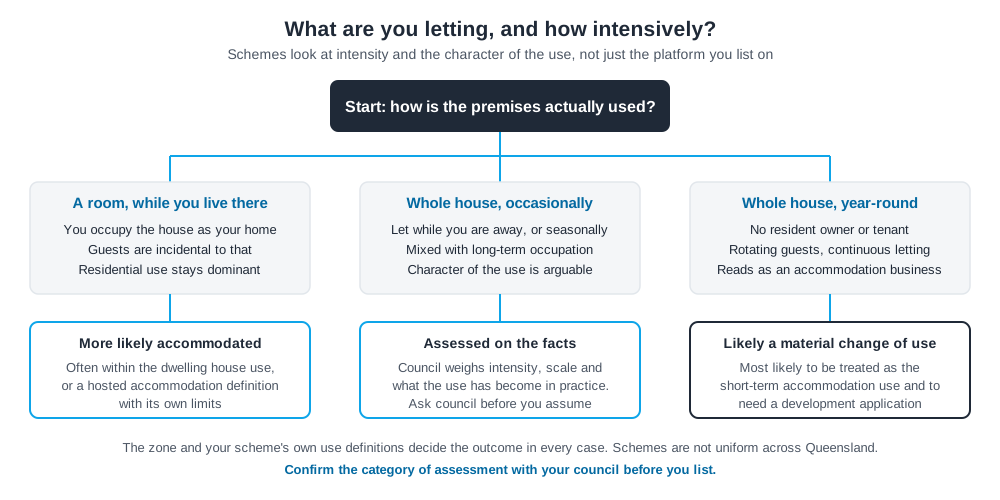
Figure 2: How what you let, and how intensively, shapes the planning answer.
Between those poles sits a grey middle — occasional letting while you're away, seasonal letting, a mix of long and short tenancies. Councils assess these on the facts. The more the pattern looks like a commercial accommodation business and the less it looks like a home, the more likely a development application is the answer.
Short-stay letting from a granny flat
A secondary dwelling is a self-contained dwelling on the same lot as, used in conjunction with but subordinate to, the primary dwelling. That word subordinate is doing real work. Letting a secondary dwelling short-stay raises the extra question of whether it stays subordinate to the house, or starts to read as an independent accommodation operation on the lot.
Losing subordinate status is what tips a secondary dwelling into a different use classification entirely, with different assessment and different requirements. If you're weighing this up, renting out a granny flat in Queensland sets out what councils look at when they test whether a secondary dwelling is still genuinely secondary.
Units and townhouses: the body corporate layer
If your property is in a community titles scheme, there is a third, separate layer. Body corporate by-laws can regulate conduct and management within the scheme — noise, common property, keys and access, parking. Generally they cannot prohibit an otherwise lawful use outright, but the boundary between regulating conduct and prohibiting a use is contested and fact-specific. Get your own advice on your scheme's by-laws.
The order to make your checks
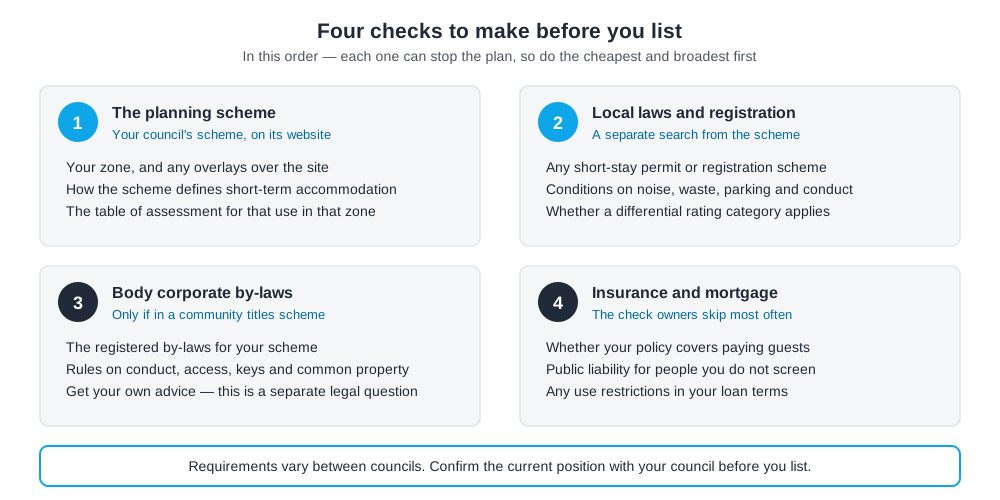
Figure 3: The four checks, in the order that saves you the most time.
Work in this sequence. First, your zone and the short-term accommodation use definition in your council's planning scheme, and what the tables of assessment say for that use in that zone. Second, the council's local laws and registration page — a separate search from the planning scheme. Third, your body corporate, if the property is in a community titles scheme. Fourth, your insurer and any mortgage terms; a standard landlord or owner-occupier policy may not cover paying guests.
If you'd rather have the zone, the overlays and the likely category of assessment worked through against your actual address, an instantDA planning report does exactly that for $169 — against the $800–$1,500 a town planner typically charges for a preliminary opinion. You can start a report in a few minutes.
Whichever way it lands, get the answer before the listing goes live. Retrofitting an approval to an operating business is always the expensive version.
- ✓Zone and short-term accommodation definition in your planning scheme
- ✓Table of assessment for that use in that zone
- ✓Council local laws, permit and registration requirements
- ✓Body corporate by-laws if in a community titles scheme
- ✓Insurance and mortgage terms
If you are already letting
This is extremely common. A property lists for two years, then a complaint or a rates reclassification surfaces the fact that the use was never approved. The use is unlawful and council can take enforcement action.
It is usually fixable. An application can be made for a use that has already started, and councils deal with these regularly. What you lose is leverage — you are now applying with a show cause notice in hand rather than at your own pace. Retrospective approval in QLD covers how that process works.
Frequently asked questions
Do I need council approval to list my house on Airbnb in Queensland?
Is renting a spare room the same as renting the whole house?
Do council local laws replace the planning scheme?
What has Brisbane City Council done about short-stay accommodation?
Can my body corporate stop me from doing short-stay letting?
What happens if I let short-stay without the approval I needed?
Ready to generate your report?
Skip the writing. Get a council-ready planning report in 5 minutes.
Get your report