Key takeaways
- ✓Emerging community is a holding zone. Council has identified the land for urban development at some future point, not now.
- ✓The zone's core job is preventing premature and out-of-sequence development that would fragment land before proper structure planning.
- ✓Interim uses are usually possible if they are low-intensity and do not prejudice the eventual urban outcome.
- ✓Many councils use precincts within the zone to signal how close the land is to being developable. Moreton Bay's Interim and Transition precincts are the clearest example.
- ✓Subdividing here is often the hardest thing to achieve, because creating small lots is the exact outcome the zone exists to defer.
Emerging Community Zone Explained
You'll usually hear this called a development application, or DA — that's the formal name for council approval under the Planning Act 2016. If your land sits in the Emerging community zone, the DA question you are really asking is one of timing, not permission: council has already decided this land will be urban one day, and most of the assessment turns on whether that day is now.
That is a genuinely different position from being in a rural zone or a residential zone. It is neither a green light nor a refusal. It is a queue.
Get a council-ready planning report in 5 minutes — no planner, no waiting.
Get your report →The short answer
The Emerging community zone identifies land intended for urban development in the future, and protects it from uses that would compromise that outcome. Development that runs ahead of infrastructure and structure planning is generally treated as premature. Interim low-intensity uses are usually acceptable if they do not prejudice the eventual urban form.
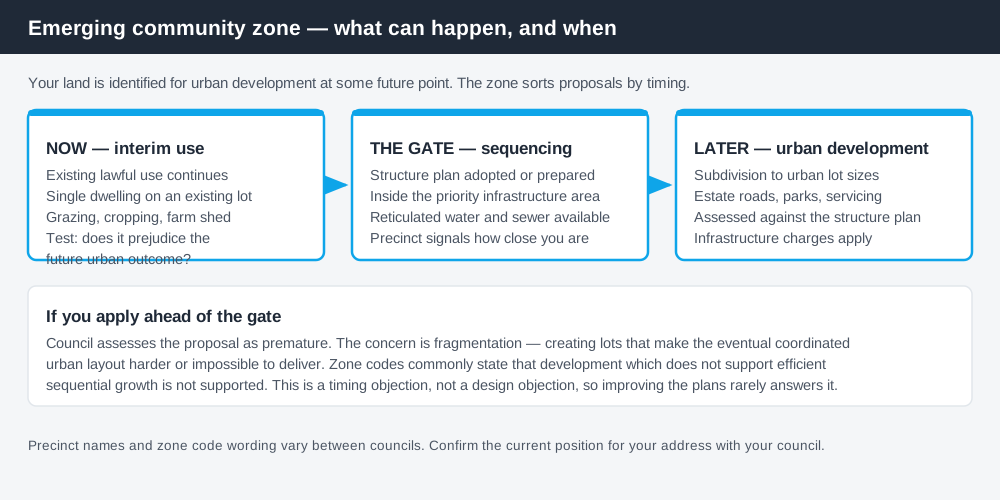
Figure 1: The zone sorts proposals by timing before it sorts them by merit.
What the zone is actually for
Emerging community is one of the zones available to Queensland councils under Schedule 2 of the Planning Regulation 2017, which sets out the zones a local planning instrument may use and a purpose statement for each. Councils cannot invent their own zone names; they draw from that list and then write their own zone code around it.
Across the schemes that use it, the purpose language is consistent. The zone exists to identify land intended for an urban purpose in the future, to protect that land from incompatible uses in the meantime, and to manage the timely, orderly and sequential conversion of non-urban land to urban land as infrastructure is delivered.
Read that last part carefully, because it is where applications succeed or fail. The zone is not primarily about what you build. It is about when, and about whether the pattern of development you create makes the eventual urban layout easier or harder to deliver.
Premature and out-of-sequence development
Spend 5 minutes, not 3 weeks
instantDA generates a council-ready planning report for Queensland development applications. No town planner. No waiting.
Get your report →The two phrases you will meet in an Emerging community zone code are premature and fragmentation, and they mean specific things.
Premature development is development that arrives before the infrastructure and planning framework that would make it work — before reticulated water and sewer, before the road network, before a structure plan settles where the collector roads and open space will go.
Fragmentation is the more permanent problem. Creating a scatter of medium-sized lots across land earmarked for a future suburb can make coordinated development effectively impossible later, because assembling those lots back together is expensive and often just does not happen. Councils are blunt about this. Lockyer Valley's scheme, for instance, states that development creating lots that does not support efficient sequential growth is considered premature and not supported.
That is why a proposal that would be unremarkable in a general residential zone can be refused here on grounds that have nothing to do with its design.
Precincts tell you where you are in the queue
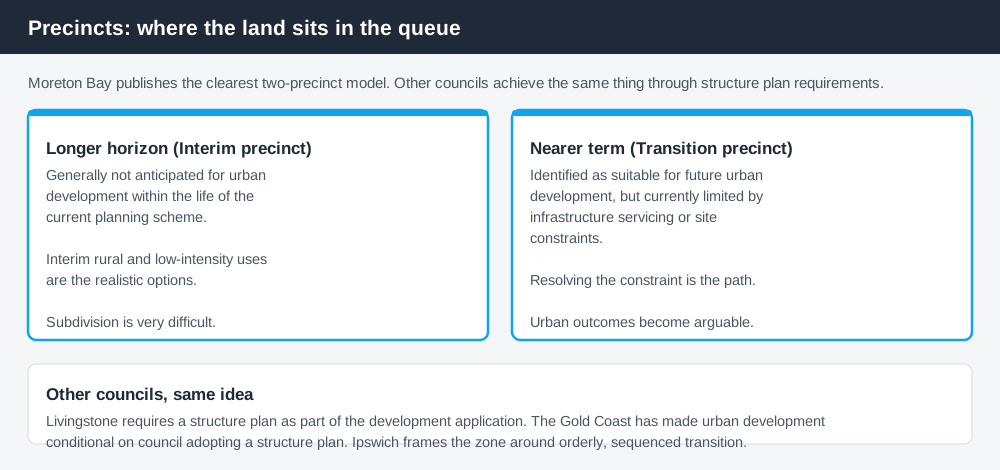
Figure 2: Precinct names differ between councils — confirm yours in the current scheme.
Several councils divide the zone into precincts, and the precinct is usually more informative than the zone itself.
Moreton Bay is the clearest published example, with an Interim precinct and a Transition precinct. Transition precinct land is identified as suitable for future urban development but currently constrained by infrastructure servicing limitations or site constraints — in other words, close, pending resolution of a known problem. Interim precinct land is generally not anticipated for urban development within the life of the planning scheme, which is a much longer horizon.
Other councils achieve the same thing with different tools. Livingstone's zone code requires a structure plan to be prepared and submitted as part of a development application. The Gold Coast has historically made urban development in its equivalent area conditional on council adopting a structure plan for the neighbourhood. Ipswich frames its zone around orderly, sequenced transition in accordance with detailed structure planning.
Because the precinct changes the realistic answer so much, take it from the council's own property report or planning scheme mapping rather than from any general list, including this one. How to find out what zone your property is in walks through where to get that mapping for any Queensland address.
- ✓Which precinct applies to the site?
- ✓Is there an adopted structure plan or local plan covering it?
- ✓Is the land inside the priority infrastructure area?
- ✓Is reticulated water and sewer available at the boundary?
- ✓What does the zone code say about interim uses?
What you can usually do in the meantime
The picture is less bleak than the word "premature" suggests, because most zone codes explicitly contemplate interim uses.
Continuing an existing lawful use is normally fine. A single house on an existing lot is commonly achievable. Low-intensity rural and rural-adjacent activities — grazing, cropping, a farm shed — are the classic interim uses, and several schemes say so directly, on the condition that the use is compatible with a semi-rural character and does not prejudice or delay future urban development of the site or its neighbours.
What that condition rules out is the permanent-feeling investment: substantial buildings sited across the middle of a future road corridor, uses that establish an amenity expectation that later urban development would breach, and anything that makes the land harder to redevelop.
Subdivision is the hard one
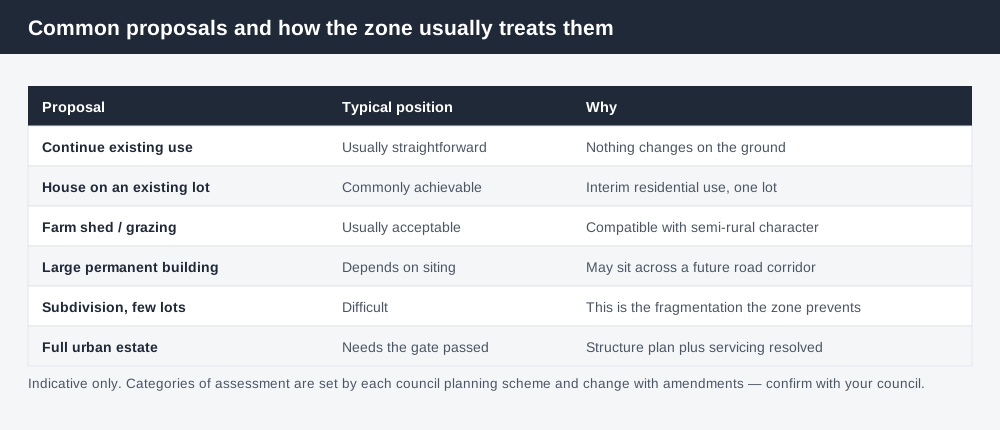
Figure 3: Indicative positions only — categories of assessment come from your council's scheme.
Reconfiguring a lot in the Emerging community zone is where most owners hit the wall, and it is worth being direct about why.
Subdivision is the mechanism that produces fragmentation, which is the specific harm the zone is designed to prevent. So an application to create a handful of lots ahead of the structure planning is running straight into the zone's purpose. It is usually impact assessable, it is assessed against the sequencing provisions, and unless it is consistent with an adopted structure plan and the infrastructure position, it is a difficult application.
Where subdivision does succeed, it is generally because the land is in the more advanced precinct, a structure plan exists or has been prepared to council's satisfaction, and servicing has been resolved — sometimes at the developer's cost. Subdividing land in Queensland covers the reconfiguring a lot process itself, and infrastructure charges covers the contribution side, which in emerging community areas can be a decisive number rather than a line item.
Before you buy Emerging community land
The zone is frequently bought as a speculative play — land priced as rural, expected to become urban. Sometimes that works very well. The risk is that the timing is entirely outside your control and can be measured in decades.
Establish the precinct, whether the land is within the priority infrastructure area, whether a structure plan exists, and what the council's published growth sequencing says about the area. Then ask the duty planner what they would expect for the specific thing you intend to do. Cross-check the site on the Queensland Globe for state layers such as vegetation and flooding, because constraints on future urban land are one of the reasons it stays future urban.
What to do next
Confirm the zone, the precinct and any structure plan for the address, then decide whether your proposal is an interim use or an urban one. The answer determines everything else.
If you'd rather see the zone, the precinct, the overlays and the likely category of assessment for an address than read a planning scheme, an instantDA planning report does that for $169 — against the $800–$1,500 a town planner typically charges for a preliminary opinion. You can start a report in a few minutes.
Then confirm with your council. Sequencing decisions are strategic and change with each scheme amendment, so a current council position is worth more than any general rule. The Rural residential zone explained covers the zone that emerging community land is often mistaken for, and which behaves quite differently.
Frequently asked questions
What does Emerging community zone mean in Queensland?
Can I build a house on Emerging community zoned land?
Can I subdivide land in the Emerging community zone?
What is premature development?
How long does land stay in the Emerging community zone?
Is Emerging community the same as rural residential?
Ready to generate your report?
Skip the writing. Get a council-ready planning report in 5 minutes.
Get your report