Key takeaways
- ✓Agritourism is not a defined land use in the Planning Regulation 2017. Your venture gets classified under existing uses.
- ✓A farm stay usually lands in short-term accommodation or tourist park. A farm gate stall usually lands in roadside stall.
- ✓The state has issued guidance encouraging councils to make low-impact agritourism accepted subject to requirements in the Rural zone.
- ✓Whether you need an application therefore depends on whether your council has actually amended its scheme.
- ✓Food licensing, local law accommodation approvals and building fire safety all sit outside planning and apply separately.
Farm Stays and Agritourism Approvals in QLD
You'll usually hear this called a development application, or DA — that's the formal name for council approval under the Planning Act 2016. If you are planning a farm stay, a cellar door, a farm gate stall or an on-farm experience, the first thing to understand is that the word "agritourism" will not appear anywhere useful in the rules.
Queensland deliberately did not create an agritourism land use. Instead your venture is broken into the existing defined uses it is made of, and each of those is assessed on its own terms in the Rural zone.
Get a council-ready planning report in 5 minutes — no planner, no waiting.
Get your report →The short answer
Agritourism is not a defined land use under the Planning Regulation 2017. A farm stay is usually assessed as short-term accommodation or a tourist park, farm gate sales as a roadside stall, and on-farm experiences as nature-based tourism. Whether you need an application depends on your council's table of assessment.
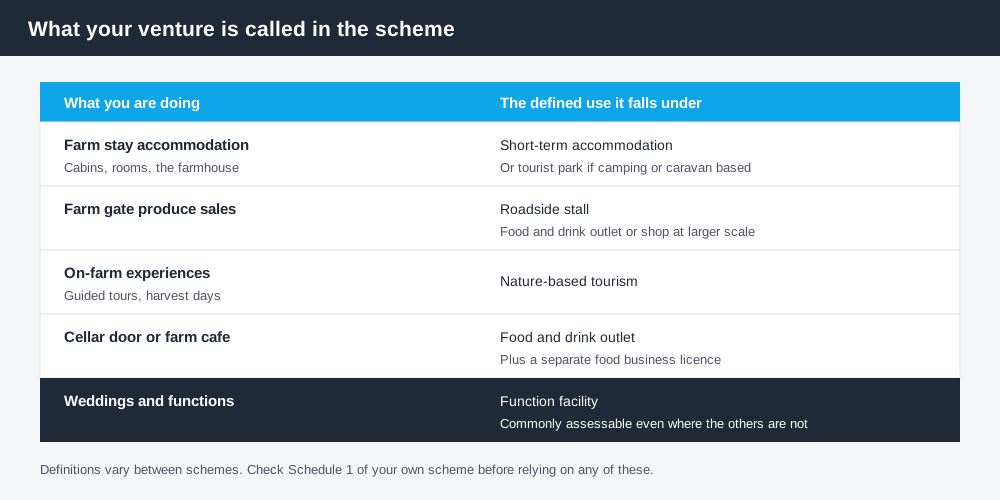
Figure 1: Break the venture into its parts. Each part has its own row in the table of assessment.
What the reforms actually did
There is a persistent belief that Queensland made agritourism accepted development on rural land. It did not.
What the state produced was guidance: Supporting agritourism through Local Government planning schemes — Guidance for local government, published by the state planning department. That document says explicitly that agritourism is not a defined land use term under the Planning Regulation 2017, and that it should be facilitated through existing use definitions rather than a new one.
The guidance encourages councils to amend their schemes to clarify agritourism-related definitions and to make low-impact ventures accepted subject to requirements or code assessable in the Rural zone, using a tourism uses code to set the benchmarks. It points councils at the streamlined amendment process under the Planning Act 2016 to do it quickly.
The practical consequence is that the answer depends on your council. A council that has taken up the guidance may let you run a small farm stay without an application. A council that has not will still require a material change of use.
Which uses your venture falls under
Spend 5 minutes, not 3 weeks
instantDA generates a council-ready planning report for Queensland development applications. No town planner. No waiting.
Get your report →The guidance identifies the uses agritourism typically involves: tourist accommodation, nature-based tourism, short-term accommodation, food and drink outlet and roadside stall, with tourist park where there is a camping or caravan element.
Mapping the common ventures:
Farm stay accommodation — cabins, rooms or a farmhouse let to visitors — is almost always short-term accommodation, or tourist park if it is camping or caravan-based.
Farm gate sales — produce sold from the property — usually falls under roadside stall, sometimes food and drink outlet or shop depending on scale and what is sold.
On-farm experiences — guided tours, harvest days, animal encounters — usually sit under nature-based tourism.
Cellar doors and farm cafés are food and drink outlets, and carry a food licensing layer as well.
Weddings and functions are the outlier. A function facility brings traffic, noise, hours and intensity issues, and is commonly assessable in the Rural zone even where other agritourism uses are not. Do not assume the farm stay pathway covers events.
- ✓What defined uses does the venture actually involve?
- ✓What does the table of assessment say for each, in the Rural zone?
- ✓Has this council amended its scheme for agritourism?
- ✓Are there thresholds you must stay under?
- ✓Does a state interest such as a state-controlled road or vegetation clearing trigger state assessment?
Do you need an application?
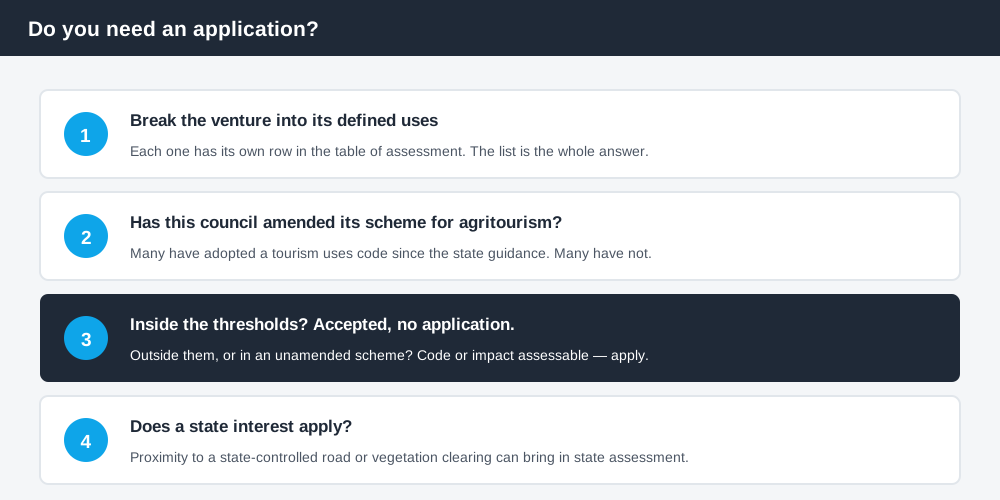
Figure 2: Same venture, different council, different answer.
In a scheme that has adopted the guidance model, uses such as nature-based tourism, roadside stall, short-term accommodation and tourist park can be accepted subject to requirements in the Rural zone. If your venture meets the thresholds and the requirements in the nominated code, no material change of use application is needed.
Exceed the thresholds, or operate in a scheme that has not been amended, and you are into code assessable or impact assessable territory and an application is required. Accepted versus assessable development in QLD explains what each of those means for cost, timing and public notification.
There is also a state layer. Some agritourism development triggers assessment by the State Assessment and Referral Agency where a state interest is engaged under the Planning Regulation 2017 — proximity to a state-controlled road being the most common on farms, along with native vegetation clearing.
Starting the use without approval where one is needed is a material change of use without approval, which is enforceable. Material change of use in QLD covers the three limbs of that test, including the intensification limb that catches ventures which grow past what was approved.
What sits outside planning
Getting the planning question right does not finish the job. Three separate regimes apply.
Food. Anything involving preparing or selling food — a cellar door, a farm café, a produce kitchen — brings food business licensing under Queensland's food safety framework, administered through your council. That is a separate application from any planning approval.
Local law accommodation approval. Many councils require an accommodation or short-stay approval under a local law made under the Local Government Act 2009 for guest accommodation, covering management, contact details and guest conduct. Some of the same councils that are enthusiastic about agritourism still require this. Airbnb and short-stay in QLD covers how the local law layer works.
Building and fire safety. Accommodating paying guests changes the building's classification and brings obligations for smoke alarms, egress, fire and evacuation planning, and in some cases a fire safety management plan. A converted shed or an old shearers' quarters will need work to meet those standards.
What to do next
Write down every distinct activity the venture involves, then look each one up in your council's table of assessment for the Rural zone. That list is the whole answer, and it is a different list for a farm stay than for a farm stay plus a wedding venue.
Check whether your council has amended its scheme for agritourism — many have published tourism uses codes since the state guidance was released, and a scheme amended two years ago may say something quite different from the version you last read.
Check the zone and overlays for your lot on the council's mapping and on the Queensland Globe, and check whether any part of the site is near a state-controlled road. Building on rural land in QLD covers the wider rural constraint picture.
If you'd rather see the zone, the overlays and the likely category of assessment for an address than work through a planning scheme yourself, an instantDA planning report does that for $169 — against the $800–$1,500 a town planner typically charges for a preliminary opinion. You can start a report in a few minutes.
Then confirm with your council. Agritourism is an area councils are actively encouraged to be helpful about, and a duty planner conversation early is often the cheapest hour you will spend on the project.
Frequently asked questions
Is agritourism a defined land use in Queensland?
Does a farm stay need council approval in Queensland?
What use is farm gate produce sales?
Do I need approval to hold weddings on my farm?
Do I need a food licence as well as planning approval?
Could the state assess my application rather than the council?
Ready to generate your report?
Skip the writing. Get a council-ready planning report in 5 minutes.
Get your report