Key takeaways
- ✓A gym is generally an indoor sport and recreation use in Queensland schemes — not a shop and not an office.
- ✓Whether you need approval depends on the tenancy's existing lawful use and the table of assessment for the zone.
- ✓Industrial sheds are cheap floor area, but indoor sport and recreation is often not anticipated in industry zones.
- ✓Acoustics, not parking, is what gets gyms conditioned — dropped weights transmit through party walls.
- ✓24-hour swipe access is common and is frequently the condition councils negotiate hardest.
Opening a Gym in QLD — Council Approval
You'll usually hear this called a development application, or DA — that's the formal name for council approval under the Planning Act 2016. For a gym the question is rarely "will council allow it" and almost always "does my tenancy already allow it, and what will they condition".
The answer turns on one thing most operators never look up: what a gym actually is under the planning scheme.
Get a council-ready planning report in 5 minutes — no planner, no waiting.
Get your report →The short answer
A gym is generally an "indoor sport and recreation" use — premises used for leisure, sport or recreation conducted wholly or mainly indoors. Whether you need a development application depends on the tenancy's existing lawful use and what your council's table of assessment says for that use in that zone.
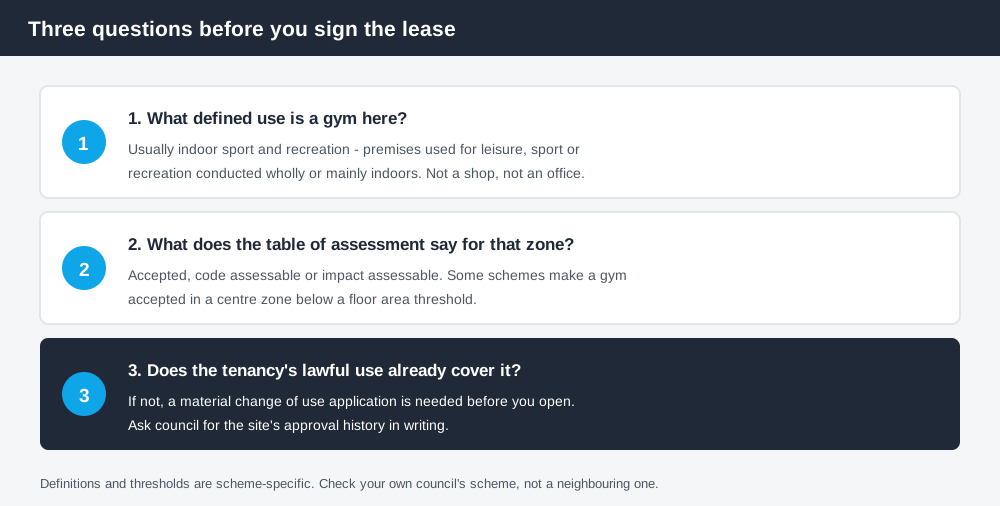
Figure 1: Three questions, in order, before you sign anything.
A gym is not a shop
Queensland planning schemes work from defined uses, and a gym almost never falls under the one people assume. Scheme definitions of indoor sport and recreation typically read along the lines of premises used for leisure, sport or recreation conducted wholly or mainly indoors, with gymnasium listed as an example alongside squash courts and bowling alleys.
That matters because tenancies are approved for a defined use. A shopfront lawfully approved as a shop is not lawfully approved for indoor sport and recreation, and moving between them is the start of a new use — which is a material change of use.
The Planning Act 2016 defines a material change of use as the start of a new use of premises, the re-establishment of a use that had been abandoned, or a material increase in the intensity or scale of a use. Any of those three limbs can catch you. Material change of use in QLD works through the test in full.
When you might not need an application
Spend 5 minutes, not 3 weeks
instantDA generates a council-ready planning report for Queensland development applications. No town planner. No waiting.
Get your report →Sometimes the answer really is nothing. Some councils treat a gym in an existing building in a centre zone as accepted development where there is no increase in gross floor area and the proposal complies fully with the applicable code. Brisbane, for example, publishes guidance that a gym in an existing centre-zone premises can be accepted development where it meets those conditions, and needs a development application otherwise.
Other schemes set floor area thresholds — accepted or code assessable below a stated gross floor area, assessable above it.
- ✓Is the tenancy already lawfully approved for indoor sport and recreation?
- ✓Does the zone's table of assessment make the use accepted, code or impact assessable?
- ✓Is there a floor area threshold, and are you under it?
- ✓Does the fitout increase gross floor area?
- ✓Do any conditions on the existing approval limit hours or patron numbers?
Queensland's planning schemes follow the Queensland Planning Provisions structure, but each council layers its own codes and overlays on top. They are not uniform — a threshold that exists in one local government area may not exist in the next. Confirm with your own council.
The industrial shed question
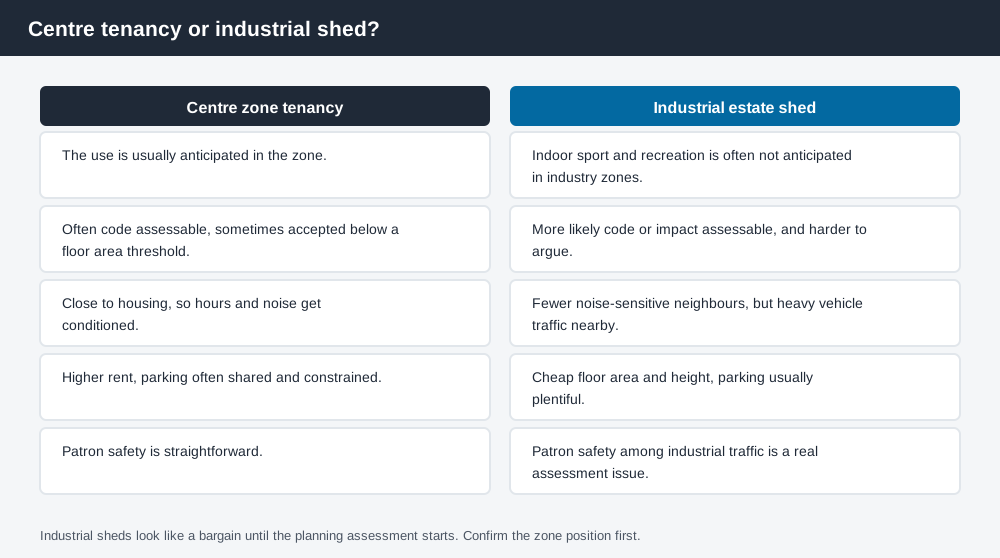
Figure 2: The cheap option is cheap for reasons that show up in assessment.
The economics are obvious: an industrial shed offers height, clear span and floor area at a fraction of centre-zone rent, with parking to spare. Plenty of Queensland gyms operate this way.
The planning problem is that industry zones exist to protect industrial land for industrial uses. Indoor sport and recreation is frequently not anticipated there, which pushes you into code or impact assessment with a weaker case than you'd have in a centre zone. Add the safety question — patrons on foot, often at night, in an estate built around heavy vehicle movements — and assessment gets genuinely harder.
Some schemes do anticipate it in certain industry or mixed use zones. The point is to check before you commit, not after. Our guide to warehouse and industrial approvals in QLD covers how industry zones are structured.
What the assessment turns on
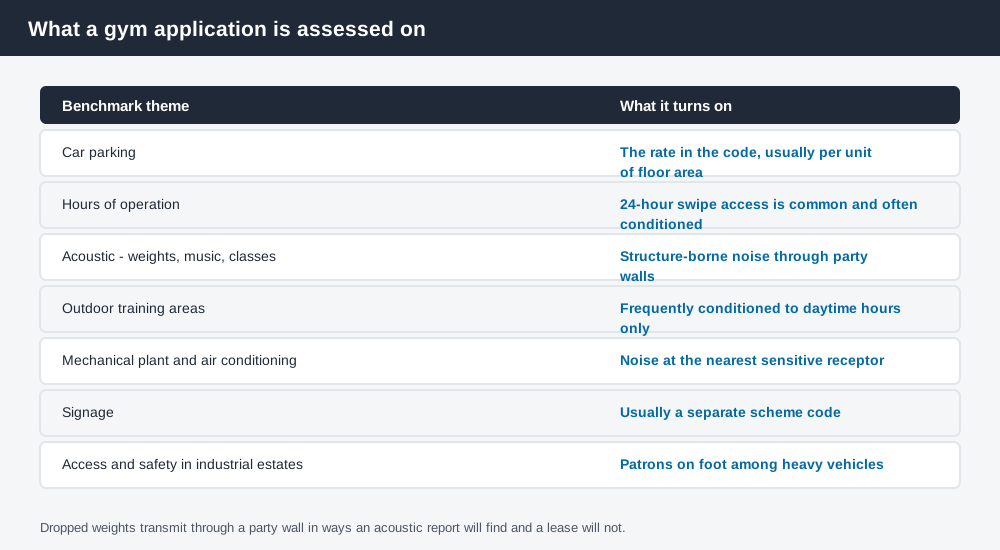
Figure 3: Parking is arithmetic. Acoustics is where applications actually get shaped.
Parking is usually a rate in the code applied to floor area, and it is arithmetic rather than argument. Get the rate, do the sum, and you know where you stand.
Acoustics is the real one. A gym generates structure-borne noise that airborne noise intuitions get wrong: a dropped barbell transmits through a slab and a party wall in a way that no amount of insulation batting fixes. Councils regularly require acoustic assessment and then condition floor treatment, plant location and hours accordingly.
Hours follow from that. 24-hour swipe access is the standard model for the modern fitness franchise and it is the thing councils scrutinise most in any location near housing. Expect it to be conditioned rather than granted by default, and build a case for it rather than assuming it.
Outdoor training — bootcamps, sled tracks, car park sessions — is regularly restricted to daytime hours by condition, because it is genuinely audible at the boundary.
What to do next
Get three things in writing before you sign a lease: the tenancy's lawful use and approval history from council, the zone and overlays for the address, and the table of assessment position for indoor sport and recreation in that zone. You can check the zone and overlays yourself on your council's planning scheme mapping and on the Queensland Globe, and the state's Sport HQ development and building approval guidance sets out the general position for sport and recreation facilities.
If a change of use is needed, changing a shop's use in QLD covers what triggers an application and what the process looks like.
If you'd rather see the zone, the overlays and the likely category of assessment for a tenancy's address than work through a planning scheme yourself, an instantDA planning report does that for $169 — against the $800–$1,500 a town planner typically charges for a preliminary opinion. You can start a report in a few minutes.
Then confirm with your council before committing. A gym fitout is expensive and largely immovable, which makes guessing here an unusually poor bet.
Frequently asked questions
Do I need council approval to open a gym in Queensland?
What use class is a gym in a Queensland planning scheme?
Can I open a gym in an industrial shed in Queensland?
Will council let me run 24-hour access?
Do I need an acoustic report for a gym application?
Does a personal training studio need the same approval as a full gym?
Ready to generate your report?
Skip the writing. Get a council-ready planning report in 5 minutes.
Get your report