Key takeaways
- ✓Queensland schemes split industrial uses by impact — warehouse, low, medium and high impact industry are different defined uses with different zone positions.
- ✓A warehouse is storage and distribution. Add processing and you may have moved into an industry use entirely.
- ✓Where the activity is a prescribed environmentally relevant activity, a separate environmental authority is needed under the Environmental Protection Act 1994.
- ✓Some ERAs are devolved to local government, so the administering authority is not always the state.
- ✓Access to a state-controlled road is the referral trigger that catches freight-generating uses most often.
Warehouse and Industrial Approvals in QLD
You'll usually hear this called a development application, or DA — that's the formal name for council approval under the Planning Act 2016. Industrial approvals in Queensland have a second layer most other uses don't: alongside the planning system there is an environmental licensing system, and an industrial operation can need both, one, or neither depending on what it actually does.
Getting the defined use right is the first fork, and the whole assessment path follows from it.
Get a council-ready planning report in 5 minutes — no planner, no waiting.
Get your report →The short answer
Queensland schemes split industrial uses by impact — warehouse, low, medium and high impact industry — with different zone positions for each. Where the activity is a prescribed environmentally relevant activity, a separate environmental authority is needed under the Environmental Protection Act 1994, alongside any planning approval.
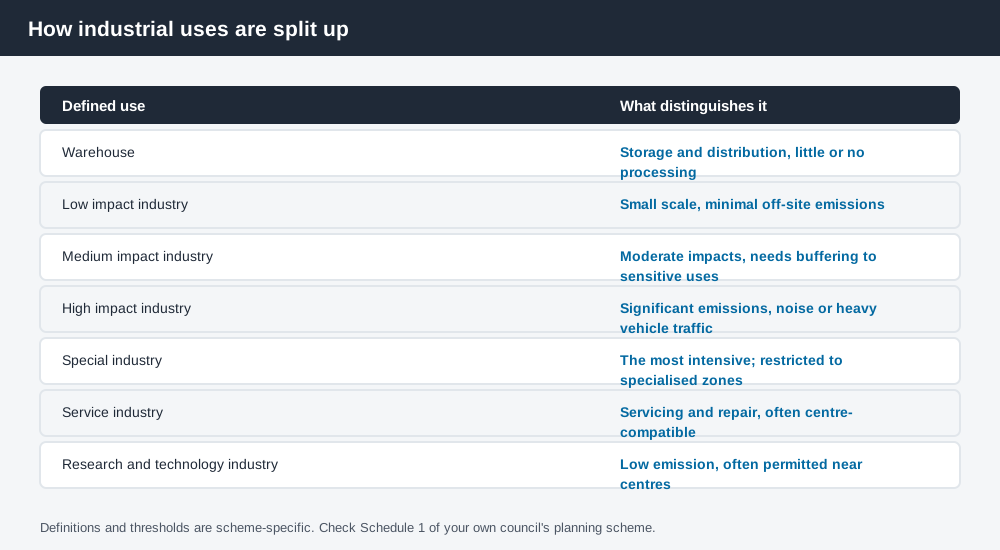
Figure 1: The categories recur. The thresholds behind them are scheme-specific.
Warehouse is not industry
The distinction that catches people is between warehouse and the industry uses. A warehouse is storage and distribution of goods — impacts are traffic and building bulk rather than emissions. The moment meaningful processing, manufacturing or treatment happens on site, you may have moved into an industry use, with a different zone position and different benchmarks.
That matters commercially, because a business that describes itself as a distribution centre and does light assembly on site is not necessarily a warehouse in scheme terms. If the defined use changes, so does the category of assessment, and starting a new defined use is a material change of use.
Queensland's planning schemes follow the Queensland Planning Provisions structure, but each council layers its own codes and overlays on top. They are not uniform — the floor area and impact thresholds separating low from medium impact industry differ between local government areas. Read Schedule 1 of your own scheme. Material change of use in QLD covers when a change in activity triggers an application.
The assessment path
Spend 5 minutes, not 3 weeks
instantDA generates a council-ready planning report for Queensland development applications. No town planner. No waiting.
Get your report →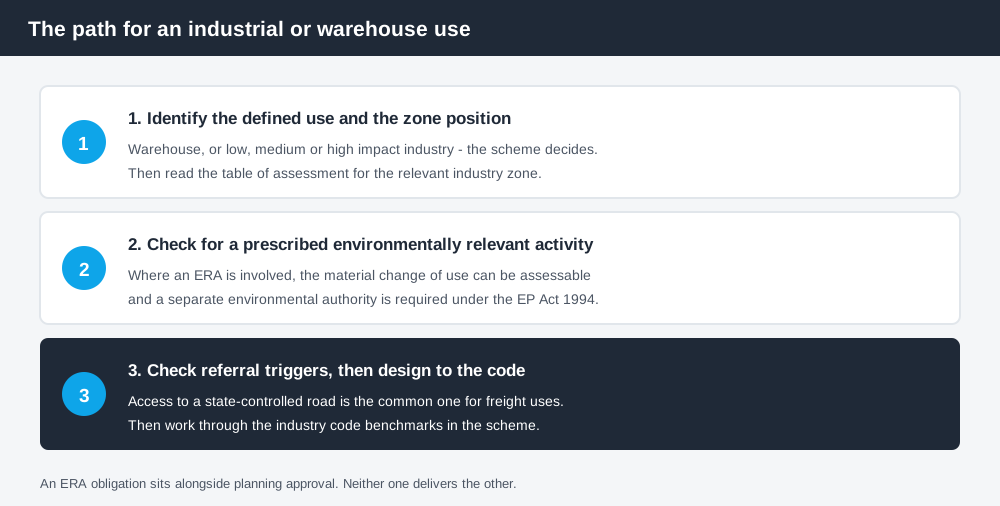
Figure 2: Three checks. The middle one is the one people skip.
- ✓Identify the defined use in Schedule 1 of the scheme
- ✓Read the table of assessment for the industry zone
- ✓Check whether the activity is a prescribed environmentally relevant activity
- ✓Check referral triggers, especially state-controlled road access
- ✓Read the industry code benchmarks and design to them
Environmentally relevant activities
This is the layer that has no equivalent for most other uses. Queensland prescribes certain activities as environmentally relevant activities (ERAs) under the Environmental Protection Act 1994 — a defined list of industrial, waste, resource and intensive agricultural activities with recognised environmental risk.
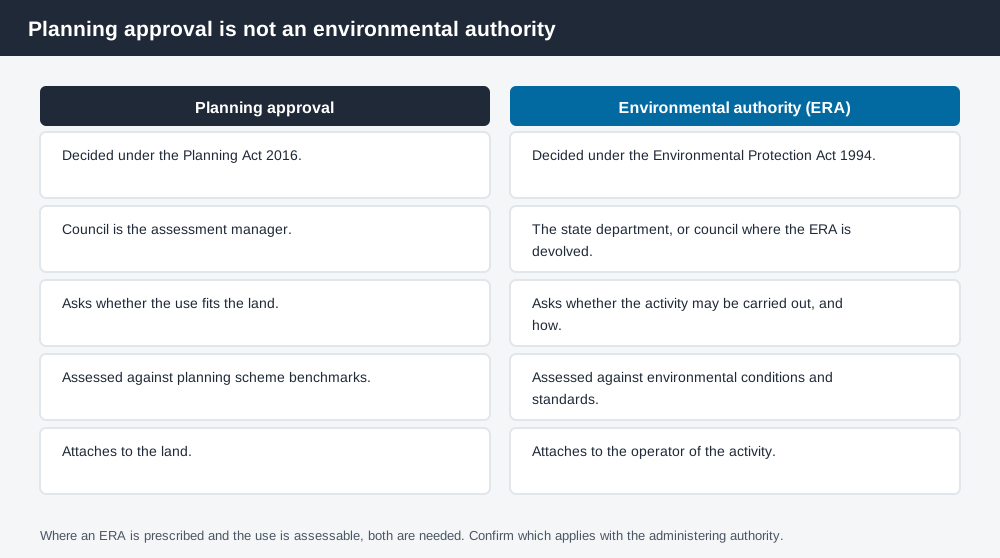
Figure 3: Two systems, two questions, two administering bodies.
Two things follow. First, where a development application is made for a material change of use for a prescribed ERA and that ERA is categorised as assessable development, the ERA aspect is dealt with through the development application as well as through environmental registration. Second, and separately, the operator needs the appropriate environmental authority before carrying out the activity.
The administering authority isn't always the state. Some prescribed ERAs are devolved to local government, which then acts as the administering authority for that activity in its area. Which body you deal with depends on which ERA is involved, so confirm it rather than assuming — the state's guidance on environmentally relevant activities is the starting point.
What industrial applications are assessed on
The benchmarks in an industry code are, unsurprisingly, about impacts crossing boundaries.
Traffic and access dominates. Heavy vehicle movements, turning paths, loading and unloading, internal manoeuvring so trucks are not reversing onto public roads, and the capacity of the road network to carry the freight task. Where the site takes new or changed access to a state-controlled road, the application can require referral to a referral agency, which assesses against state codes. That adds a stage and is worth identifying early — SARA and referral agencies in QLD covers how referral works.
Emissions and separation follows. Noise, air, odour, light and dust, and whether there is sufficient separation or buffering to sensitive uses. This is precisely why schemes grade industry by impact: the grading is a proxy for how far the use needs to be from housing.
There is a strategic dimension to this that first-time industrial applicants underestimate. Industry zones in Queensland are under sustained pressure from higher-value uses — showrooms, gyms, self-storage, food manufacturing with retail attached — and councils are increasingly protective of the remaining stock. An application that reads as an industrial use with a retail component grafted on will be assessed on the retail component. Being straightforward about the mix from the outset generally produces a better result than presenting a warehouse and adding a shopfront later.
Built form and interface covers setbacks, screening, landscaping and hours of operation where the site adjoins non-industrial land.
Hardstand, storage and stormwater matters more in industrial settings than most. Large impervious areas concentrate runoff, and outdoor storage raises both visual and contamination questions. If your operation involves substantial outdoor storage, storage yards and outdoor storage in QLD deals with that specifically.
What to do next
Start with the defined use, because everything else follows from it. Read Schedule 1 of the scheme, find the use that actually matches what you'll do on site — including any processing — and then read the table of assessment for the zone.
Then run the ERA question in parallel. It is genuinely independent of the planning question, and discovering an ERA obligation after you've secured planning approval is an expensive way to learn that.
You can check zoning, overlays and constraints on your council's planning scheme mapping and on the Queensland Globe, which also shows environmental and infrastructure layers useful for industrial site selection.
If you'd rather see the zone, the overlays and the likely category of assessment for a site than work through a planning scheme yourself, an instantDA planning report does that for $169 — against the $800–$1,500 a town planner typically charges for a preliminary opinion. You can start a report in a few minutes.
Then confirm with your council and with the administering authority for any ERA before you commit. Industrial projects have long lead times, and both systems reward being asked early.
Frequently asked questions
What is the difference between a warehouse and industry in a Queensland planning scheme?
Do I need council approval for a warehouse in Queensland?
What is an environmentally relevant activity?
Who administers environmentally relevant activities in Queensland?
Does planning approval cover my environmental obligations?
What triggers a state referral for an industrial development?
Ready to generate your report?
Skip the writing. Get a council-ready planning report in 5 minutes.
Get your report