Key takeaways
- ✓Storage yards look simple because nothing is built, but the assessment is about the surface, the water and the contents.
- ✓Outdoor storage is rarely anticipated outside industry zones, so a yard on rural or residential land is usually assessable.
- ✓What you store matters — some materials and wastes bring the activity within the environmentally relevant activity framework.
- ✓A large hardstand is impervious, so stormwater has to reach a lawful point of discharge, not the neighbour.
- ✓Screening and stormwater are the two conditions imposed most often on outdoor storage approvals.
Storage Yards and Outdoor Storage in QLD
You'll usually hear this called a development application, or DA — that's the formal name for council approval under the Planning Act 2016. A storage yard is the use that most reliably surprises people, because it involves no building. Gravel, a fence, some stacked material, a truck or two: it doesn't feel like development.
It is. Using land is exactly what the planning system regulates, and a yard changes what land is used for.
Get a council-ready planning report in 5 minutes — no planner, no waiting.
Get your report →The short answer
Storing goods, materials or vehicles outdoors is a use of land and generally needs a material change of use approval where it isn't already approved. Outdoor storage is rarely anticipated outside industry zones, and what you store can also bring the activity within the environmentally relevant activity framework.
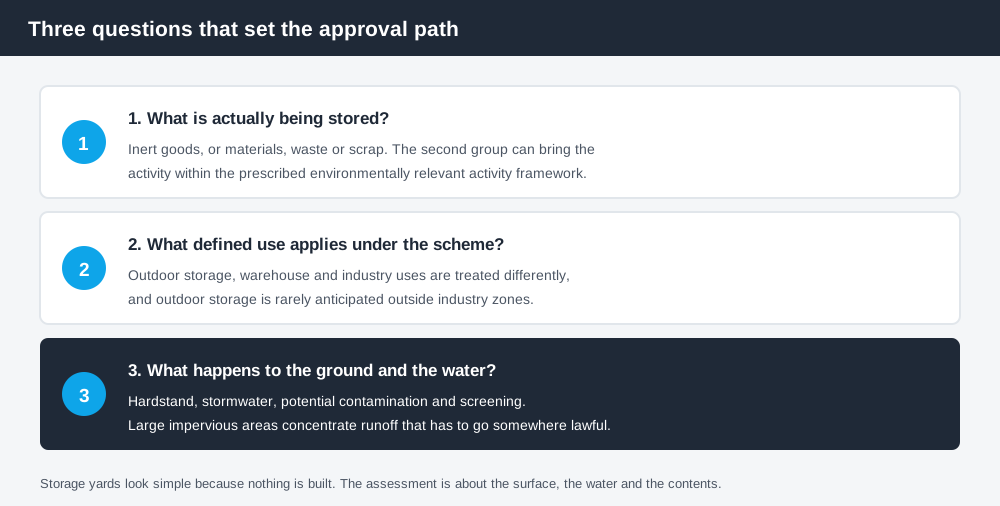
Figure 1: Three questions. The first one determines whether a second regulator is involved.
Which defined use applies
Queensland schemes handle outdoor storage in various ways. Some have a specific outdoor storage or storage yard definition. Others fold it into a warehouse or industry use, or treat it as ancillary to a primary use on the same site. A few deal with particular versions of it — truck parking, machinery hire depots, landscape supplies — under their own definitions.
The practical consequence is consistent even where the labels differ: outdoor storage is generally anticipated in industry and enterprise zones, and generally not anticipated elsewhere. A yard proposed on rural, rural residential or residential land is usually assessable, often impact assessable, and has to be argued.
Queensland's planning schemes follow the Queensland Planning Provisions structure, but each council layers its own codes and overlays on top. They are not uniform — read Schedule 1 of your own scheme to find the definition that actually matches what you'll do. Warehouse and industrial approvals in QLD covers how industry zones and industry use definitions are structured.
Ancillary storage is different — until it isn't
Spend 5 minutes, not 3 weeks
instantDA generates a council-ready planning report for Queensland development applications. No town planner. No waiting.
Get your report →Storage genuinely ancillary to an approved use on the same site usually rides along with that use. A joinery workshop storing timber outside, a builder storing scaffold at their yard, a nursery storing potting mix: where the storage supports the primary use and stays proportionate to it, it's normally part of that use.
Where it stops being proportionate, it becomes its own use. A site approved as a workshop that now stores three other businesses' equipment for a fee has started a new use, or materially increased the intensity of the existing one — either of which is a material change of use. Material change of use in QLD covers both limbs.
This is also the most common enforcement scenario for yards: a site that legitimately stored its own materials gradually became a commercial storage operation.
What you store can trigger a second system
Queensland prescribes certain activities as environmentally relevant activities under the Environmental Protection Act 1994, and several of them involve storing, sorting, handling or treating materials and wastes. Where a prescribed ERA is involved, the operator needs the appropriate environmental authority, quite separately from any planning approval, and the administering authority may be the state or — for devolved ERAs — the local government.
Inert goods in crates are one thing. Scrap metal, waste, chemicals, fuels, soil and demolition material are another, and are exactly where the ERA framework bites. Check this before you commit, because the two approval systems are independent and neither delivers the other. The state's guidance on environmentally relevant activities is the starting point.
What the assessment turns on
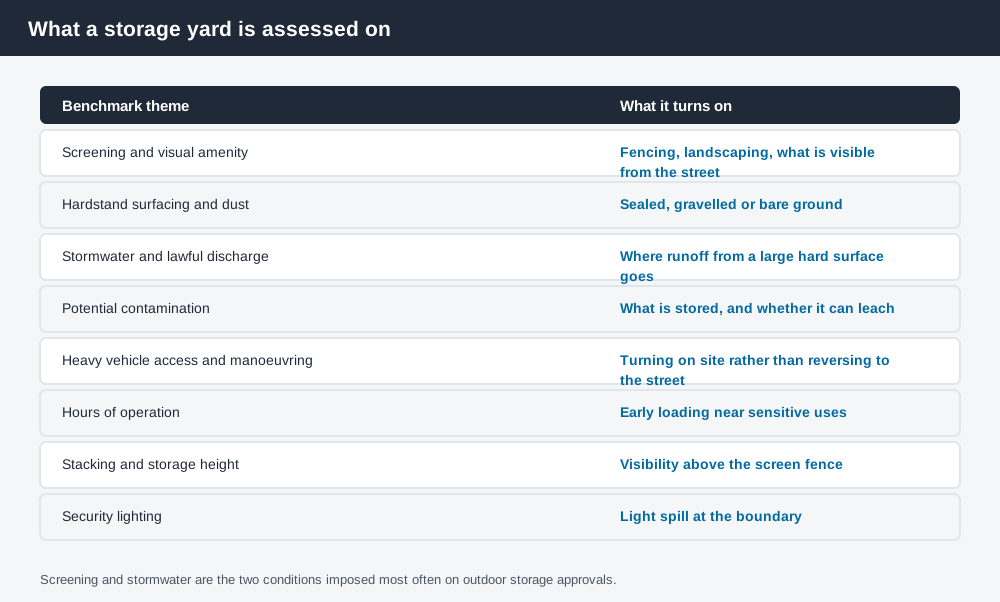
Figure 2: Screening and stormwater carry most of the conditions.
Stormwater is the technical heart of it. A yard is a large impervious or semi-impervious surface, and water that used to soak in now runs off. It has to reach a lawful point of discharge — kerb and channel, inter-allotment drainage, or a council easement where permitted — and it must not be increased or concentrated onto neighbouring land. Where the yard stores anything that could contaminate runoff, treatment before discharge becomes part of the design.
Screening carries the amenity case. Solid fencing, landscaping and stacking height limits are the standard toolkit, and the practical test is what is visible from the street and from adjoining properties. Applications that show a considered screening treatment fare noticeably better than those that don't.
- ✓Where does runoff from the hardstand actually go?
- ✓What is the surface — sealed, gravelled or bare ground?
- ✓Can trucks turn on site without reversing onto the road?
- ✓What is visible above the fence line?
- ✓Could anything stored here contaminate soil or water?
- ✓Do the hours suit the neighbours?
- ✓Does security lighting spill at the boundary?
The surface itself is a decision with consequences in both directions. A sealed hardstand controls dust and contamination and makes runoff predictable, but it is fully impervious and increases the volume of water you have to manage. Gravel sheds less water but generates dust and lets contaminants reach the soil. Councils generally prefer sealed surfaces with proper drainage and treatment for anything other than the most inert storage, and pricing that into the project from the start avoids an unwelcome condition later.
Heavy vehicle access and hours follow the usual industrial pattern: manoeuvring on site rather than on the street, and early loading movements conditioned where sensitive uses are nearby.
What to do next
Establish two things independently. On the planning side, check the zone and overlays for the land on your council's planning scheme mapping and on the Queensland Globe, then find the definition in the scheme that matches your intended storage and read the table of assessment for that zone. On the environmental side, check whether what you store is a prescribed environmentally relevant activity.
If the storage is at your home rather than on commercial land, the constraints are different again and considerably tighter — working from home in QLD covers where outdoor storage takes a home based business outside the exemption.
If you'd rather see the zone, the overlays and the likely category of assessment for a site than work through a planning scheme yourself, an instantDA planning report does that for $169 — against the $800–$1,500 a town planner typically charges for a preliminary opinion. You can start a report in a few minutes.
Then confirm with your council before you start filling the yard. Outdoor storage is highly visible, which makes it one of the most complained-about uses in Queensland, and complaints arrive faster than approvals do.
Frequently asked questions
Do I need council approval for a storage yard in Queensland?
Can I store materials on my rural block without approval?
Is storing my own business equipment on my own site a separate use?
Does a storage yard need building approval?
What are the stormwater rules for a hardstand or gravel yard?
When does storage become an environmentally relevant activity?
Ready to generate your report?
Skip the writing. Get a council-ready planning report in 5 minutes.
Get your report