Key takeaways
- ✓Industry zones are graded by the impact of the activity, not by the size of the building.
- ✓The scale of an industry can be what pushes it from the medium impact zone into the high impact zone.
- ✓Separation from sensitive land uses — homes, schools, childcare — is the organising idea behind the whole set of zones.
- ✓There is no single state-wide table of separation distances. The distances come from council schemes and state guidance on emissions and hazardous activities.
- ✓Being in an industry zone does not remove the need for approval. It changes which approvals are likely to be straightforward.
Industry Zones Explained: Low, Medium and High Impact
You'll usually hear this called a development application, or DA — that's the formal name for council approval under the Planning Act 2016. For industrial premises, the zone in the scheme is the first filter, and it works on a logic that catches people out: Queensland's industry zones are graded by impact, not by size.
A large, quiet warehouse can sit comfortably in a low impact industry zone. A small operation that generates odour, noise at night or handles dangerous goods may not.
Get a council-ready planning report in 5 minutes — no planner, no waiting.
Get your report →The short answer
Queensland's industry zones are graded by the potential impact of the activity on surrounding uses. Low impact industry is for small-scale, low-nuisance operations; medium and high impact zones accommodate activity needing greater separation from homes and other sensitive uses. Scale, not just activity type, can determine which zone suits.
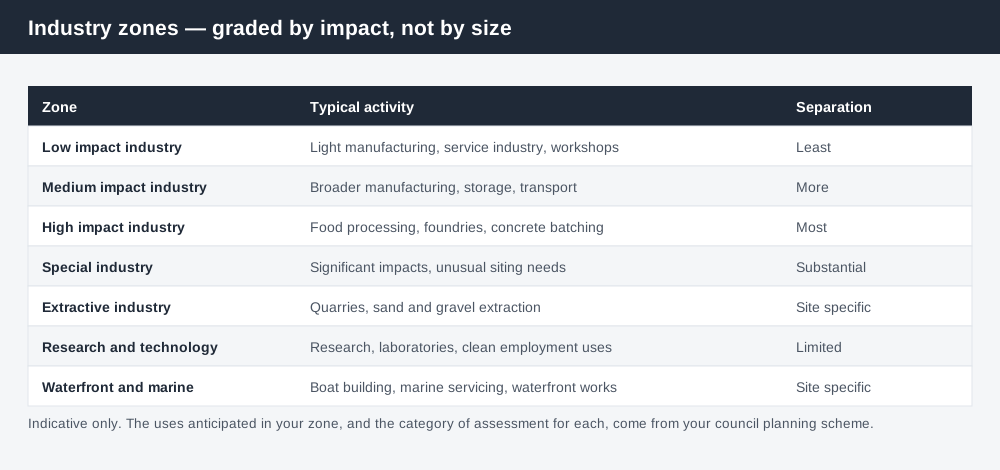
Figure 1: Indicative examples only — the anticipated uses in your zone come from the council's scheme.
The zones, in order of impact
The industry zones a Queensland council can apply come from Schedule 2 of the Planning Regulation 2017, which sets out the zones available to a local planning instrument together with a purpose statement for each. Councils then write their own zone codes and tables of assessment.
Low impact industry. For smaller-scale industrial activity with limited potential to affect surrounding uses. Zone codes commonly do two jobs at once: keeping higher-impact industry out, and protecting the industrial land from encroachment by sensitive uses that would later complain about it. Light manufacturing, service industry, workshops and warehousing typically sit here.
Medium impact industry. For activity that needs more separation from sensitive uses than low impact operations, generally at larger scale and covering a broader range of manufacturing, storage, transport and service uses.
High impact industry. For industry that may have high impacts. The state zone material for this zone makes a point worth remembering: the scale of the industry helps determine whether it belongs in the high impact or the medium impact zone. Examples associated with the zone include food processing, metal foundries, concrete batching and warehousing of dangerous goods.
Special industry. Used by councils for activity with particularly significant impacts or unusual siting requirements, typically needing substantial site area and stronger separation.
Extractive industry. A separate category tied to resource extraction — quarries, sand and gravel. The State Planning Policy addresses extractive resources, and local governments assess extractive industry development through their planning schemes.
Research and technology industry, and waterfront and marine industry, are further zones available to councils for cleaner research and employment uses, and for marine-related industrial activity near waterfronts, respectively. Their scope is set locally.
Separation from sensitive uses is the organising idea
Spend 5 minutes, not 3 weeks
instantDA generates a council-ready planning report for Queensland development applications. No town planner. No waiting.
Get your report →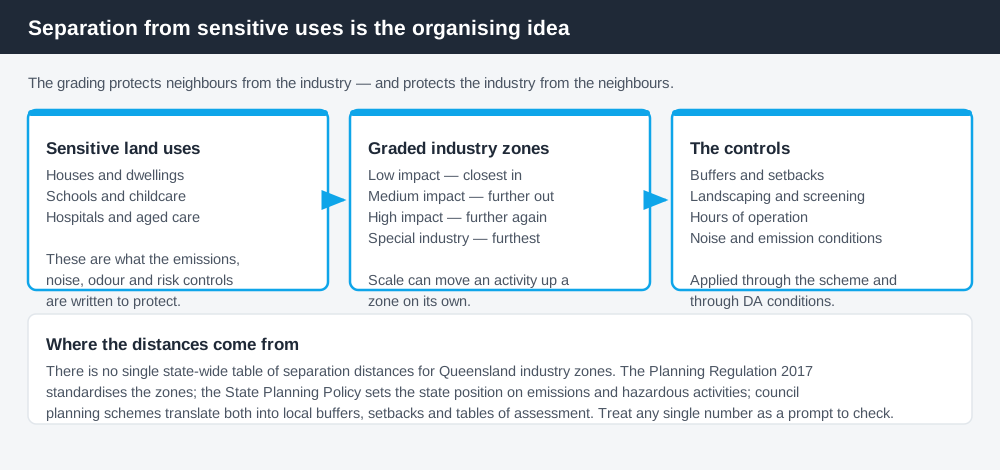
Figure 2: Councils grade industrial land partly by how far it sits from the things industry can affect.
Almost everything about the industry zones makes sense once you see the underlying idea: keep incompatible uses apart so industry can operate normally without causing unacceptable noise, odour, dust, emissions, traffic or safety risk for nearby homes, schools and childcare centres.
Councils are explicit about this. Townsville's published material describes industrial zones as planned around the potential for industry impacts on sensitive uses, with higher-impact industry separated from residences to protect amenity, health and wellbeing.
Separation works in both directions, and the second direction is the one people miss. The zone protects the neighbours from the industry, and it also protects the industry from the neighbours — because if housing creeps to the fence line, the operating conditions on the industrial site tend to tighten over time.
- ✓Which industry zone is the site in?
- ✓How close is the nearest sensitive use?
- ✓Is your activity defined the way you assume in the scheme?
- ✓Does it involve emissions, odour, noise at night, or dangerous goods?
- ✓Does it need an environmental authority as well as a DA?
Where the separation distances come from
This is worth being precise about, because a specific-sounding number from the wrong source is worse than no number.
There is no single state-wide table of separation distances applying to every industry zone in Queensland. What exists is a layered framework:
The Planning Regulation 2017 standardises the zones and the use categories councils build their schemes around. The State Planning Policy provides the state position on emissions and hazardous activities, and state guidance material addresses how planning should respond to those hazards, including consulting specialist agencies where relevant. Individual council planning schemes then translate all of that into local zone codes, setbacks, buffers and tables of assessment.
So the answer to "how far do I need to be from housing?" is a scheme question with a state policy backdrop, and it is genuinely site-specific. Treat any single distance you read online — including here — as a prompt to check, not an answer.
Being in the right zone is not the same as being approved
A common assumption is that industrial land means industrial freedom. It does not.
You still need to check the defined use in the scheme against what you actually intend to do, and then the category of assessment for that use in that zone. Warehousing, low impact industry, service industry, transport depot and storage yard are separate defined terms with separate assessment positions, and the difference between them is frequently the difference between a straightforward application and a notified one. Warehouse and industrial approvals in Queensland covers that path in more detail.
Then there are the approvals that sit outside the planning system entirely. Building work goes through the building approval track under the Building Act, usually with a private certifier — a separate decision-maker from council as assessment manager. Some activities are environmentally relevant activities requiring an environmental authority. Operational works for access, stormwater and earthworks may need their own approval. Operational works in Queensland touches on the yard and hardstand side of this, which is regularly underestimated.
Checking a site before you lease
Establish the zone and precinct, then the defined use, then the category of assessment. Look at what sits around the site — particularly any residential zoning within a few hundred metres — because that proximity shapes how conditions are written even when the use is anticipated.
Cross-check the site on the Queensland Globe for state layers, and look at what council has recently approved nearby. Approved applications on comparable sites tell you more about the real position than the code does, because they show what conditions council attaches in practice.
What to do next
Confirm the industry zone, the defined use and the resulting category of assessment before signing anything. Industrial leases are typically long, and an approval problem discovered after commencement is expensive to unwind.
If you'd rather see the zone, the overlays and the likely category of assessment for an address than work through a planning scheme yourself, an instantDA planning report does that for $169 — against the $800–$1,500 a town planner typically charges for a preliminary opinion. You can start a report in a few minutes.
Then confirm with your council, and consider a pre-lodgement meeting for anything at medium impact scale or above. Centre zones explained covers the commercial side of the same logic, which matters if your operation has a retail or showroom component.
Frequently asked questions
What is the difference between low and medium impact industry zones?
What goes in a high impact industry zone?
How far must industry be from houses in Queensland?
Can I run a warehouse in a low impact industry zone?
Do I still need a DA if my site is already zoned industrial?
Is building approval the same as development approval for a factory?
Ready to generate your report?
Skip the writing. Get a council-ready planning report in 5 minutes.
Get your report