Key takeaways
- ✓Place of worship, community use and community care centre are three separate defined uses, and a single site may involve more than one.
- ✓In residential zones these uses are commonly impact assessable, which means public notification and submitter appeal rights.
- ✓Peak assembly is what drives the assessment — parking and traffic are sized for the busiest gathering, not the average day.
- ✓Ancillary activities like a hall, a school or a cafe can each add a defined use of their own.
- ✓These applications are decided on amenity, so a well-designed interface with neighbours does more than any argument about need.
Places of Worship and Community Uses in QLD
You'll usually hear this called a development application, or DA — that's the formal name for council approval under the Planning Act 2016. Community organisations often come to this process from a standing start, without a developer's instincts, and the two things that surprise them most are that their proposal is likely to be publicly notified, and that the whole assessment is really about parking and noise.
Neither of those is hostility. Both follow from what these uses actually do: they concentrate a lot of people into one place, at once, on a predictable schedule.
Get a council-ready planning report in 5 minutes — no planner, no waiting.
Get your report →The short answer
Place of worship, community use and community care centre are separate defined uses in Queensland planning schemes. Establishing one is generally a material change of use, and in residential zones these uses are commonly impact assessable — meaning public notification and submitter appeal rights.
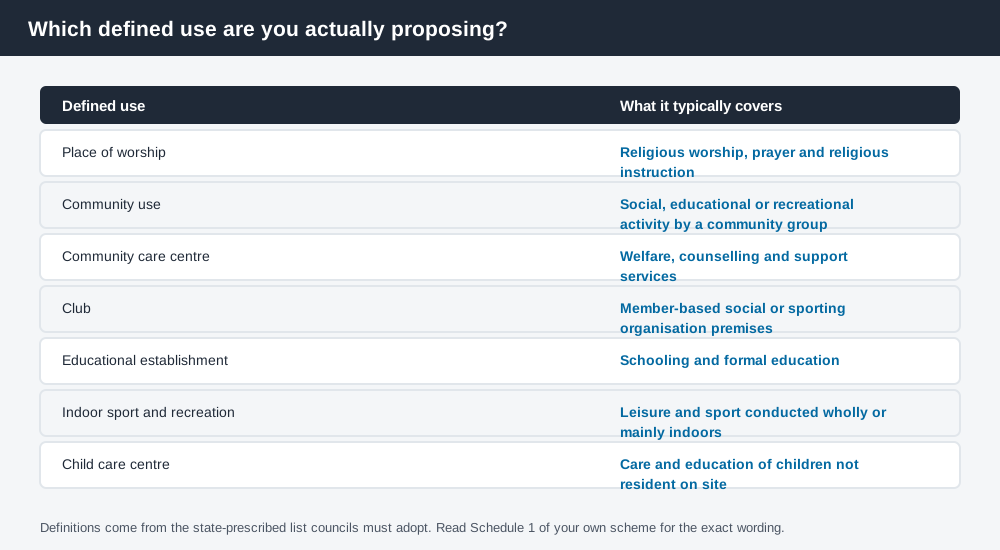
Figure 1: Seven definitions that overlap in ordinary language and don't in the scheme.
Getting the defined use right
Queensland councils adopt land use definitions from a state-prescribed list, so the terminology is reasonably consistent across schemes even where the zone positions are not. A place of worship covers religious activities — worship, prayer, religious instruction. A community use covers social, educational or recreational activity by a community or not-for-profit organisation. A community care centre covers welfare, counselling and support services.
Real proposals rarely sit neatly in one. A congregation that meets for worship, runs a weeknight youth programme, operates a food relief service on Saturdays and rents the hall out for functions may be proposing several defined uses on one site. Each one may sit differently in the table of assessment.
If part of the operation is a childcare service or a school, that is a further use again with its own regulatory layer — opening a childcare centre in QLD covers what that adds.
Expect public notification
Spend 5 minutes, not 3 weeks
instantDA generates a council-ready planning report for Queensland development applications. No town planner. No waiting.
Get your report →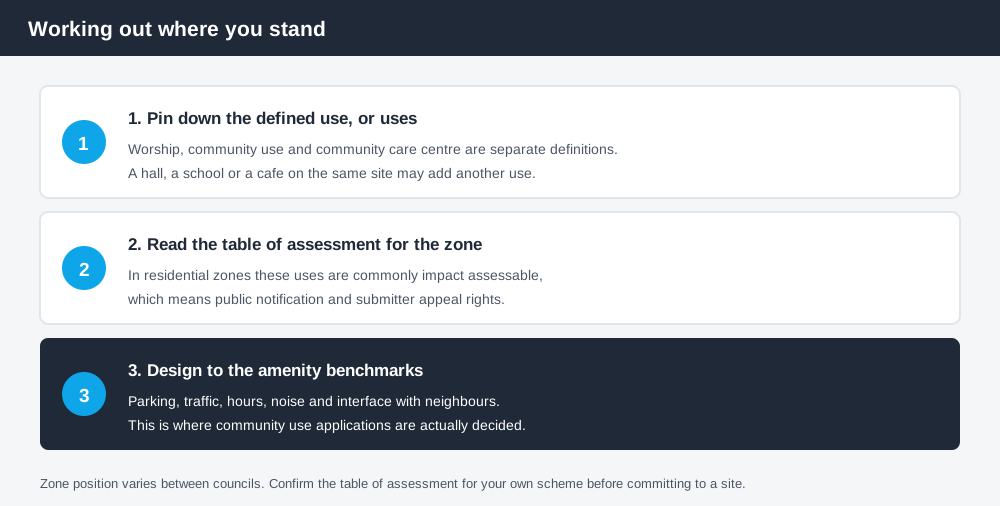
Figure 2: Three steps, and the second one determines how public this becomes.
In centre, community facilities and some mixed use zones, these uses are often anticipated and may be code assessable. In low density residential zones — where community groups most often find affordable land — they are commonly impact assessable.
Impact assessment means the application is publicly notified, anyone may make a submission, submissions must be considered, and submitters can gain appeal rights. That is a materially different process from code assessment and it should be planned for rather than discovered. Public notification in QLD sets out what the stage involves, and accepted versus assessable development in QLD explains what each category means.
Queensland's planning schemes follow the Queensland Planning Provisions structure, but each council layers its own codes and overlays on top. They are not uniform, so the zone position for a place of worship in one local government area tells you nothing reliable about the next.
Peak assembly is the whole problem
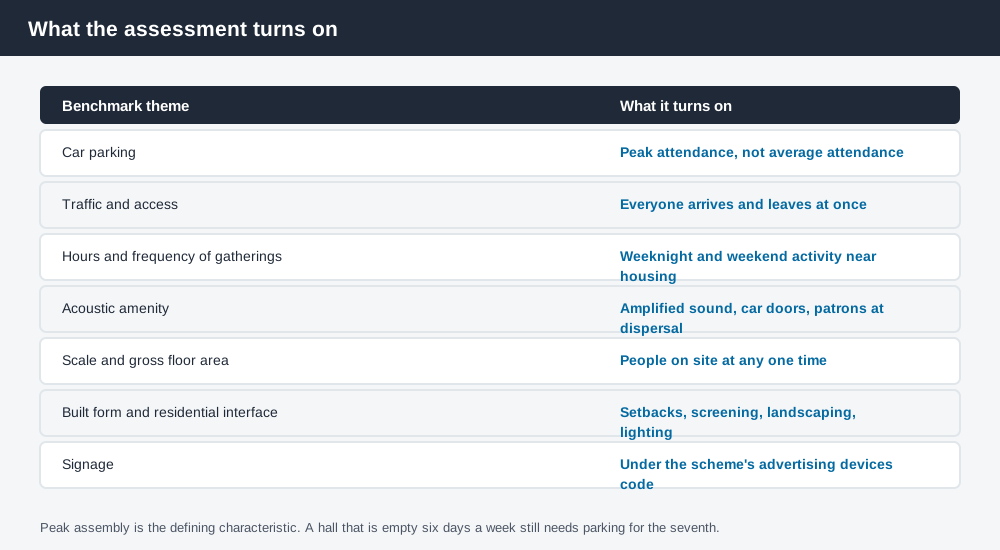
Figure 3: Every benchmark on this list is a consequence of everyone arriving at once.
A shop generates a steady trickle of vehicles across trading hours. A place of worship generates almost none for most of the week and then, for two hours on a Sunday morning, generates more traffic than the street sees in a day. Assessment is sized for that peak.
- ✓Parking calculated on peak attendance, not average
- ✓Vehicle access and internal circulation that works when everyone arrives together
- ✓Hours and frequency of gatherings, including weeknight activity
- ✓Acoustic management of amplified sound and dispersal noise
- ✓Setbacks, screening and landscaping at the residential interface
- ✓Lighting that doesn't spill into neighbouring bedrooms
- ✓Signage under the scheme's advertising devices code
Two things reliably drive objections. The first is overflow parking into residential streets, which is the single most common complaint about community uses anywhere in Australia. The second is dispersal noise — car doors, conversation, engines starting — which happens late, all at once, and is genuinely audible.
Both are solvable at design stage and nearly unsolvable by argument afterwards. Providing parking above the code rate, and designing the car park so it empties away from the most sensitive boundary, does more for an application than any amount of correspondence about community benefit.
Hours and frequency deserve the same treatment. A proposal that sets out honestly what happens on which nights, and what the acoustic and traffic consequences of each are, gives council something it can condition. A proposal that describes only the Sunday service and stays vague about the rest invites conditions drawn tightly enough to catch activities you hadn't mentioned — which then have to be varied later through a change application.
Existing buildings and existing rights
Many community organisations occupy buildings that have been used the same way for decades. Two questions matter there.
First, is the current use lawful — approved, or lawfully established before approval was required? Second, has anything changed materially since? A congregation that has grown, added weeknight programmes, or started renting the hall commercially may have moved into a material increase in the intensity or scale of the use, which is itself a material change of use. Material change of use in QLD covers that limb.
The other trap is abandonment. A hall that stood unused for several years may not simply resume — re-establishing an abandoned use can require approval.
Funding cycles make this worse than it needs to be. Community organisations often secure a grant or a bequest with a spending deadline attached, then start the approval process against that clock. An impact assessable application with a notification stage does not compress to suit a funding milestone, and the applications that go badly are almost always the ones lodged in a hurry with unresolved parking.
What to do next
Before committing to a site, check the zone and overlays on your council's planning scheme mapping and on the Queensland Globe, then read the table of assessment for the specific use you're proposing. If it is impact assessable, budget time and goodwill for notification — early conversations with immediate neighbours consistently produce better outcomes than a notice on a fence does.
If you'd rather see the zone, the overlays and the likely category of assessment for a site than work through a planning scheme yourself, an instantDA planning report does that for $169 — against the $800–$1,500 a town planner typically charges for a preliminary opinion. You can start a report in a few minutes.
Then confirm with your council. Duty planners are usually generous with community groups, and getting the defined uses right at the start is worth far more than it costs.
Frequently asked questions
Do I need council approval to open a church in Queensland?
Will neighbours be notified about a place of worship application?
What is the difference between a place of worship and a community use?
How is parking assessed for a church or community hall?
Does an existing church building need new approval if the congregation grows?
Can a community group use a hall that has been vacant for years?
Ready to generate your report?
Skip the writing. Get a council-ready planning report in 5 minutes.
Get your report