Key takeaways
- ✓The Planning Act 2016 is the head of Queensland's planning system. It sets the framework; the detail sits in the Planning Regulation and your council's scheme.
- ✓Section 44 establishes three categories of development: prohibited, assessable and accepted.
- ✓Section 45 establishes two categories of assessment for assessable development: code assessment and impact assessment.
- ✓Section 43 covers categorising instruments — the regulation and local instruments that put development into those categories.
- ✓Building approval is a separate track under the Building Act, with a private certifier rather than council as decision-maker.
The Planning Act 2016 Explained
You'll usually hear this called a development application, or DA — that's the formal name for council approval, and the Planning Act 2016 is the legislation that creates it. Almost every rule you will meet in a Queensland planning scheme sits somewhere beneath this Act.
Most people never need to read it. But knowing what the Act does, and what it deliberately leaves to other instruments, makes the rest of the system far easier to navigate — particularly the moment when your council says a proposal is "code assessable" and you need to know what that actually means.
Get a council-ready planning report in 5 minutes — no planner, no waiting.
Get your report →The short answer
The Planning Act 2016 is Queensland's principal planning legislation. It creates the development assessment system, establishes three categories of development — prohibited, assessable and accepted — and two categories of assessment for assessable development, code and impact. The detail sits in the Planning Regulation 2017 and each council's scheme.
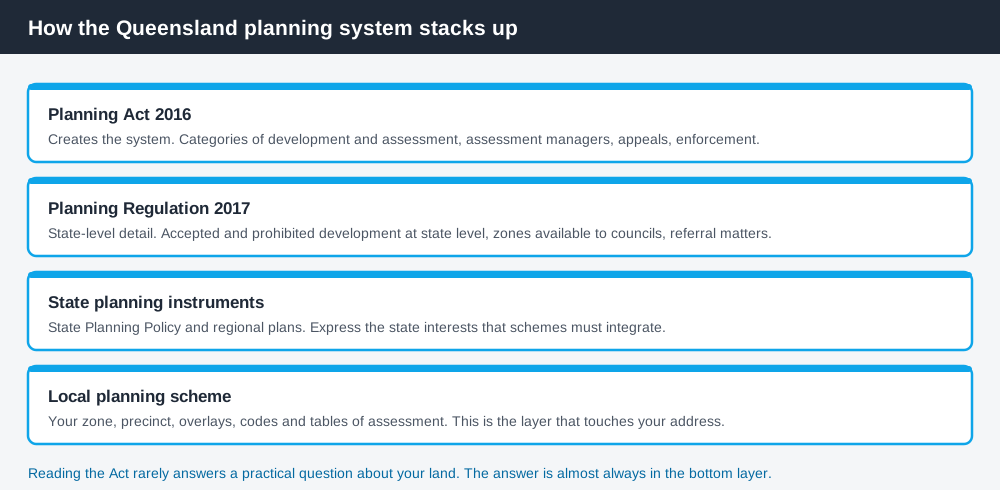
Figure 1: The Act sets the framework. The instruments beneath it carry the detail that applies to your land.
What the Act actually does
The Act's central job is to establish a framework and then delegate. It creates the categories, defines the players, sets the appeal rights and the enforcement powers — and then leaves the substantive rules about what can happen on a particular piece of land to instruments made under it.
That design is why reading the Act rarely answers a practical question. If you want to know whether you can build a shed, the Act tells you that your shed will fall into one of three categories; it does not tell you which one. That answer comes from a categorising instrument, which in most cases means your council's planning scheme.
The three categories of development
Spend 5 minutes, not 3 weeks
instantDA generates a council-ready planning report for Queensland development applications. No town planner. No waiting.
Get your report →Section 44 of the Planning Act 2016, headed "Categories of development", establishes that there are three categories: prohibited, assessable and accepted development.
Prohibited development cannot be applied for at all. A development application for prohibited development is not a difficult application; it is not an available one.
Assessable development requires a development approval before it can lawfully be carried out. This is the category that produces DAs.
Accepted development does not require a development approval. Note the wording carefully — accepted development is not "approved" development and it is not unregulated. Where a scheme makes development accepted subject to requirements, you must comply with those requirements, and if you do not, you are carrying out assessable development without an approval. That distinction causes a lot of grief, and accepted versus assessable development covers it properly.
Section 44 also provides that a categorising instrument may categorise development, which is the hinge between the Act and everything below it.
The two categories of assessment
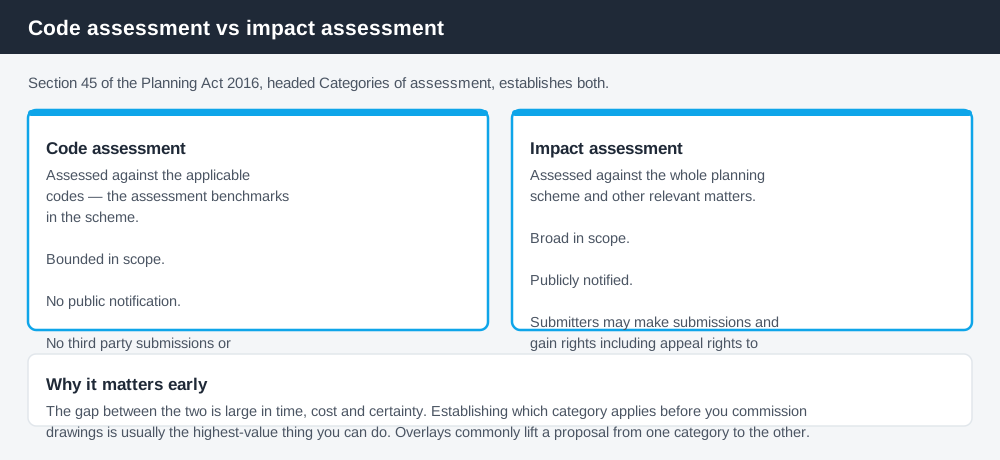
Figure 2: The category of assessment drives time, cost, and whether your neighbours get a say.
Section 45 of the Planning Act 2016, headed "Categories of assessment", establishes that there are two categories of assessment for assessable development: code assessment and impact assessment.
Code assessment is assessment against the applicable codes — the benchmarks in the scheme. It is bounded. There is no public notification, and third parties do not get appeal rights against the decision.
Impact assessment is broader. The assessment is against the whole planning scheme and other relevant matters, the application is publicly notified, submissions can be made, and submitters gain rights that include appeal rights to the Planning and Environment Court.
The practical gap between the two is large — in time, in cost, and in certainty. Establishing which one applies to your proposal is usually the single most valuable thing you can do early.
- ✓Is the development prohibited, assessable or accepted?
- ✓If accepted, is it subject to requirements you must meet?
- ✓If assessable, is it code or impact assessable?
- ✓Which codes or benchmarks apply?
- ✓Do you also need building approval, plumbing approval or operational works?
Categorising instruments
Section 43, headed "Categorising instruments", deals with the instruments that do the categorising — the planning regulation and local categorising instruments, which for most people means the council's planning scheme and any temporary local planning instrument.
This is why two identical proposals on either side of a local government boundary can be categorised differently. The Act is uniform across Queensland; the categorising instruments are not. Queensland's planning schemes share a common structure, but each council writes its own codes and tables of assessment on top. They are not uniform, and any advice that assumes they are should be treated carefully.
What the Act does not cover
Three things regularly get attributed to the Planning Act that belong somewhere else.
Building approval. Whether a structure complies with the building assessment provisions is a Building Act question, usually decided by a private certifier rather than by council. Development approval and building approval are separate approvals, from separate legislation, with separate decision-makers. You can hold one and still need the other.
Plumbing and drainage. On-site sewerage and plumbing work sits under the Plumbing and Drainage Act 2018, administered with your licensed plumber and the council's plumbing team.
Environmental authorities. Some activities are environmentally relevant activities requiring a separate approval under environmental legislation, quite apart from any development approval.
How this connects to your property
The chain runs downward. The Act creates the framework. The Planning Regulation 2017 fills in the state-level detail, including which development is accepted or prohibited at state level and the zones a council may use — the Planning Regulation 2017 explained covers that layer. State planning instruments, including the State Planning Policy, express the state's interests and are integrated into schemes. Your council's planning scheme then does the work that touches your address: the zone, the precinct, the overlays and the tables of assessment.
For your own land, that means the Act is background and the scheme is foreground. How to find out what zone your property is in is the practical starting point.
What to do next
If you are trying to work out whether you need a DA, do not start with the Act. Start with your address: the zone, the precinct, the overlays and the table of assessment for the use you have in mind. Then use the Act's vocabulary to understand what the answer means.
If you'd rather see the zone, the overlays and the likely category of assessment for an address pulled together in one place, an instantDA planning report does that for $169 — against the $800–$1,500 a town planner typically charges for a preliminary opinion. You can start a report in a few minutes.
Then confirm with your council. The current text of the Act is published on the Queensland legislation site at legislation.qld.gov.au, which is the only source worth relying on for the wording, since amendments are frequent.
Frequently asked questions
What is the Planning Act 2016 in Queensland?
What are the categories of development under the Planning Act 2016?
What is the difference between code and impact assessment?
Does the Planning Act 2016 replace my council's planning scheme?
Is building approval covered by the Planning Act 2016?
Where can I read the Planning Act 2016?
Ready to generate your report?
Skip the writing. Get a council-ready planning report in 5 minutes.
Get your report