Key takeaways
- ✓The Planning Regulation 2017 is subordinate legislation under the Planning Act 2016. It carries the state-level detail the Act delegates.
- ✓Development stated in schedule 7 is accepted development; development stated in schedule 10 to be prohibited is prohibited development.
- ✓Schedule 2 sets out the zones a local planning instrument may use, so councils choose from a fixed list of zone names.
- ✓The regulation also prescribes referral agencies, which is how state agencies get involved in a council application.
- ✓It is amended frequently — check the current consolidated version rather than any copy reproduced elsewhere.
The Planning Regulation 2017 Explained
You'll usually hear this called a development application, or DA — that's the formal name for council approval under the Planning Act 2016. The Planning Regulation 2017 is the instrument sitting immediately beneath that Act, and it is where a surprising amount of the practical detail actually lives.
If the Act is the constitution of Queensland's planning system, the regulation is the operating manual. It is also the reason your council sometimes tells you a decision is not entirely theirs to make.
Get a council-ready planning report in 5 minutes — no planner, no waiting.
Get your report →The short answer
The Planning Regulation 2017 is subordinate legislation under the Planning Act 2016. It sets out the mechanics of the planning system: which development is accepted or prohibited at state level, the zones a council may use, who the assessment manager is, and which applications must be referred to state agencies.
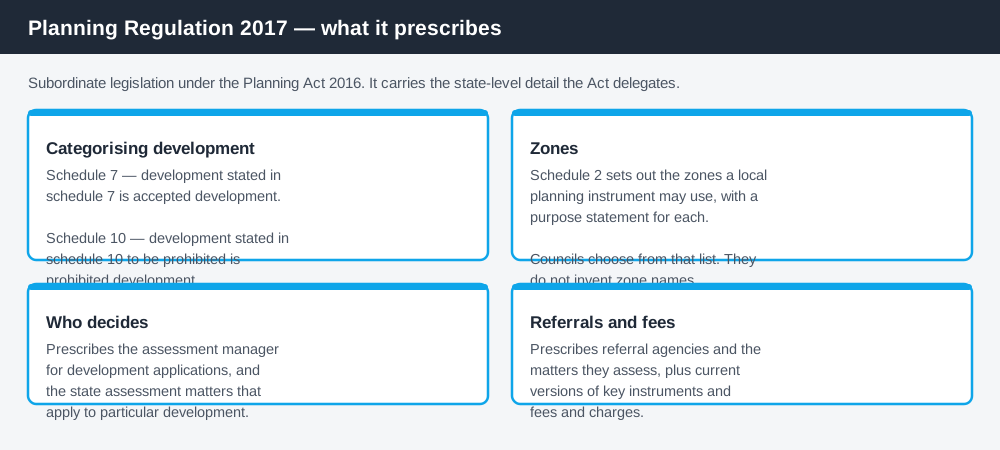
Figure 1: The regulation carries the detail the Act deliberately leaves out.
Where it sits
The Planning Act 2016 creates the framework and delegates. The Planning Regulation 2017 is what it delegates to — made under the Act, published on the Queensland legislation site, and amended considerably more often than the Act itself.
The state planning department describes the regulation as outlining the mechanics for the operation of the Planning Act 2016 and prescribing matters for the state, including how development is categorised, who the assessment manager is, state assessment matters, the current versions of key instruments, and fees.
That is a good description, because it captures the regulation's dual character. Part of it is procedural plumbing that only practitioners ever touch. Part of it directly determines whether an ordinary homeowner needs an approval.
The schedules that matter
Spend 5 minutes, not 3 weeks
instantDA generates a council-ready planning report for Queensland development applications. No town planner. No waiting.
Get your report →Three schedules come up repeatedly in ordinary applications.
Schedule 7 — accepted development. The regulation provides that, for the relevant provision of the Act, development stated in schedule 7 is accepted development. This is state-level accepted development, sitting alongside whatever your council's scheme makes accepted.
Schedule 10 — prohibited development. The regulation provides that development is prohibited development if it is stated in schedule 10 to be prohibited development. Schedule 10 also consolidates assessment and referral matters for particular development, arranged by topic, which is why it is the schedule most often cited in state referral discussions.
Schedule 2 — zones for local planning instruments. This schedule sets out the zones a local planning instrument may use, with a purpose statement for each. It is the reason zone names are consistent across Queensland even though the zone codes behind them are not. Councils choose from this list; they do not invent zone names. How to find out what zone your property is in covers what to do with that once you have it.
A caution worth taking seriously: schedule numbering and content change with amendments. Always work from the current consolidated version at legislation.qld.gov.au, not from a summary — including this one.
- ✓Is the development caught by a state-level accepted or prohibited provision?
- ✓Which zone does the scheme apply, and is it a zone from the regulation's list?
- ✓Does the application trigger a state referral?
- ✓Who is the assessment manager?
- ✓Are you looking at the current consolidated version?
Referral agencies: why the state appears in your council application
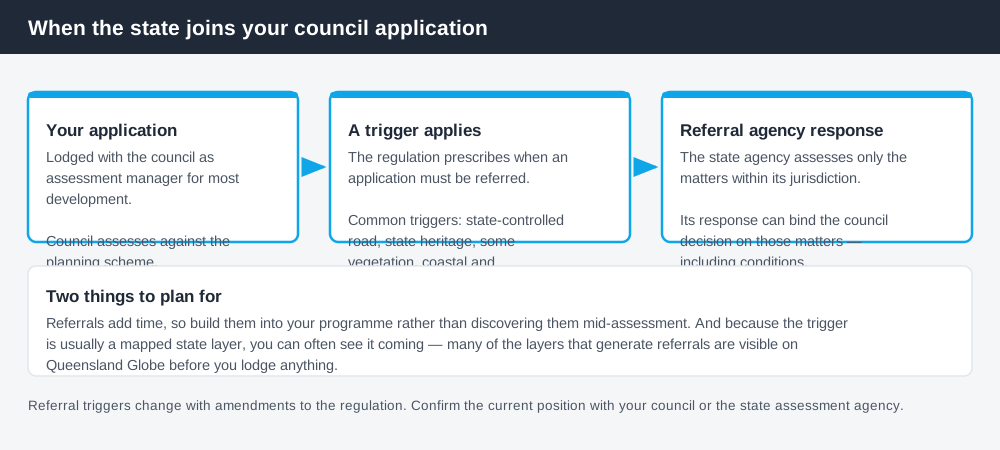
Figure 2: A referral adds a second decision-maker with its own jurisdiction over specific matters.
This is the part of the regulation that most often surprises applicants.
For many applications, the council is the assessment manager and the only decision-maker. But the regulation prescribes circumstances in which an application must be referred to a state referral agency — in practice usually the State Assessment and Referral Agency, which coordinates the state's role — and specifies the matters that agency assesses.
Common triggers include proximity to a state-controlled road, work affecting state heritage, certain vegetation clearing, some coastal and waterway matters, and particular infrastructure interests. The referral agency's response can bind the council's decision on the matters within its jurisdiction, which means a condition can arrive from an agency you never contacted.
Two practical consequences follow. Referrals add time, so factor them into your programme rather than discovering them mid-assessment. And the trigger is usually a mapped state layer, which means you can often see it coming — the Queensland Globe shows many of the state-administered layers that generate referrals.
What the regulation does not do
It does not tell you what is allowed on your land. That remains the province of your council's planning scheme, which applies the zone, the precinct, the overlays and the tables of assessment.
It does not set built form standards for ordinary development — heights, setbacks, site cover and parking rates are scheme matters.
It does not decide your application. The regulation identifies the assessment manager and the referral agencies; the assessment itself runs against the benchmarks in the scheme.
And it is not a policy document. The state's substantive policy positions sit in the State Planning Policy and regional plans, which work differently: they express state interests that must be integrated into schemes rather than operating as direct rules. The State Planning Policy explained covers that distinction, which is one of the more useful things to understand about how the state influences local outcomes.
Using it without getting lost
For most homeowners, the regulation is something to check for two specific things: whether a state-level accepted or prohibited provision catches the proposal, and whether a state referral is likely.
For everything else, go to your council's scheme first. The regulation's structure rewards people who already know what they are looking for and punishes browsing — the schedules are long, topic-based, and heavily cross-referenced.
If you find something that appears to apply, confirm it with the council's duty planner before acting on it. Misreading a schedule is easy, and the consequence of assuming development is accepted when it is not is that you have carried out assessable development without an approval.
What to do next
Establish the zone, overlays and category of assessment for your address, then check whether a state referral is likely. Between them, those two things describe the shape of your application.
If you'd rather see the zone, the overlays and the likely category of assessment for an address pulled together in one place, an instantDA planning report does that for $169 — against the $800–$1,500 a town planner typically charges for a preliminary opinion. You can start a report in a few minutes.
Then confirm with your council. The Planning Act 2016 explained covers the layer above this one, and is worth reading first if the vocabulary here is unfamiliar.
Frequently asked questions
What is the Planning Regulation 2017 in Queensland?
What is schedule 7 of the Planning Regulation 2017?
What is prohibited development in Queensland?
Does the Planning Regulation 2017 set the zones?
Why does the state get involved in a council development application?
How often does the Planning Regulation 2017 change?
Ready to generate your report?
Skip the writing. Get a council-ready planning report in 5 minutes.
Get your report