Key takeaways
- ✓The State Planning Policy is a state planning instrument expressing the state's interests in planning and development.
- ✓It works mostly indirectly: councils integrate it into their schemes, and you meet it as an overlay or a code rather than as a policy document.
- ✓Schemes must include a statement identifying state planning instruments and which parts have been appropriately integrated.
- ✓The SPP is policy. The Planning Regulation 2017 is rules. Confusing the two leads people to look in the wrong place.
- ✓Natural hazards — flood, bushfire, coastal — are where most homeowners actually encounter the state's interests.
The State Planning Policy Explained
You'll usually hear this called a development application, or DA — that's the formal name for council approval under the Planning Act 2016. Queensland's State Planning Policy, almost always shortened to SPP, is one of the instruments that shapes what your council does with that application, even though you will probably never read it.
It is the least visible part of the planning system and one of the more influential, because it is how the state's priorities end up written into a local council's overlay codes.
Get a council-ready planning report in 5 minutes — no planner, no waiting.
Get your report →The short answer
The State Planning Policy is a state planning instrument that sets out the state's interests in planning and development — matters such as natural hazards, environment, infrastructure and economic growth. Councils integrate it into their planning schemes, so most people meet the SPP indirectly, as an overlay or a code.
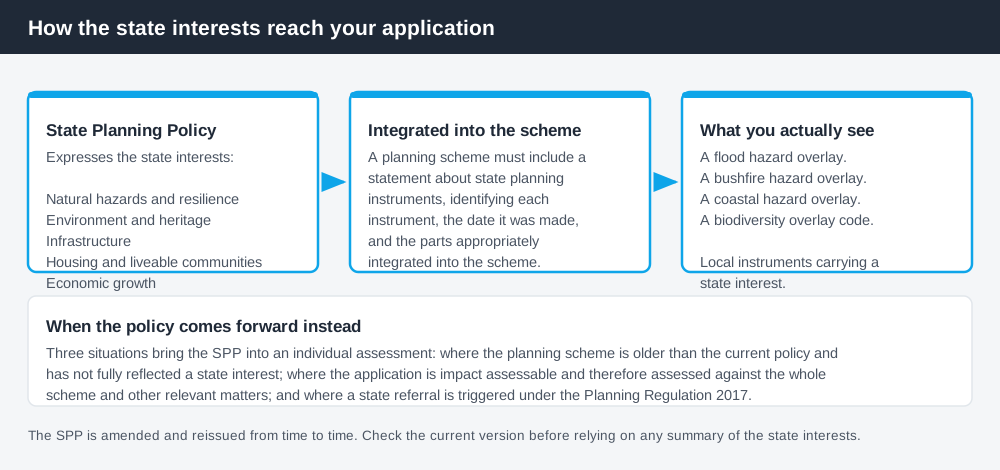
Figure 1: The SPP mostly reaches your application through your council's scheme, not directly.
Policy, not rules
The most useful distinction to hold onto is between the SPP and the Planning Regulation 2017, because people routinely look for one in the other.
The Planning Regulation 2017 is subordinate legislation. It is machinery: how development is categorised at state level, which zones councils may use, who the assessment manager is, which applications must be referred to state agencies. It contains rules you check. The Planning Regulation 2017 explained covers it.
The State Planning Policy is a policy instrument. It expresses what the state cares about and what outcomes it wants planning to achieve — protecting agricultural land, managing natural hazard risk, safeguarding water quality and biodiversity, supporting infrastructure and economic activity. It sets direction rather than procedure.
Both sit under the Planning Act 2016. They do different jobs, and looking for a rule about your shed in the SPP is a category error.
The state interests
Spend 5 minutes, not 3 weeks
instantDA generates a council-ready planning report for Queensland development applications. No town planner. No waiting.
Get your report →The SPP organises the state's interests into broad themes, covering matters including:
Liveable communities and housing — housing supply and diversity, and the qualities that make neighbourhoods work.
Economic growth — agriculture, development and construction, tourism, mining and extractive resources, and ports.
Environment and heritage — biodiversity, coastal environment, water quality, emissions and hazardous activities, and cultural heritage.
Hazards and safety — natural hazards, risk and resilience, covering flood, bushfire, coastal hazards and landslide.
Infrastructure — including the planning and protection of infrastructure and corridors that serve more than one local government area.
Because the SPP is amended and reissued from time to time, check the current version on the state planning site rather than relying on a themed list reproduced elsewhere, including this one. The themes are stable; the detailed wording of individual state interests is not.
How it reaches your council's scheme
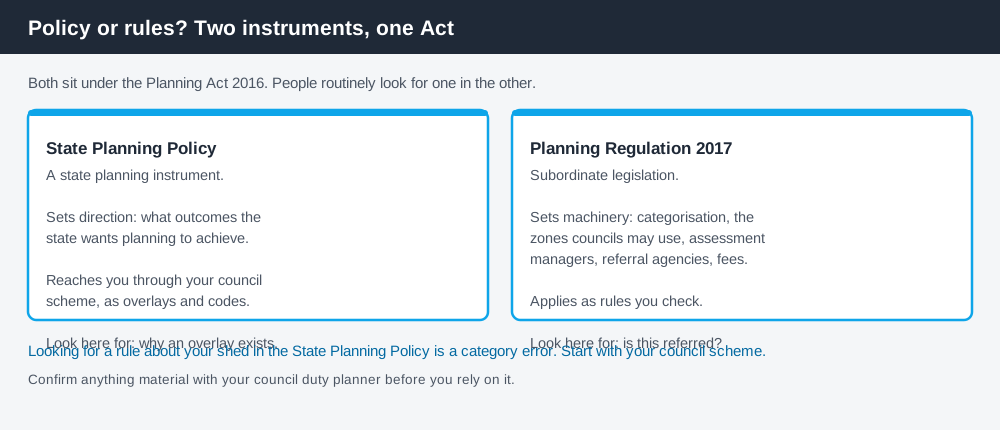
Figure 2: Two instruments under the same Act, doing different jobs.
The integration mechanism is deliberate and traceable.
When a local government makes or amends a planning scheme, it must respond to the current state planning instruments. Guidance on the current framework describes the requirement for a "Statement about State planning instruments" in a scheme, which must identify the instrument, the date it was made, and the parts that are appropriately integrated into the planning scheme.
That statement is genuinely worth finding in your own council's scheme. It tells you which state interests the council considers it has already dealt with, and where. It is usually near the front, in the administrative provisions.
Where a scheme has integrated a state interest properly, you engage with the council's code rather than the state policy. Where a state interest has not been adequately reflected, the SPP can become directly relevant to assessment — which is one of the ways a matter you thought was purely local acquires a state dimension.
- ✓Does your scheme include a statement about state planning instruments?
- ✓Which state interests does it say are integrated?
- ✓Which overlays on your site correspond to a state interest?
- ✓Is a state referral triggered as well?
- ✓Has the SPP been amended since your scheme was made?
Where you actually meet it
For most homeowners, the answer is overlays — and specifically the natural hazard ones.
The state's interest in natural hazards, risk and resilience is why flood, bushfire, coastal hazard and landslide are mapped and coded so consistently across Queensland councils. When your property report shows a flood hazard overlay and an overlay code that dictates floor levels, you are looking at a state interest that has been integrated into a local instrument. The flood hazard overlay explained covers what that means in practice.
The same is true of biodiversity and vegetation, water quality, coastal environment and heritage. The overlay is local. The reason it exists is usually not.
Seeing that connection is more useful than it sounds. When an overlay code seems arbitrary — a floor level requirement, a vegetation setback, a limit on building in a particular part of a lot — it usually is not arbitrary at all. It is a local expression of a state interest, and understanding the interest behind it tells you what a council is likely to accept by way of an alternative solution. Councils have discretion in how they respond to a performance outcome, but very little appetite for a response that abandons the state interest the provision exists to protect.
When it matters for a single application
For a routine application on a site with a modern scheme, the SPP usually stays in the background. Three situations bring it forward.
Where the scheme is older than the current SPP. Schemes are amended on their own cycles, and a scheme made before a state interest was updated may not fully reflect it.
Where the proposal is large or sensitive. Impact assessable applications are assessed against the whole planning scheme and other relevant matters, and state interests are more likely to feature in that broader assessment.
Where a state referral is triggered. The referral agency assesses the matters within its jurisdiction, and those matters are usually the operational expression of a state interest. How referrals work sits in the regulation rather than the policy, but the two connect here.
What to do next
For your own property, work from the council's scheme and its overlays. That is where the state's interests will have been translated into something you can actually comply with.
If you'd rather see the zone, the overlays and the likely category of assessment for an address pulled together in one place, an instantDA planning report does that for $169 — against the $800–$1,500 a town planner typically charges for a preliminary opinion. You can start a report in a few minutes.
Then confirm with your council. The current state planning instruments are published at planning.qld.gov.au, and it is worth checking the version there before relying on any summary of the state interests.
Frequently asked questions
What is the State Planning Policy in Queensland?
What is the difference between the SPP and the Planning Regulation 2017?
How does the State Planning Policy affect my property?
How does the SPP get into a planning scheme?
Do I need to read the SPP before lodging a development application?
Is the State Planning Policy the same as a regional plan?
Ready to generate your report?
Skip the writing. Get a council-ready planning report in 5 minutes.
Get your report