Key takeaways
- ✓The QPP was the standard template for planning schemes under the repealed Sustainable Planning Act 2009.
- ✓Under the Planning Act 2016 its role is performed by the regulated requirements in the Planning Regulation 2017 and the Minister's Guidelines and Rules.
- ✓The QPP's structural legacy is why every Queensland planning scheme still looks broadly the same.
- ✓Shared structure is not shared content. The codes, thresholds and tables of assessment behind the familiar headings are council-specific.
- ✓If a source refers to the QPP as a live instrument you must comply with, treat that source as out of date.
The Queensland Planning Provisions (QPP) Explained
You'll usually hear this called a development application, or DA — that's the formal name for council approval under the Planning Act 2016. If you have been researching Queensland planning for any length of time, you will have met the phrase Queensland Planning Provisions, usually abbreviated to QPP, and usually without much explanation of what it is or whether it still applies.
The short version is that the QPP explains why Queensland's planning schemes look so similar to each other — and that it is no longer the instrument doing that job.
Get a council-ready planning report in 5 minutes — no planner, no waiting.
Get your report →The short answer
The QPP was the standard template for local planning schemes under the repealed Sustainable Planning Act 2009. Under the Planning Act 2016 its role is performed by the regulated requirements in the Planning Regulation 2017 and the Minister's Guidelines and Rules. Schemes still share the QPP's structure.
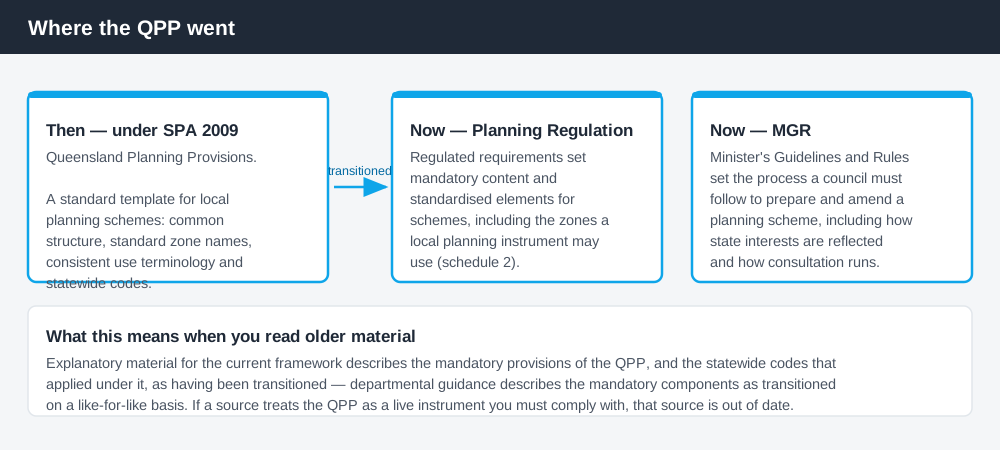
Figure 1: The template did not disappear. Its job moved to different instruments.
What the QPP was
Under the Sustainable Planning Act 2009, Queensland had a problem worth solving. Every council wrote its own planning scheme in its own way, with its own terminology, its own structure and its own zone names. Comparing two councils meant learning two systems, and anyone operating across local government boundaries — builders, developers, consultants, and eventually the state itself — carried that cost repeatedly.
The Queensland Planning Provisions were the answer: a standard template setting out a common structure and mandatory content for local planning schemes. Standard zone names. A common arrangement of parts. Consistent terminology for uses. Statewide codes for particular development.
It worked. The reason a Queensland planning scheme feels navigable once you have read one is the QPP.
What replaced it
Spend 5 minutes, not 3 weeks
instantDA generates a council-ready planning report for Queensland development applications. No town planner. No waiting.
Get your report →When the Planning Act 2016 commenced, the QPP did not simply continue. The explanatory material for the new framework describes the Planning Regulation 2017 as transitioning the regulated requirements for local planning instruments, including the mandatory provisions from the Queensland Planning Provisions made under the repealed Sustainable Planning Act 2009, and transitioning the statewide codes that applied to particular development under the QPP.
Departmental guidance on the new regulation puts it plainly: the mandatory components of the QPP were generally transitioned on a like-for-like basis.
So the function was preserved and redistributed. Today, two instruments carry it:
The Planning Regulation 2017. Its regulated requirements set mandatory content and standardised elements for schemes, including — in schedule 2 — the zones a local planning instrument may use, each with a purpose statement. The Planning Regulation 2017 explained covers that instrument in more detail.
The Minister's Guidelines and Rules. These set out the process a local government must follow to prepare and amend a planning scheme, including how state interests are reflected and how consultation runs.
The practical upshot: the QPP is not a current instrument you comply with. If a website, a consultant's report or an old council document treats it as one, that material predates the current framework or has not been updated.
- ✓Is the source referring to the QPP as current, or as historical?
- ✓Which Act is the source written under — SPA 2009 or the Planning Act 2016?
- ✓Does the scheme you are reading state the version and date?
- ✓Are the zone names the ones in the Planning Regulation's schedule?
- ✓Have you checked the scheme's own amendment history?
Why schemes still look the same
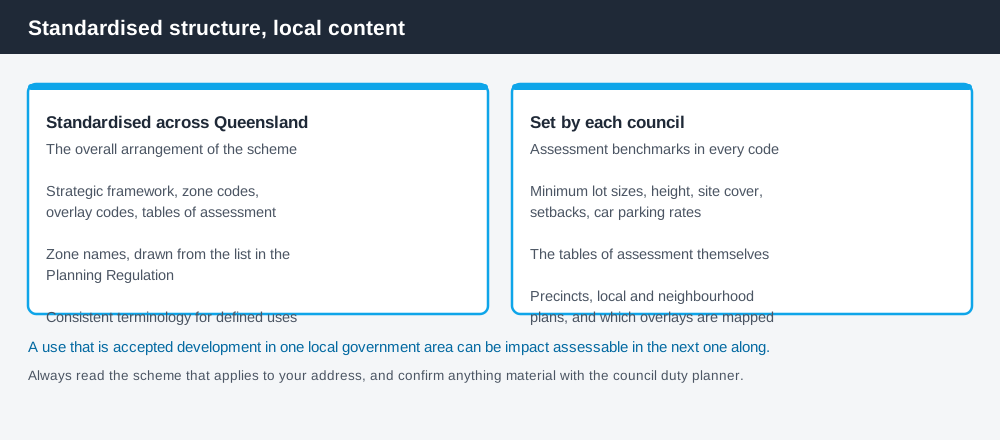
Figure 2: Familiar structure, unfamiliar content. The second half is where the money is.
The resemblance persists because the standardisation persisted — the instruments changed, not the objective.
That gives you a genuine practical advantage. Once you know that a Queensland scheme puts its strategic framework near the front, its zone codes in a predictable part, its overlay codes after those, and its tables of assessment in a recognisable form, you can find your way around a scheme you have never opened before in a couple of minutes.
Use that. Learning the shape of one scheme is a transferable skill across every Queensland local government.
Where the resemblance misleads
Here is the trap, and it catches experienced people.
Shared structure is not shared content. Two councils can use the same zone name, in the same position in the scheme, with the same heading above the code — and require quite different things underneath it. Minimum lot sizes, site cover, height limits, setbacks, car parking rates and, critically, the tables of assessment are local. A use that is accepted development in one local government area can be impact assessable next door.
Precincts and local plans are entirely local. They have no standardised equivalent, and they frequently override the zone position.
Overlays vary in name and content. The concept of an overlay is standard. Which overlays a council maps, what triggers them, and how demanding their codes are, is not.
Defined uses are consistent, but the assessment attached to them is not. Standardised terminology means a secondary dwelling is a secondary dwelling everywhere in Queensland. It does not mean a secondary dwelling is treated the same way everywhere. The definition is shared; the row in the table of assessment is local, and so are the conditions the council typically attaches.
So when someone tells you what the rule is in Queensland for a shed, a granny flat or a shop fitout, the honest answer is almost always that it depends on the council. How to find out what zone your property is in is where that specific answer starts, and centre zones explained shows how much variation sits behind a single standardised zone name.
Using the structure to move faster
A method that works on any Queensland scheme: find the zone for the address, read the zone code's purpose statement, then go straight to the table of assessment for the defined use you care about, then check every overlay that touches the site and read those codes too. Where several apply, the highest level of assessment prevails.
That sequence works everywhere precisely because of the standardisation the QPP began. It just is not the QPP you are relying on any more.
What to do next
Work from your council's current scheme, and treat any QPP reference you encounter as a signal to check the source's date.
If you'd rather see the zone, the overlays and the likely category of assessment for an address pulled together in one place, an instantDA planning report does that for $169 — against the $800–$1,500 a town planner typically charges for a preliminary opinion. You can start a report in a few minutes.
Then confirm with your council. The state's planning framework material is published at planning.qld.gov.au, which is the right place to check what is current before relying on anything older.
Frequently asked questions
What are the Queensland Planning Provisions?
Are the Queensland Planning Provisions still in force?
What replaced the QPP?
Why do Queensland planning schemes look so similar?
Do all Queensland councils apply the same planning rules?
Where do the standard zone names come from now?
Ready to generate your report?
Skip the writing. Get a council-ready planning report in 5 minutes.
Get your report