Key takeaways
- ✓A container home is a Class 1a dwelling. It is assessed against the same standards as a conventionally built house.
- ✓A storage container is usually a Class 10a structure, and councils commonly require building approval once it stays beyond about 30 days.
- ✓Several councils regulate containers by local law for amenity, with different time limits inside and outside urban zones.
- ✓Cutting openings or joining containers changes the structure, and an engineer has to certify that it still performs.
- ✓Insulation and energy efficiency are where container homes most often fail certification.
Shipping Container Homes in QLD — Council Approval
You'll usually hear this called a development application, or DA — that's the formal name for council approval under the Planning Act 2016. Container homes attract a particular kind of optimism: the container already exists, so surely it is not a building.
Queensland councils do not see it that way. Once a container is fixed, adapted or used for long enough, it is a building or structure, and once it is lived in it is a dwelling assessed against the same standards as any house.
Get a council-ready planning report in 5 minutes — no planner, no waiting.
Get your report →The short answer
A container home is a Class 1a dwelling under the National Construction Code and needs building approval assessed against the same standards as any house. A container used for storage is generally a Class 10a structure, and councils commonly require building approval once it stays beyond around 30 days.
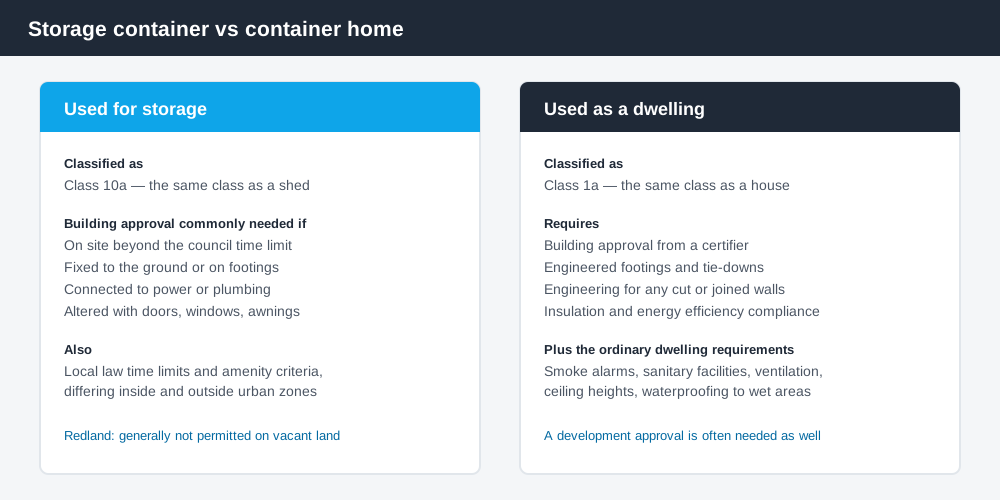
Figure 1: The same steel box, two entirely different regulatory positions.
Containers used for storage
Councils across Queensland treat a container used for storage as a Class 10a structure, the same class as a shed, once it is long-term or fixed to the ground.
The published positions are consistent. Gold Coast City Council requires building approval from a private building certifier where a container will be on the property for more than 30 days. Western Downs Regional Council applies the same 30-day trigger. Sunshine Coast Regional Council requires building approval where the container is used as a building or structure, used for long-term storage, fixed to the ground with footings or connected services, or altered with building works such as doors, windows or awnings. Redland City Council treats a container as building work where it is fixed to the ground, forms part of another structure, or is adapted for the purpose of a Class 1 to 10 building.
Toowoomba Regional Council goes further, describing containers as generally assessable development because of their size, and requiring a development approval before the container is placed on site even for a short time.
Local laws and amenity
Spend 5 minutes, not 3 weeks
instantDA generates a council-ready planning report for Queensland development applications. No town planner. No waiting.
Get your report →Several councils regulate containers by local law as well, principally for visual amenity.
Redland City Council has a subordinate local law dealing specifically with the placement of shipping containers, railway carriages and other objects on land, covering temporary placement for storage or during dwelling construction, and it states that placement is generally not permitted on vacant land.
Sunshine Coast Regional Council operates a self-assessable pathway for temporary placement, with different time limits by zone — under 30 days in an urban zone and under 90 days outside one — subject to criteria including that the container must not detrimentally impact local amenity or obstruct views. Beyond those limits a local law approval is required.
Logan City Council allows a container on private land for up to 30 days without a permit where it is wholly within the property, and requires a temporary permit for placement on a footpath.
Central Highlands Regional Council applies different time limits again — under 30 days in the General Residential zone, under 60 days outside it, with conditions on container size and use.
- ✓How long will the container be on site?
- ✓Which zone is the land in?
- ✓Is it fixed to the ground or connected to services?
- ✓Has it been cut, joined or altered?
- ✓Will anyone live in it?
Making a container home lawful
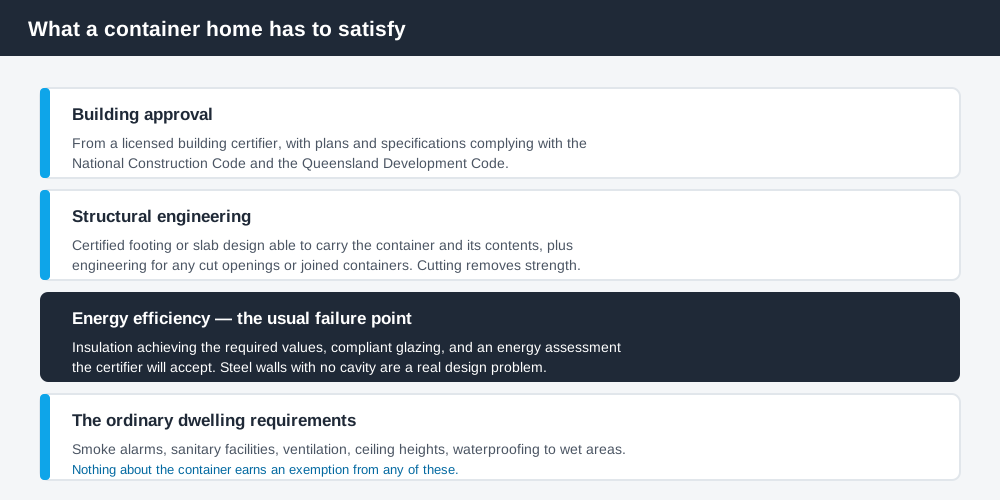
Figure 2: A container home is a house that happens to be made of containers.
Once anyone is going to live in it, the container is a Class 1a building — a single dwelling — and it is treated like any other home. Sunshine Coast states that a container used as a house, secondary dwelling or bedroom is a building and needs building approval. Redland reaches the same result for a container adapted for the purpose of a Class 1 building. Central Highlands requires a building development approval and engagement of a licensed private certifier.
That means the full package:
Building approval from a licensed building certifier, with plans and specifications complying with the National Construction Code and the Queensland Development Code.
Structural engineering. Toowoomba requires structural details including a design certificate from a Registered Professional Engineer of Queensland for footings or slab design capable of supporting the container and its contents and withstanding loads. Where openings are cut into container walls or multiple containers are joined, an engineer must confirm the modified structure still meets the structural performance requirements — a container gets much of its strength from its intact walls, and cutting it changes that.
Energy efficiency. Container homes must meet the same thermal performance requirements as any dwelling: insulation achieving the required values, compliant glazing, and an energy assessment the certifier will accept. Steel walls with no cavity are a genuine design problem, not a formality.
The ordinary dwelling requirements. Smoke alarms, sanitary facilities, ventilation, ceiling heights, waterproofing to wet areas.
Is a development approval also needed?
Separately, yes, sometimes. Western Downs says you may need a development permit depending on the size and location of the container, and notes that its scheme regulates containers the same way it regulates ordinary Class 10a or Class 1a structures — no special container rules, just the normal siting and size criteria.
For a container home in most residential zones, assume building approval is mandatory and that a development approval is likely if the dwelling is not accepted development in that zone, if siting or setbacks do not comply, or if an overlay applies. Shipping containers and council approval in QLD covers the residential storage-container question in more detail, and tiny houses and council approval in QLD covers the adjacent small-dwelling question.
Siting and setbacks
Containers follow the same siting rules as sheds and dwellings — the Queensland Development Code siting provisions for Class 1 and Class 10 buildings, as applied or modified by the local scheme. Confirm the applicable part with your certifier.
Central Highlands' published figures give a sense of the typical thresholds: a container placed within 1.5 metres of a side or rear boundary, or within 6 metres of the front boundary, requires a siting relaxation from town planning. It also notes that building in a flood hazard area requires council approval and may need additional engineering to prevent the container being displaced.
Why container homes fail certification
The recurring failures are predictable:
Wrong classification. Treating a lived-in container as a Class 10a shed, and missing the dwelling requirements that follow from Class 1a.
Insufficient engineering. No certified footing and tie-down design, or no engineering for openings cut into the walls and for joining or stacking containers.
Insulation and energy efficiency. Thin or absent insulation, non-compliant glazing, and no acceptable energy assessment.
Siting. Too close to a boundary without a relaxation, or over an easement or infrastructure.
Amenity. No cladding, screening or landscaping to soften the industrial appearance, in councils that assess amenity and aesthetics.
What to do next
Engage a private building certifier before you buy containers, not after. Get an engineer's view on your specific configuration, particularly any cutting or joining. Check the zone and overlays for the lot on your council's mapping and on the Queensland Globe, and check the council's local laws register for container-specific rules.
If you'd rather see the zone, the overlays and the likely category of assessment for an address than work through a planning scheme yourself, an instantDA planning report does that for $169 — against the $800–$1,500 a town planner typically charges for a preliminary opinion. You can start a report in a few minutes.
Then confirm with your council. Relocatable and removal homes in QLD covers the closely related question of bringing an existing building onto a site.
Frequently asked questions
Do I need council approval for a shipping container home in Queensland?
How long can a shipping container sit on my property without approval?
Does a storage container need building approval?
Can I cut windows and doors into a container?
Why do container homes fail certification?
Can I put a container on a vacant block?
Ready to generate your report?
Skip the writing. Get a council-ready planning report in 5 minutes.
Get your report