Key takeaways
- ✓A battle-axe block is a rear lot, created through reconfiguring a lot (ROL) — that is the term your council and your surveyor will use.
- ✓Many planning schemes exclude the access handle from the lot area calculation, which can drop an apparently compliant lot below the minimum.
- ✓There is no state-wide access handle width in Queensland; every figure comes from an individual council's planning scheme.
- ✓Somerset Regional Council limits how many lots can take access from one access strip; South Burnett requires 6m of road frontage for a rear lot in its low density residential zone.
- ✓The handle is land you buy, build, drain and maintain but cannot build on — price that in before you commit.
Battle-Axe Blocks in QLD — Subdivision Rules
You'll usually hear this called a battle-axe block: a rear lot reached from the street by a long, narrow strip of land, so the shape on the plan looks like an axe with a handle. In Queensland the formal term is a rear lot created through reconfiguring a lot, or ROL — the language your council, your surveyor and your development approval will all use. Splitting a large suburban block into a front lot and a rear lot is the most common subdivision in the state, and it is also where a plan that looked obvious on a napkin quietly falls apart.
Get a council-ready planning report in 5 minutes — no planner, no waiting.
Get your report →The short answer
A battle-axe block is a rear lot created through reconfiguring a lot. Councils control the access handle's width, whether its area counts towards the lot size, the driveway's construction and gradient, room for services and bins, and how many lots one handle may serve. Every figure comes from your own planning scheme.
That last sentence is the one that matters. Queensland's schemes follow the Queensland Planning Provisions structure, but each council layers its own codes and overlays on top, and rear lot standards are among the least uniform provisions going.
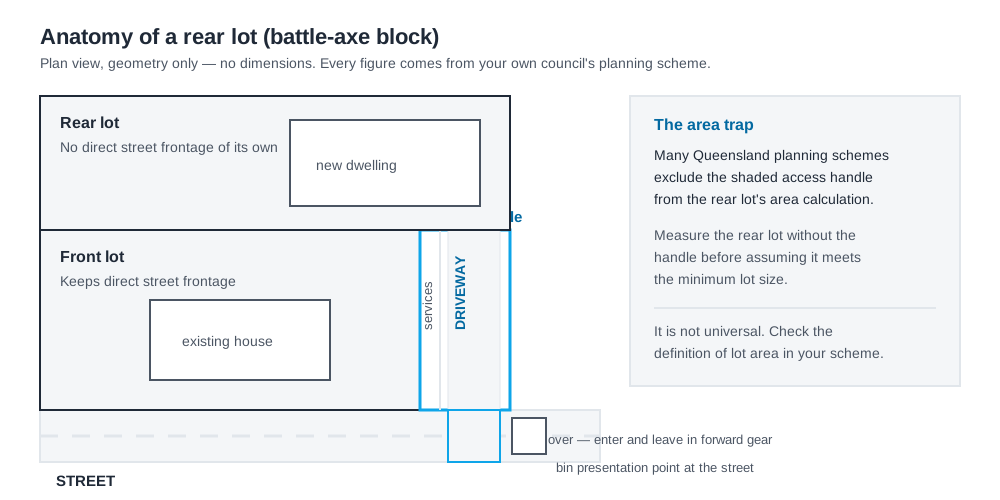
Figure 1: The parts of a rear lot, and the strip that many schemes leave out of the area calculation.
What a rear lot actually is
A rear lot sits behind another lot with no direct street frontage of its own. Instead it owns a narrow arm of land running out to the road — called the access handle, the access strip or the accessway depending on which scheme you are reading. That arm is part of the rear lot's title. It is not a shared driveway and it is not an easement, though an easement over a neighbouring lot is sometimes used where a handle cannot be created.
Because the handle is owned land, the rear owner pays for it, builds the driveway on it, drains it and maintains it. They also cannot build on it. That is the economics of a battle-axe: you buy a strip of land whose only purpose is to let you reach the useful part.
What planning schemes control for a rear lot
Spend 5 minutes, not 3 weeks
instantDA generates a council-ready planning report for Queensland development applications. No town planner. No waiting.
Get your report →Rear lot standards appear in the reconfiguring a lot code, the zone code and sometimes an access or driveway code. Read all three; a lot can satisfy one and fail another.
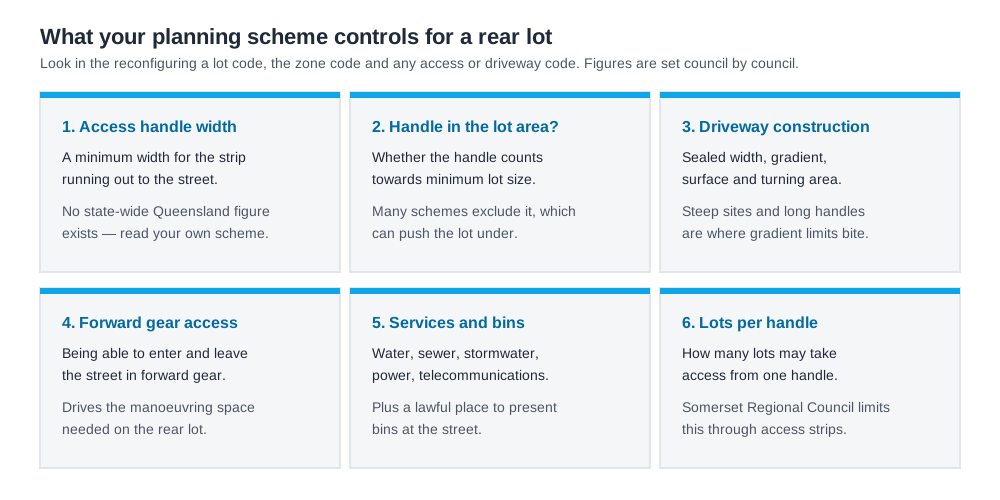
Figure 2: The six matters to look for in your scheme's reconfiguring a lot code.
- ✓Minimum width of the access handle
- ✓Whether the handle area is excluded from the lot area
- ✓Driveway sealed width, gradient, surface and turning provision
- ✓Ability to enter and leave the street in forward gear
- ✓Space in the handle for water, sewer, stormwater, power and telecommunications
- ✓Somewhere to present bins for collection
- ✓The number of lots permitted to take access from one handle
Handle width is set council by council. There is no state-wide access handle width in Queensland, so treat any number you find on a forum or in a sales listing as belonging to some other council until you have read your own scheme.
The area trap that catches most rear lots
This is the rule that ends more battle-axe proposals than any other, and it is easy to miss. Many Queensland planning schemes exclude the area of the access handle when calculating whether the rear lot meets the minimum lot size. Not all do, but enough do that you should assume it until proven otherwise.
Work it in the right order: find the minimum lot size for your zone, read the definition of "lot area" or the note under the reconfiguring a lot code to see whether the handle is excluded, then measure the rear lot without the handle. If that number falls short, the design does not work as drawn, however comfortable the total site area looked. Because minimum lot sizes are set by each council rather than by the State, our guide to minimum lot sizes in Queensland is worth reading before you sketch anything.
The driveway, the services and the bins
The handle has to carry more than a car. Schemes commonly specify a sealed driveway of a stated width, a maximum gradient, an acceptable surface, and enough manoeuvring space that a vehicle can enter the street in forward gear rather than reversing blind past a fence. Steep sites and long handles are where gradient limits bite hardest, and the fix — regrading, retaining, a longer transition at the crossover — is civil work, not drafting.
Underneath the driveway sits everything the rear dwelling needs: a water connection and meter, a sewer connection, stormwater drainage, electricity and telecommunications. Each has its own cover and separation requirements, and the handle has to hold them all alongside the pavement. Refuse collection is the one people forget — most councils will not send a truck up a handle, so the rear lot needs a lawful place to present bins at the street.
Most of this becomes conditions on the ROL approval, then design and construction under a separate development permit. Our guide to operational works in Queensland explains that second approval, where driveway crossovers, drainage and service reticulation are actually assessed.
Two Queensland councils, and why they are not the rule
Two councils publish rear lot positions clearly enough to quote.
Somerset Regional Council explicitly controls rear lots through access strips, limiting the number of lots that may take access from a single access strip and preventing rear lots from being concentrated together in one part of a neighbourhood.
South Burnett Regional Council requires a minimum 6m road frontage for a rear lot in its low density residential zone, alongside larger frontages for standard and corner lots.
These are two councils' figures. They are not a Queensland standard and they do not apply anywhere else. Your own planning scheme is the only document that governs your land — confirm the position with your council before relying on anything. The South Burnett subdividing land fact sheet shows how a council sets these standards out.
What goes wrong beyond the numbers
A rear lot can clear every measurable standard and still be a poor development. Assessment against the scheme looks at outcomes, not just figures.
Amenity and privacy come first. The rear dwelling looks into the front dwelling's back yard, and the front dwelling loses the yard it used to have. Where the proposal is impact assessable, that is exactly what neighbours will make submissions about. Stormwater is next: rear parts of blocks often fall away from the street, so the natural drainage path runs to a neighbour rather than to a kerb, and overland flow across the handle has to be managed rather than ignored. Sewer connection is a question of depth and distance — a long, flat handle can put the rear dwelling below the level it needs to drain by gravity. And mature trees in the handle are usually the first casualty of a driveway, which matters if the scheme or an overlay protects them; check what sits over your land using Queensland Globe early.
The order to check things in
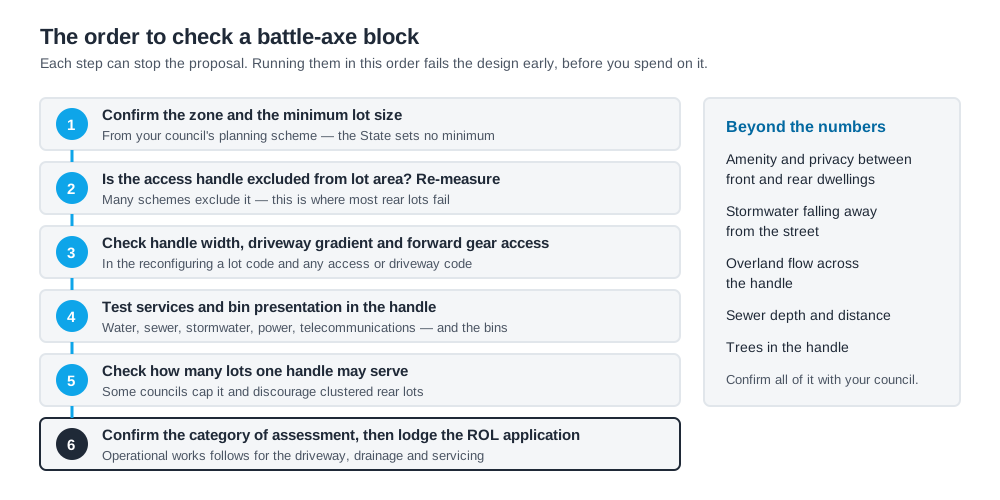
Figure 3: The checks in the order that saves you the most money.
Confirm the zone and the minimum lot size. Check whether the handle area is excluded, and re-measure. Read the handle width and driveway standards. Test services and bin presentation. Check how many lots one handle may serve. Only then work out the category of assessment and what a reconfiguring a lot application will involve under the Planning Act 2016.
If you would rather see that worked through against your actual address, an instantDA planning report sets out your zone, your overlays and the likely category of assessment for $169 — against the $800–$1,500 a town planner typically charges for a preliminary opinion. You can start a report in a few minutes. Either way, confirm the final position with your council, because your scheme is the one that governs.
Frequently asked questions
What is a battle-axe block in Queensland?
How wide does an access handle have to be in QLD?
Does the access handle count towards the lot size?
How many lots can share one access handle?
Do I need a separate approval for the driveway?
Can a rear lot be refused even if it meets the minimum lot size?
Ready to generate your report?
Skip the writing. Get a council-ready planning report in 5 minutes.
Get your report