Key takeaways
- ✓Ipswich City Plan 2025 took effect on 1 July 2025, replacing the Ipswich Planning Scheme 2006.
- ✓Council runs its own Development.i instance for looking up applications near you.
- ✓Development approval and building approval are separate. One does not substitute for the other.
- ✓Land in the Ripley Valley Priority Development Area is assessed under a state development scheme, not the City Plan.
- ✓Flooding, former mining land and character housing are the three constraints that most often surprise Ipswich owners.
Do You Need Council Approval in Ipswich?
You'll usually hear this called a development application, or DA — that's the formal name for council approval under the Planning Act 2016. In Ipswich, Council is the assessment manager for most of these, and the rules it applies come from Ipswich City Plan 2025.
Ipswich is unusual in two ways. Its planning scheme is brand new: Council adopted Ipswich City Plan 2025 on 29 May 2025 and it took effect on 1 July 2025, replacing the Ipswich Planning Scheme 2006 that had governed the city for nearly two decades. And a large slab of the local government area — the Ripley Valley — is not assessed under the City Plan at all.
Get a council-ready planning report in 5 minutes — no planner, no waiting.
Get your report →The short answer
In Ipswich, you need a development application when Ipswich City Plan 2025 makes the work assessable for your zone and overlays. Some minor domestic work is accepted development. Building approval is a separate decision, usually made by a private certifier. Land in the Ripley Valley is assessed under a different scheme entirely.
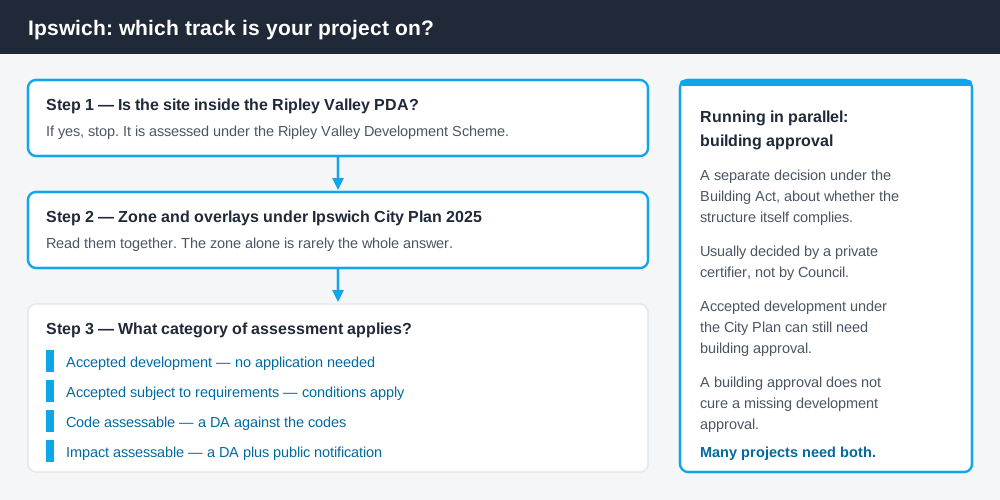
Figure 1: Two tracks run in parallel. Answering one does not answer the other.
A scheme that is only a year old
A 2025 scheme replacing a 2006 one means almost every reference point older than mid-2025 is out of date. A report prepared before July 2025 may have been right then and wrong now.
Like every Queensland scheme, Ipswich City Plan 2025 follows the standardised structure used across the state — zones, overlays, and tables giving the category of assessment for a defined use — but the codes layered on top are Council's own. Queensland schemes are far less uniform than people assume, and an outcome approved in a neighbouring council tells you very little about Ipswich. How to find out what zone your property is in covers reading that structure generally.
Two approval tracks, not one
Spend 5 minutes, not 3 weeks
instantDA generates a council-ready planning report for Queensland development applications. No town planner. No waiting.
Get your report →This is the single most useful distinction for an Ipswich homeowner.
Development approval is a Planning Act 2016 decision. Council is the assessment manager. It deals with land use, siting, scale, and compliance with the codes in the City Plan.
Building approval is a Building Act decision about whether the structure complies with the building assessment provisions. It is usually given by a private certifier, not by Council.
They are separate approvals, from separate legislation, with separate decision-makers. A shed can be accepted development under the City Plan and still need building approval. Holding a building approval does not cure the absence of a development approval where one was required. Building approval versus development approval covers the distinction in full, and accepted versus assessable development explains why "accepted" and "accepted subject to requirements" are not the same thing.
- ✓What zone applies to the address?
- ✓Which overlays touch it?
- ✓Is the site inside the Ripley Valley PDA?
- ✓Is the work accepted, or assessable?
- ✓Do you also need building approval from a private certifier?
Checking your own address in Ipswich
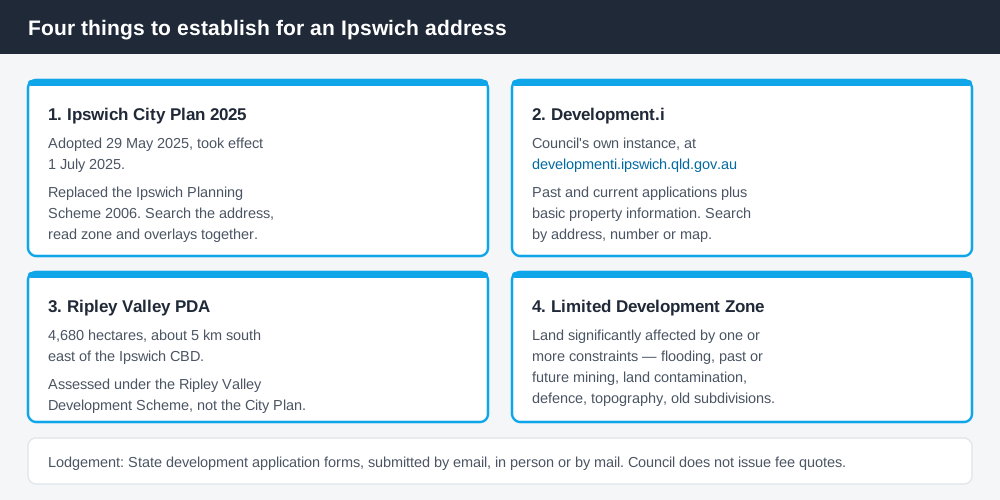
Figure 2: Four Ipswich-specific things to establish before you design anything.
Council publishes Ipswich City Plan 2025 as an online scheme with property search and mapping. Search your address, and read the zone and every overlay together — the zone alone is rarely the whole answer.
Council also runs its own instance of Development.i at developmenti.ipswich.qld.gov.au — a way to stay informed about your area, gather information to help prepare applications, and make a submission. What has actually been approved on comparable sites near you often tells you more than the code text does. Using Development.i covers what the tool does and does not show.
For state-administered layers, cross-check the site on the Queensland Globe.
What catches Ipswich owners out
Flooding. Ipswich sits on the Bremer River and has a long, well-documented flood history. The City Plan carries flood mapping and codes that drive floor levels and, for some work, the category of assessment. Council's fee register even lists a charge for using Council's own flood model — an indication of how central flood modelling is to development here. The flood hazard overlay explained covers what that mapping does to a project.
Former mining land. Ipswich has a coal mining history, and land affected by past or future mining activity is treated as a genuine constraint. Council's Limited Development Zone material describes that zone as identifying land significantly affected by constraints such as flooding, land contamination, past or future mining activities, or topography. In that zone, the starting assumption is that little further development is anticipated.
Character housing. Ipswich has a substantial stock of older housing, and the City Plan carries character and heritage provisions that bite on demolition and on work visible from the street. The character overlay explained covers how these controls operate.
The Ripley Valley. This is the one most people get wrong. The Ripley Valley Priority Development Area covers 4,680 hectares about five kilometres south east of the Ipswich CBD, declared in October 2010 under state legislation administered by Economic Development Queensland. Applications there are assessed against the Ripley Valley Development Scheme, not Ipswich City Plan 2025 — Council decides most of them, but as delegate of the Minister for Economic Development Queensland. Reading the City Plan for a Ripley address is reading the wrong document.
When you will probably need a DA
Work that changes the use of a property, adds a dwelling, subdivides, sits on flood or mining-affected land, affects a character building, or exceeds the thresholds in the applicable code, is likely to be assessable.
Minor domestic work on an unconstrained suburban lot — a modest shed, a standard-height fence, internal alterations that do not change floor area or height — is much more often accepted development, subject to any requirements attached to that acceptance. The only reliable way through is the categorisation table for your defined use, read against your zone and overlays.
What to do next
Pull the planning details for your address from the City Plan, list every overlay, confirm whether the site is inside the Ripley Valley PDA, then read the relevant table.
If you'd rather see the zone, the overlays and the likely category of assessment for an Ipswich address pulled together in one place, an instantDA planning report does that for $169 — against the $800–$1,500 a town planner typically charges for a preliminary opinion. You can start a report in a few minutes.
Then confirm with Council. Applications are lodged on the State development application forms and may be submitted by email to [email protected], in person, or by mail. Note that Council does not issue development application fee quotes or invoices — you work the fee out yourself from Council's fees and charges register, reissued annually, so always take the figure from the current version.
Frequently asked questions
What is Ipswich's planning scheme?
Do I need council approval in Ipswich for a shed or deck?
How do I lodge a development application with Ipswich City Council?
Why is the Ripley Valley different?
Is building approval the same as council approval in Ipswich?
Ready to generate your report?
Skip the writing. Get a council-ready planning report in 5 minutes.
Get your report