Key takeaways
- ✓The Northern Peninsula Area, at the tip of Cape York, is a single council formed in 2008 from five communities: Bamaga, Injinoo, New Mapoon, Seisia and Umagico.
- ✓The land is trust land held for Aboriginal and Torres Strait Islander residents, not ordinary freehold, so the practical first step is usually a lease or permission from the landholder.
- ✓Because five communities sit under one council, tenure and requirements can differ between them — the position for Bamaga is not automatically the position for Injinoo.
- ✓The Council assesses development under the Planning Act 2016, and has prepared a planning scheme; confirm the current scheme status with the Council.
- ✓Building approval under the Building Act 1975 is a separate approval again, usually from a private certifier.
Do You Need Council Approval in the Northern Peninsula Area?
The Northern Peninsula Area sits at the very tip of Cape York. It is a single regional council, formed in 2008 by bringing together five communities — Bamaga, Injinoo, New Mapoon, Seisia and Umagico. Two of those communities are Torres Strait Islander and three are Aboriginal, and that mix matters, because the land is held in trust for the community rather than owned as ordinary freehold. Before the familiar "do I need a development application" question comes a prior one: who holds the land here, and what interest can you get in it.
Get a council-ready planning report in 5 minutes — no planner, no waiting.
Get your report →The short answer
It depends on the community, and tenure comes first. The Northern Peninsula Area covers five communities on trust land held for Aboriginal and Torres Strait Islander residents. You normally need a lease or permission from the landholder before anything else. The Council assesses development under the Planning Act 2016.
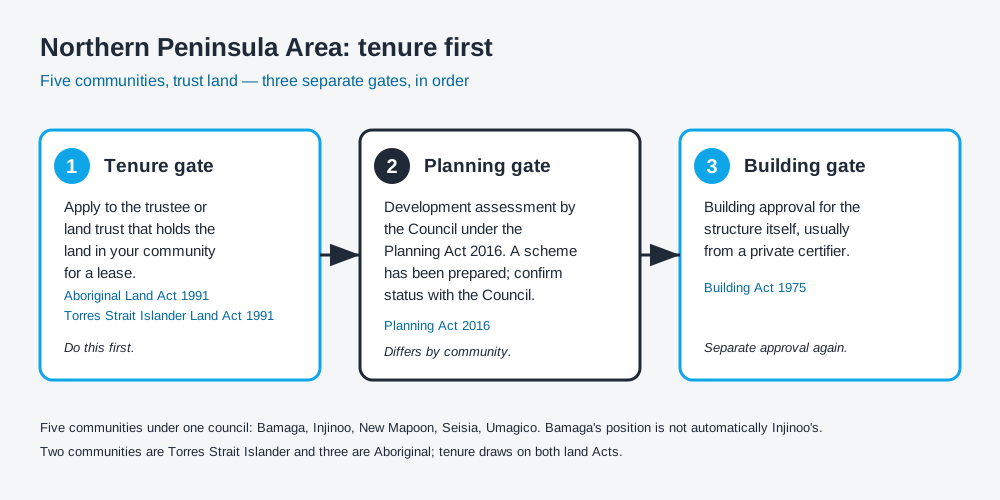
Figure 1: Tenure first, then assessment. With five communities under one council, the details differ between them.
What the land tenure is
The five communities of the Northern Peninsula Area sit on trust land — land granted by the State in fee simple in trust and held for the benefit of the community, not sold as ordinary private freehold. Because the area brings together both Aboriginal and Torres Strait Islander communities, the trust arrangements draw on the Aboriginal Land Act 1991 (Qld) and the Torres Strait Islander Land Act 1991 (Qld), alongside the Land Act 1994 (Qld). Native title is part of the picture too, handled under the Native Title Act 1993 (Cth).
The practical consequence is the same across all five: to build or use a parcel, you first need a lawful interest in that specific land, and on trust land that is usually a lease granted by the trustee or land trust that holds it. You apply to the landholder, it decides whether to grant a lease for the use, term and conditions, and the lease is registered with the State land registry. Only then do you hold something to build on.
The reason to check community by community is that the tip is not uniform. The position for a lot in Bamaga is not automatically the position for a lot in Injinoo, so the first question is always which community the land is in and who holds it.
Does a planning scheme apply?
Spend 5 minutes, not 3 weeks
instantDA generates a council-ready planning report for Queensland development applications. No town planner. No waiting.
Get your report →The Council assesses development under the Planning Act 2016 — its published decisions include material change of use approvals and reconfiguring a lot applications across the area, so the assessment machinery is live. The Council has also prepared a planning scheme for the area. Because the current status and coverage of that scheme is the sort of thing that changes, the reliable step is to confirm with the Council which instrument applies to your parcel and its community before you plan around it.
The land interest and the planning approval are two different decisions. One practical link worth knowing: the Planning Act treats a lease of more than 10 years that divides a lot as reconfiguring a lot, which is itself assessable — so a long community lease and a development approval are often connected.
The practical sequence is: (1) approach the Council in its trustee capacity with a proposal that identifies the parcel, the proposed use, and the term; (2) the Council as trustee decides whether to grant a lease under the Land Act 1994 and the Aboriginal Land Act 1991, including any native title procedures required under the Native Title Act 1993 (Cth); (3) if granted, the lease is registered with the State land registry and you hold a registrable interest; (4) with that interest in hand, approach the same Council in its separate capacity as assessment manager to determine whether a development application is needed under the planning scheme.
What still works the same way
Beneath the tenure layer, the ordinary framework applies. Where a development application is required, it is lodged on the standard DA Form 1, and the Council is the assessment manager. Building work is handled separately again under the Building Act 1975, usually by a private building certifier — a different approval from the planning one. Where the project is small domestic work that is accepted development under the scheme, no development application is needed — but building approval from a private certifier under the Building Act 1975 may still apply. Accepted development does not mean unregulated; it means the project meets all of the planning scheme standards without needing a DA. Keep records of how it meets those standards in case the question arises. Building approval versus development approval sets out that distinction. In a remote community, getting a private building certifier is a practical constraint in its own right. There may be only one or two certifiers who regularly work in the region, and travel costs can add materially to the project. It is worth identifying a certifier early — before you finalise a design — to confirm they are available and to understand their fee structure for the location. Finding a building certifier in QLD and building approval versus development approval set out the general process.
Where to start
Start with the Northern Peninsula Area Regional Council, and lead with two facts: which of the five communities the land is in, and whether you already hold an interest in it. That lets the Council point you to the right landholder for a lease and tell you how development is assessed for that community. Where the State has a role — a state-controlled road or other State interest — the State Assessment and Referral Agency (SARA) is the referral point.
Because the first gate here is tenure rather than a planning lookup, an instantDA planning report is not the starting point for a Northern Peninsula Area project — the Council and the community landholder are. A report can help later, if a development application is needed, but it does not grant or replace the interest in the land that has to come first.
Frequently asked questions
Which communities does the Northern Peninsula Area cover?
Can I buy land freehold in the Northern Peninsula Area?
Do I need a development application to build here?
Who do I contact first?
Is building approval the same as council approval?
Ready to generate your report?
Skip the writing. Get a council-ready planning report in 5 minutes.
Get your report