Key takeaways
- ✓Weipa is not an Aboriginal Shire. It is a company town administered by the Weipa Town Authority, a statutory body.
- ✓The town sits on land tied to long-standing bauxite mining lease arrangements. Rio Tinto (formerly Comalco) owns or controls most of the land and infrastructure.
- ✓Getting an interest in land in Weipa runs through those arrangements — the town authority and Rio Tinto under the Weipa Township Agreement — not a Deed of Grant in Trust.
- ✓Weipa does have a local planning scheme, the Weipa Town Planning Scheme, with the Weipa Town Authority as assessment manager under the Planning Act 2016.
- ✓Building approval under the Building Act 1975 is a separate approval again, usually from a private certifier.
Do You Need Council Approval in Weipa?
Weipa is unlike anywhere else on this list. It is not an Aboriginal Shire and it is not an ordinary council area. It is a company town on the western side of Cape York, built to serve one of the world's largest bauxite operations, and it is administered by the Weipa Town Authority rather than a shire council. That history shapes both who controls the land and who approves development.
Get a council-ready planning report in 5 minutes — no planner, no waiting.
Get your report →The short answer
Usually yes, but the land question is unusual. Weipa is a company town administered by the Weipa Town Authority, on bauxite-lease land where Rio Tinto controls most of it. Securing an interest in land runs through those arrangements first. Development is then assessed under the Weipa Town Planning Scheme.
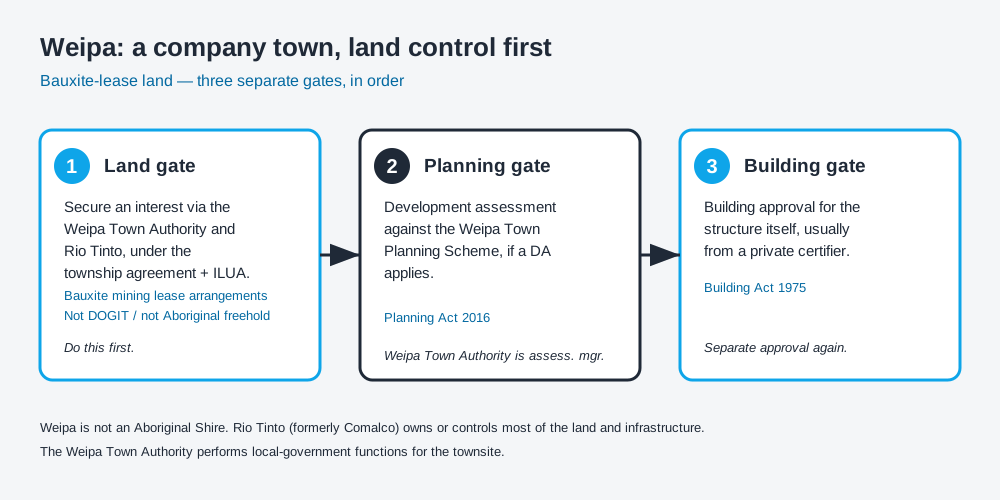
Figure 1: In a company town the land-control question comes before the planning question.
What the land tenure is
Weipa's land is not Deed of Grant in Trust and it is not Aboriginal freehold. The townsite sits on land tied to long-standing bauxite mining lease arrangements between the State and the mining company — arrangements that date back to the agreement of the 1950s that established the operation, originally run by Comalco and now by Rio Tinto. In practical terms, Rio Tinto owns or controls most of the land and infrastructure in and around the town, and it laid the town out.
The town is administered by the Weipa Town Authority, a statutory body that performs local-government functions for the townsite. Its board reflects the town's structure: it includes elected community representatives, a Traditional Owner representative, and a Rio Tinto representative, and the town operates under the Weipa Township Agreement. Traditional Owner interests are recognised through an Indigenous Land Use Agreement.
The consequence for anyone wanting to build or run a business is that the first question is not "which zone am I in" but "how do I secure an interest in this land." That runs through the Weipa Town Authority and, given Rio Tinto's control of most land, the company's arrangements — subject to the township agreement and the land use agreement with Traditional Owners.
Does a planning scheme apply?
Spend 5 minutes, not 3 weeks
instantDA generates a council-ready planning report for Queensland development applications. No town planner. No waiting.
Get your report →Yes. Weipa has a local planning scheme — the Weipa Town Planning Scheme — and the Weipa Town Authority acts as the assessment manager under the Planning Act 2016. So once the land question is settled, development assessment works like elsewhere in Queensland: the scheme sets zones and codes and tells you whether a use or building is accepted, code assessable or impact assessable. Accepted versus assessable development explains those categories.
As in the trust communities, the land decision and the planning decision are separate — but in Weipa the land decision involves the company and the town authority rather than a trustee of community land. The Weipa Town Authority was established under the Local Government Act 2009 through a specific regulation that created a town authority for the Weipa townsite. Unlike a conventional council, it does not have a mayor and a full council elected by residents. Its board comprises community-elected representatives, a Traditional Owner representative nominated under the Indigenous Land Use Agreement, and a representative appointed by Rio Tinto — reflecting the tripartite arrangement between the community, the Traditional Owners, and the mining company that owns and operates the town's infrastructure.
Because the authority performs local-government functions but does not own the land or the infrastructure, its development assessment role under the Planning Act 2016 operates within the practical constraint that most land is controlled by Rio Tinto. The Weipa Town Planning Scheme provides the zone and code framework, and the authority assesses development applications against it in the usual way — but an applicant must first secure an interest in the relevant land through the company's arrangements and the township agreement. This is the key structural difference from a standard council: the consent authority and the land-controlling entity are not the same body.
For practical purposes, the process is: (1) confirm with the Weipa Town Authority that the proposed use is consistent with the planning scheme zone and codes; (2) secure an interest in the land through Rio Tinto's processes under the Weipa Township Agreement and the Indigenous Land Use Agreement; (3) lodge the development application with the authority as assessment manager. For building work, a private certifier issues building approval separately under the Building Act 1975 — the certifier is engaged by the applicant, not by the authority, and remoteness means identifying a certifier who services Cape York is a practical step to take early. The certifier checks the project against the Building Code of Australia and the Queensland Development Code, entirely separately from the planning assessment. For building work, a private certifier issues building approval separately under the Building Act 1975. A new or intensified use is still a material change of use that may need a development application.
What still works the same way
Where a development application is required, it is lodged on the standard DA Form 1, with the Weipa Town Authority as assessment manager. Building work is handled separately again under the Building Act 1975, usually by a private building certifier — a different approval from the planning one. Where the project is small domestic work that is accepted development under the scheme, no development application is needed — but building approval from a private certifier under the Building Act 1975 may still apply. Accepted development does not mean unregulated; it means the project meets all of the planning scheme standards without needing a DA. Keep records of how it meets those standards in case the question arises. Building approval versus development approval sets out that distinction. In a remote community, getting a private building certifier is a practical constraint in its own right. There may be only one or two certifiers who regularly work in the region, and travel costs can add materially to the project. It is worth identifying a certifier early — before you finalise a design — to confirm they are available and to understand their fee structure for the location. Finding a building certifier in QLD and building approval versus development approval set out the general process. Where the State has a role — a state-controlled road or other State interest — the State Assessment and Referral Agency (SARA) is the referral point.
Where to start
Start with the Weipa Town Authority. Because most land is controlled through the mining lease arrangements, the authority is the right first point of contact to understand how to secure an interest in a particular parcel and how development is assessed for it. Expect the land question and the planning question to be handled as two separate steps.
Because the controlling-interest-in-land step here is a company-town arrangement rather than an ordinary title search, an instantDA planning report is not the starting point for a Weipa project — the Weipa Town Authority is. A report can help later, once you have an interest and a development application is in prospect, by pulling the zone and codes together, but it does not resolve the land-control question that comes first.
Frequently asked questions
Is Weipa an Aboriginal Shire?
Who owns the land in Weipa?
Does Weipa have a planning scheme?
Who do I contact first?
Is building approval the same as council approval?
Ready to generate your report?
Skip the writing. Get a council-ready planning report in 5 minutes.
Get your report