Key takeaways
- ✓The scheme is the Central Highlands Regional Council Planning Scheme 2016, adopted 24 February 2016. The current version is Amendment No. 7, which commenced 7 June 2024.
- ✓It replaced four former shire schemes — Emerald, Duaringa, Bauhinia and Peak Downs — so older advice tied to those schemes is out of date.
- ✓Part 8 of the scheme carries eight overlays, including flood hazard, extractive and mineral resources, agriculture and airport environs.
- ✓The scheme does NOT apply inside the Blackwater and Blackwater East priority development areas. Council assesses those under the Economic Development Act 2012 instead.
- ✓Non-resident workforce accommodation is a defined use with its own strategic framework element, and it is treated very differently in town than out on a mining lease.
Do You Need Council Approval in Central Highlands?
You'll usually hear this called a development application, or DA — that's the formal name for council approval under the Planning Act 2016. In Central Highlands, Council is the assessment manager, and the rules it applies come from the Central Highlands Regional Council Planning Scheme 2016.
This is a region of roughly 60,000 square kilometres and near 30,000 residents, plus a large non-resident mining workforce not counted in that. Emerald is the service centre, Blackwater and Tieri are coal towns, Capella and Springsure sit in grazing country, and the Bowen Basin runs under much of it.
In this guide: how the scheme is structured, the two approval tracks, how to check an address, and what catches owners out here.
Get a council-ready planning report in 5 minutes — no planner, no waiting.
Get your report →The short answer
In Central Highlands you need a development application when the Planning Scheme 2016 makes your proposal assessable for that zone and those overlays. Flood, agriculture and resource overlays trigger it often. Inside the Blackwater priority development areas a different Act applies. Building approval is separate again.
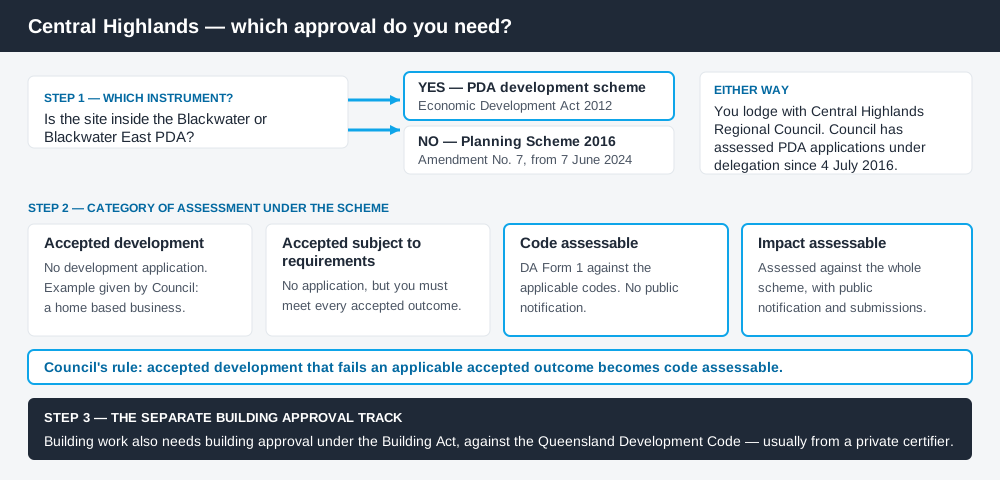
Figure 1: Three questions run in parallel. Answering one does not answer the others.
The Central Highlands Regional Council Planning Scheme 2016
Council adopted the scheme on 24 February 2016, superseding the four planning schemes of the former Emerald, Duaringa, Bauhinia and Peak Downs shires. Older builder advice in Emerald or Springsure often still references shire-era rules that stopped applying a decade ago.
The current version is Amendment No. 7, commenced 7 June 2024 — a business improvement package touching tourism, agriculture, emerging technologies and mapping. A ten-year review is underway, so check the version before relying on a downloaded extract.
Like other Queensland schemes it follows the Queensland Planning Provisions structure — strategic framework, zones, overlays, codes, tables of assessment — but the content is local. Queensland schemes share a skeleton, not a rulebook. Zones here include Township, Emerging community, Community facilities, Recreation and open space, the centre zones and the industry zones. What zone your property is in is the first step.
Part 8 — the overlays that actually bite
Spend 5 minutes, not 3 weeks
instantDA generates a council-ready planning report for Queensland development applications. No town planner. No waiting.
Get your report →Part 8 of the scheme carries eight overlays: airport environs; biodiversity areas, waterways and wetlands; bushfire hazard; extractive and mineral resources; flood hazard; agriculture; regional infrastructure; and water resource catchments.
Three are unusually live here. The flood hazard overlay reflects a serious record — the Nogoa River at Emerald peaked around 15.4 metres in January 2008, then set a new record above 16 metres on 31 December 2010, inundating well over 80 per cent of the town and roughly a thousand houses. Fairbairn Dam upstream stores water for irrigation and town supply; it is not a gated flood mitigation dam, so once it is full its spare capacity cannot help you. Flood hazard overlays explains how the layer behaves.
The extractive and mineral resources and agriculture overlays are the other two. In a Bowen Basin council, land is often valuable for something other than what you want to do with it, and both exist to stop incompatible uses creeping onto it. How to check overlays covers reading the layers.
Two approval tracks, not one
Development approval is a Planning Act 2016 decision. Council is the assessment manager, and it covers land use, siting, intensity, scale and the scheme's assessment benchmarks. Categories run from accepted development, through accepted subject to requirements, to code assessable and impact assessable — and Council's guidance makes the key point plainly: accepted development that fails an applicable accepted outcome becomes code assessable.
Building approval is a Building Act decision about whether the structure complies with the building assessment provisions and the Queensland Development Code, usually given by a private certifier. A development approval does not give you one. Building approval versus development approval sets out the split. Municipal works here are built to the Capricorn Municipal Development Guidelines, not a council-authored standard.
- ✓Which zone?
- ✓Which of the eight Part 8 overlays?
- ✓Inside a Blackwater PDA?
- ✓Accepted, or assessable?
- ✓Building approval as well?
- ✓Operational works too?
Checking your own address
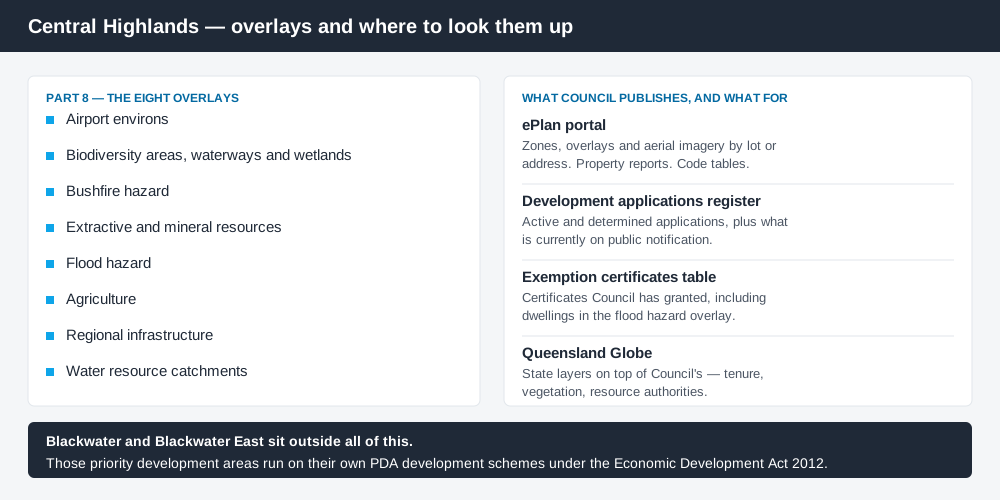
Figure 2: What Council publishes, and what each source is actually for.
Council runs a genuine ePlan platform, linked from its planning scheme page. You can search a property by lot or address, view zone and overlay mapping over aerial imagery, request a property report, and download code compliance tables. By default it shows the current version.
Council also publishes a development applications register and a public table of exemption certificates it has granted — a useful read, recording two dwelling houses in the flood hazard overlay released from assessment, and a water pipeline over a local heritage place at Capella.
For state layers on top of Council's, cross-check the site on the Queensland Globe.
What catches Central Highlands owners out
Blackwater. The Planning Scheme 2016 does not apply to the Blackwater and Blackwater East priority development areas. Those are assessed against their own PDA development schemes under the Economic Development Act 2012. Since 4 July 2016 Council assesses them by delegation from the Minister for Economic Development Queensland — so you still lodge with Council, but the forms and benchmarks are different documents entirely. Assuming the scheme applies in Blackwater is the most expensive mistake made here.
Workers' accommodation. Non-resident workforce accommodation is a defined use with its own element in the strategic framework. Rural locations are generally contemplated for construction phases, with close-out and rehabilitation expectations attached; proposals in or near towns face design and adaptive re-use expectations. It is a material change of use, and rarely a quiet one.
Rural scale. Large holdings are not unregulated ones. Earthworks, vegetation clearing and advertising devices are operational work, and reconfiguring a lot engages the scheme regardless of paddock size. Building on rural land covers it.
When you will probably need a DA
Anything that starts a new use or materially intensifies an existing one is a material change of use and likely assessable. So is subdividing, altering the shape of the land, or building in a mapped flood hazard area. Modest work on an unconstrained town lot is far more often accepted development.
What to do next
Pull the zone and overlays for your address from Council's ePlan, confirm whether the site sits inside a Blackwater PDA, then read the relevant table of assessment.
If you would rather see the zone, the mapped constraints and the likely category of assessment for a Central Highlands address in one place, an instantDA planning report does that for $169 — against the $800–$1,500 a town planner typically charges for a preliminary opinion. You can start a report in minutes.
Then talk to Council's Strategic Land Use team before spending money on drawings, and ask for a fee quotation — fees change each financial year. Council's planning scheme page has the scheme, the ePlan link and the amendment history.
Frequently asked questions
What is Central Highlands Regional Council's planning scheme?
Does the planning scheme apply in Blackwater?
Where can I check zoning and overlays in Central Highlands?
What overlays are in the Central Highlands planning scheme?
How much does a development application cost in Central Highlands?
Ready to generate your report?
Skip the writing. Get a council-ready planning report in 5 minutes.
Get your report