Key takeaways
- ✓Noosa's planning scheme is Noosa Plan 2020, most recently amended by Amendment No.3, which commenced on 20 March 2026.
- ✓Noosa is deliberately low-rise. A dwelling house is capped at 8 metres and 2 storeys in the Low and Medium Density Residential zones.
- ✓Noosa Plan 2020 setbacks differ from the standard Queensland Development Code provisions and vary by zone.
- ✓Short stay letting needs lawful planning rights plus a separate local law approval, renewed annually.
- ✓Development approval and building approval are separate. One does not substitute for the other.
Do You Need Council Approval in Noosa?
You'll usually hear this called a development application, or DA — that's the formal name for council approval under the Planning Act 2016. In Noosa Shire, Council is the assessment manager for most of these, and the rules it applies come from Noosa Plan 2020.
Noosa runs its own scheme because it was re-established as a separate local government on 1 January 2014, after a community campaign to undo the 2008 amalgamation of three Sunshine Coast councils. It plans deliberately for a low-rise shire, with roughly 35 per cent of its area protected as national park, reserve or conservation area, in a landscape recognised as a UNESCO Biosphere.
Get a council-ready planning report in 5 minutes — no planner, no waiting.
Get your report →The short answer
In Noosa, you need a development application when Noosa Plan 2020 makes the work assessable for your zone and overlays. A lot of minor domestic work is accepted development. Building approval is separate and is usually decided by a private certifier. Short stay letting needs an extra local law approval.
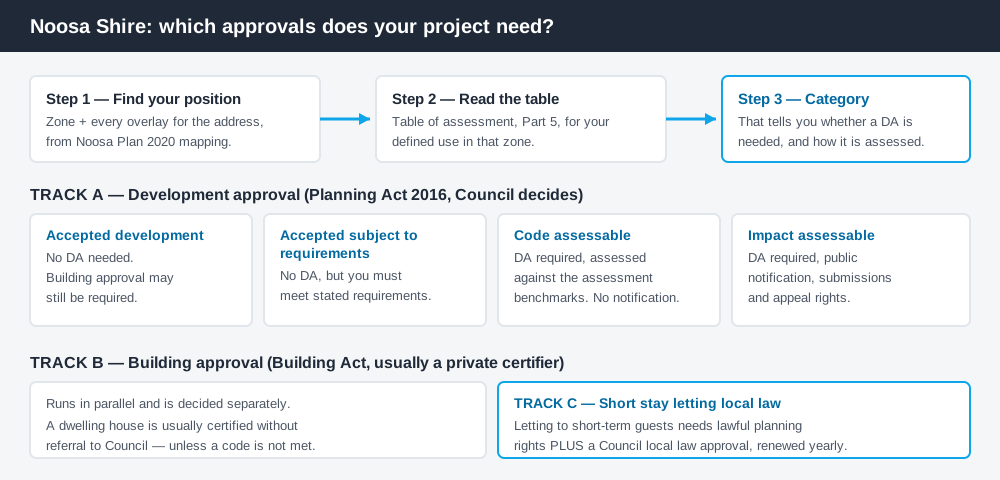
Figure 1: Two tracks run in parallel, and short stay letting adds a third.
Noosa Plan 2020
Noosa Plan 2020 commenced on 31 July 2020 and replaced the previous scheme entirely, mapping included. It has since been amended three times: an administrative amendment in September 2020, a major amendment commencing 26 September 2025, and a minor amendment commencing 20 March 2026.
That history matters. The 2025 amendment reworked significant parts of the scheme, particularly housing and short-term accommodation, so advice more than a year old may no longer hold.
Like every Queensland scheme, Noosa Plan 2020 follows the standardised structure that runs across the state — a strategic framework, local plans, zones, overlays, tables of assessment and development codes — with Noosa's own codes layered on top. The structure is familiar; the content is not interchangeable with any other council's. How to find out what zone your property is in covers reading that structure.
Two approval tracks, not one
Spend 5 minutes, not 3 weeks
instantDA generates a council-ready planning report for Queensland development applications. No town planner. No waiting.
Get your report →Development approval is a Planning Act 2016 decision, with Council as assessment manager. It deals with land use, siting, scale, and compliance with the codes in Noosa Plan 2020.
Building approval is a Building Act decision about whether the structure complies with the building assessment provisions, and it is usually given by a private certifier. Council's own fact sheet is blunt: in most cases a dwelling house is assessed by a private certifier without referral to Council, unless the design fails an acceptable outcome or the site carries a constraint.
They are separate approvals, from separate legislation, with separate decision-makers. Building approval versus development approval covers the distinction in full.
- ✓What is the zone for the address?
- ✓Which overlays apply?
- ✓Does the design meet every acceptable outcome?
- ✓Is the work accepted, or assessable?
- ✓Do you also need building approval?
- ✓Is short stay letting involved?
Checking your own address
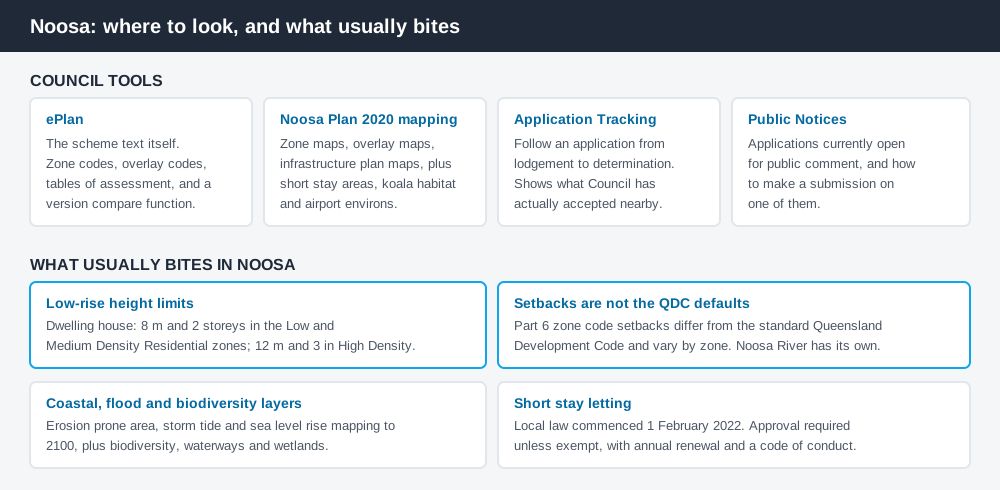
Figure 2: Three Council tools, doing three different jobs.
Council publishes Noosa Plan 2020 through its ePlan at noosaplan.noosa.qld.gov.au/eplan, where you can read the scheme text and compare versions. Alongside it, Council's Noosa Plan 2020 mapping carries the zone maps, overlay maps, infrastructure plan maps, and other plan maps covering short stay areas, koala habitat and airport environs.
Council also runs Application Tracking and a Public Notices tool, which let you follow applications from lodgement to determination and see what is open for comment. What has been approved on comparable sites near you tells you what Council actually accepts.
What catches Noosa owners out
Height. Noosa is low-rise by design. For a dwelling house, the maximum is 8 metres and 2 storeys in the Low Density Residential and Medium Density Residential zones, 12 metres and 3 storeys in the High Density Residential zone, and 8 metres and 2 storeys in the Rural and Rural Residential zones — where a pitched roof may reach 9 metres provided no other part exceeds 8 metres. Building height rules covers how height is measured.
Setbacks that are not the QDC. Council warns explicitly that the zone code setbacks in Part 6 of Noosa Plan 2020 differ from the standard Queensland Development Code provisions and vary by zone. Special setbacks also apply along the Noosa River, at the Noosa Waters revetment wall, and for rural land adjoining Environmental Management and Conservation zoned properties. Boundary setbacks explains the framework.
Short stay letting. Council's Short Stay Letting and Home Hosted Accommodation Local Law was adopted on 21 October 2021 and commenced on 1 February 2022. Approval is required for all existing and new properties operating short stay letting or home hosted accommodation unless exempt, by one-off application with annual renewal, subject to conditions including a local contact person and a code of conduct for guests. That sits on top of your planning position, not instead of it. Short stay accommodation rules covers the planning side.
Coastal hazard. Council has produced its own coastal hazard mapping through its Coastal Hazards Adaptation Plan, going beyond the State's first-pass assessment. It maps an Erosion Prone Area layer, a sea level rise inundation layer and a 1% AEP storm tide inundation layer across four horizons: current, 2040, 2070 and 2100. Coastal hazard overlays explains what that means.
When you will probably need a DA
Work that changes the use of a property, adds a dwelling, subdivides, exceeds a height or site cover figure, sits within a biodiversity, coastal or flood overlay, or involves letting a dwelling to short-term guests, is likely to be assessable. Minor domestic work on an unconstrained lot that meets every acceptable outcome is more often accepted development. The reliable route is the table of assessment in Part 5, read against your zone and overlays.
What to do next
Find the zone and every overlay for your address in Council's mapping, then read the zone code and the table of assessment for what you intend to build.
If you'd rather see the zone, the overlays and the likely category of assessment for a Noosa address pulled together in one place, an instantDA planning report does that for $169 — against the $800–$1,500 a town planner typically charges for a preliminary opinion. You can start a report in a few minutes.
Then confirm with Council. Application fees are set in Council's annual fees and charges schedule and change every year — the 2026-27 schedule lists a code assessable material change of use for a dwelling house at $3,000.
Frequently asked questions
What is Noosa's planning scheme?
How tall can I build in Noosa?
Do I need approval to rent my Noosa house to holiday guests?
Is building approval the same as council approval in Noosa?
Do Noosa's setbacks match the Queensland Development Code?
How do I see what has been approved near me?
Ready to generate your report?
Skip the writing. Get a council-ready planning report in 5 minutes.
Get your report