Key takeaways
- ✓The scheme is the Richmond Shire Planning Scheme 2020, gazetted 26 February 2021 and commenced 1 March 2021.
- ✓A material change of use is impact assessable by default here — that is the single most important local rule.
- ✓There are eight zones and only three overlays: bushfire hazard, environmental values and flood hazard.
- ✓An overlay does not change the level of assessment in this scheme; it adds a code to assess against.
- ✓Council's 2025-2026 fees are $590 for a code assessable application and $1,185 for an impact assessable one.
Do You Need Council Approval in Richmond Shire?
You'll usually hear this called a development application, or DA — that's the formal name for council approval under the Planning Act 2016. In Richmond Shire, Council is the assessment manager, and the benchmarks it applies come from the Richmond Shire Planning Scheme 2020.
Richmond sits on the south bank of the Flinders River, which the scheme itself describes as Queensland's longest, roughly 500 kilometres west of Townsville and 400 east of Mount Isa. The scheme records a shire population of about 802, around 520 of them in Richmond town, and notes that about two-thirds of the shire is held under pastoral lease. What makes planning here unusual is not the size of the scheme but one drafting decision inside it.
In this guide: how the scheme categorises work, the two approval tracks, how to check an address, and what catches owners out.
Get a council-ready planning report in 5 minutes — no planner, no waiting.
Get your report →The short answer
In Richmond Shire you need a development application whenever the scheme's table of assessment makes your proposal code or impact assessable. A material change of use is impact assessable unless the table says otherwise. Building approval is a separate approval, usually from a private certifier.
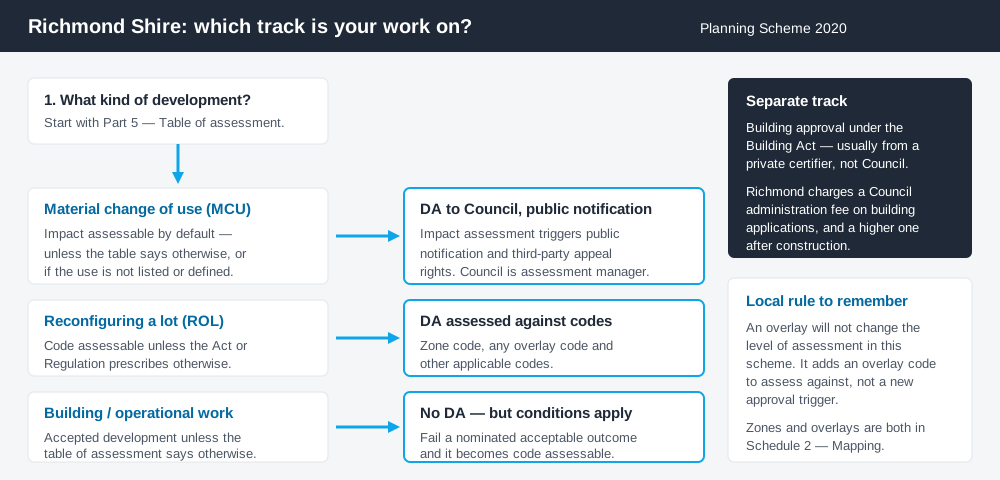
Figure 1: Two tracks run side by side. Clearing one does not clear the other.
The Richmond Shire Planning Scheme 2020
The scheme states that it may be cited as the Richmond Shire Planning Scheme 2020. A notice appeared in Government Gazette No. 29 on 26 February 2021, and the commencement date was 1 March 2021. Amendments sit in Appendix 1.
It is built on three themes — liveability, economy and environment — and follows the standard Queensland structure of strategic framework, zones, tables of assessment and codes. Queensland schemes share that structure, not their content, so a rule you learned in another shire will not transfer. There are eight zones: Rural, Rural residential, General residential, Centre, Mixed use, Industry, Community facilities, and Recreation and open space. The scheme includes no local government infrastructure plan, on the basis that existing networks can service anticipated growth.
Impact assessment is the default for a change of use
Spend 5 minutes, not 3 weeks
instantDA generates a council-ready planning report for Queensland development applications. No town planner. No waiting.
Get your report →This is the local quirk that matters most. The scheme provides that a material change of use is assessable development requiring impact assessment unless the table of assessment states otherwise, or if a use is not listed or defined. Reconfiguring a lot is code assessable unless otherwise prescribed, and building and operational work are accepted development unless the table says otherwise.
Read that ordering carefully. Propose something the scheme never contemplated — an unusual tourism venture, a use with no matching definition in Schedule 1 — and you land in impact assessment, with public notification and third-party appeal rights attached. Material change of use and public notification explain what that means in practice.
The second local rule is quieter but useful: an overlay will not change the level of assessment. In many schemes an overlay pushes work up a category. Here it does not. It adds a code to assess against, and where a site is only partly affected, it applies only to that part.
Two approval tracks, not one
Development approval is a Planning Act 2016 decision about land use, siting, scale and compliance with the scheme's codes. Council is the assessment manager and lodgement is direct — Richmond runs no online DA portal, so DA Form 1 and its supporting material go to the Council office on Goldring Street.
Building approval is a separate Building Act decision about whether the structure complies with the building assessment provisions, normally given by a private certifier. Council's adopted fees list the building application fee as at cost, plus a Council administration fee per application — and a substantially higher one where the work is dealt with after construction. That gap is the clearest signal in the schedule that retrospective approval costs more. Building approval versus development approval covers the split.
- ✓Which of the eight zones?
- ✓Bushfire, environmental values or flood overlay?
- ✓Is the use listed in the table?
- ✓Accepted, code or impact assessable?
- ✓Building approval as well?
- ✓Fees confirmed with Council?
Checking your own address
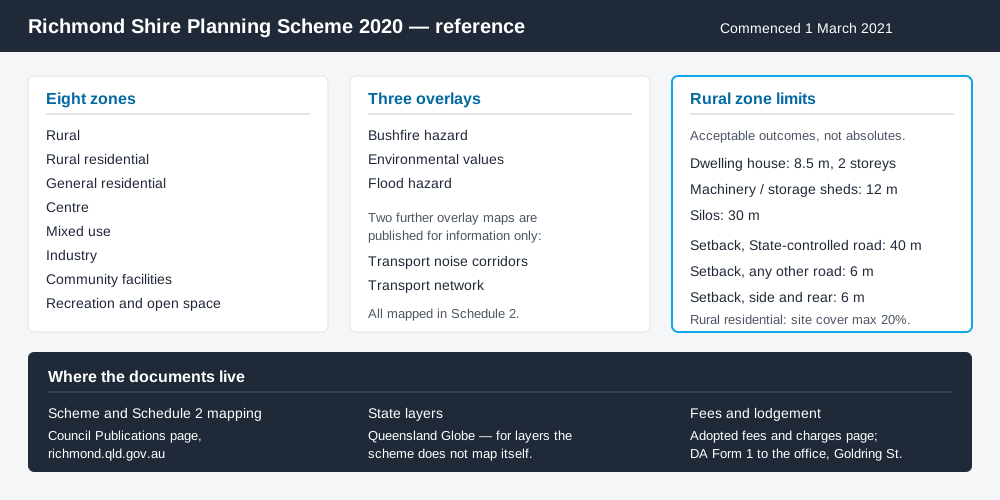
Figure 2: What the scheme contains, and where each document sits.
Richmond does not publish an interactive planning platform. Zoning and overlay mapping live in Schedule 2 — Mapping inside the scheme itself, which Council makes available from its Council Publications page. That is the authoritative source for your zone.
For state layers the scheme does not map, cross-check the site on the Queensland Globe. The zone is the step everything else hangs off; what zone is my property walks through it.
What catches Richmond owners out
Flood. The town sits on the Flinders River and the scheme carries a flood hazard overlay code aimed at avoiding exposure of people and property, protecting floodplain storage and conveyance, and preventing material increases in flood extent or severity. Being inside the mapped flood hazard area means that code applies to your assessment. Flood hazard overlays explains the pattern.
Rural scale is not rural exemption. The Rural zone sets acceptable outcomes of 8.5 metres and two storeys for a dwelling house, 12 metres for machinery and storage buildings, 30 metres for silos, and setbacks of 40 metres from a frontage to a state-controlled road and 6 metres elsewhere. Intensive animal industry carries far larger separations again — up to a kilometre from land in a residential zone for an abattoir, piggery or feedlot. Miss an acceptable outcome and accepted development becomes code assessable. Building on rural land covers the ground.
Tourism proposals. The scheme actively supports farm and fossil tourism, marine reptile tourism and a mix of accommodation types — Kronosaurus Korner and Lake Fred Tritton are named in its strategic framework. Support there is not an approval, and accommodation is a material change of use.
When you will probably need a DA
Anything that starts a new use or intensifies an existing one, subdivides or realigns boundaries, or breaches a nominated acceptable outcome is likely to need an application. Sheds, yards and modest works on an unconstrained lot are far more often accepted development, subject to the requirements attached.
What to do next
Get the zone from Schedule 2, check the three overlays for the same site, then read the table of assessment for what you intend to do.
If you'd rather see the zone, the mapped constraints and the likely category of assessment for a Richmond address in one place, an instantDA planning report does that for $169 — against the $800–$1,500 a town planner typically charges for a preliminary opinion. You can start a report in minutes.
Then call Council. In a shire this size the Goldring Street office will tell you in one conversation what a week of reading might not.
Frequently asked questions
What is Richmond Shire's planning scheme?
Is a change of use automatically impact assessable in Richmond Shire?
What overlays apply in Richmond Shire?
How much does a development application cost in Richmond Shire?
Does Richmond Shire Council have an online DA portal?
Ready to generate your report?
Skip the writing. Get a council-ready planning report in 5 minutes.
Get your report