Key takeaways
- ✓The scheme is the Whitsunday Regional Council Planning Scheme 2017, commenced 3 July 2017 and updated to Version 5.0 on 30 March 2026.
- ✓Short-term accommodation requires approval from Council in every zone, and in some zones the application must be publicly notified.
- ✓Version 5.0 tightened short-term accommodation in the Low density residential zone, supporting it only in ten identified precincts.
- ✓Development applications are lodged electronically by email to Council, not through a state lodgement portal.
- ✓Coastal hazard, flood hazard and agricultural land overlays do most of the work across this region.
Do You Need Council Approval in the Whitsundays?
You'll usually hear this called a development application, or DA — that's the formal name for council approval under the Planning Act 2016. In the Whitsunday region, Whitsunday Regional Council is the assessment manager for most of them, applying the Whitsunday Regional Council Planning Scheme 2017.
What makes this council distinctive is that one land use dominates its enquiries. Holiday letting runs through Airlie Beach and Cannonvale as it does in few other Queensland councils, and Council has written unusually explicit rules about it. The cane and horticultural country around Proserpine and Bowen, and a coastline that took a direct cyclone crossing in 2017, drive a very different set of constraints.
Get a council-ready planning report in 5 minutes — no planner, no waiting.
Get your report →The short answer
You need a development application when the Whitsunday Regional Council Planning Scheme 2017 makes your work assessable for your zone and overlays. Short-term accommodation needs Council approval in every zone. Building approval is separate and is usually decided by a private certifier.
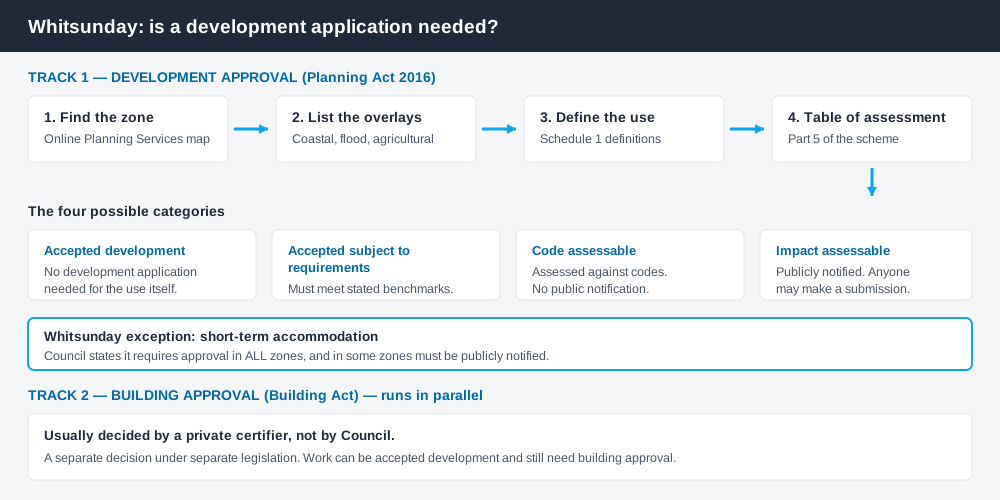
Figure 1: Two tracks run in parallel. Answering one does not answer the other.
The Whitsunday Regional Council Planning Scheme 2017
The scheme commenced on 3 July 2017, the first for the region after the amalgamation of the Bowen and Whitsunday shires, and Council states it was updated to Version 5.0 on 30 March 2026. That update matters: it was a major amendment dealing squarely with short-term accommodation, so a position you checked in 2024 or 2025 may have moved. Take the current version from Council, not a saved PDF.
The scheme follows the standardised structure used across Queensland — strategic framework, zone codes, overlay codes and tables of assessment — with Whitsunday's own codes on top. Queensland schemes are not uniform, so the local codes are where the answers sit. How to find out what zone your property is in covers that structure.
Two approval tracks, not one
Spend 5 minutes, not 3 weeks
instantDA generates a council-ready planning report for Queensland development applications. No town planner. No waiting.
Get your report →Development approval is a Planning Act 2016 decision, with Council as assessment manager. It deals with land use, siting, scale and compliance with the scheme's codes.
Building approval is a Building Act decision about whether the structure complies with the building assessment provisions, usually given by a private certifier.
They are separate approvals under separate legislation. A shed can be accepted development and still need building approval, and holding a building approval does not cure the absence of a development approval where one was required. Building approval versus development approval covers the distinction in full.
Council also warns that the tables of assessment must be read alongside the Planning Regulation 2017, which makes some development accepted or prohibited regardless of the scheme.
Short-term accommodation — the local rule that bites
Where the permanent resident lives in the dwelling and rents part of it out, the use is a home based business, which Council states needs no approval in residential zones if it meets all of its criteria — no more than three private bedrooms used for guests, no more than six guests at once, stays no longer than 14 consecutive nights, bathroom and toilet facilities separate from the residents, and at least one parking space per guest bedroom. Miss any one, and a development application is required.
Where the owner does not live there and rents the dwelling out for stays typically under three consecutive months, it is short-term accommodation — and Council states this requires approval in all zones, with public notification in some.
Version 5.0 sharpened this. It applies to the Low density residential zone region wide and clarifies that short-term accommodation is generally not supported there, except within ten identified precincts with an established history of holiday home use. Short-stay accommodation rules cover the general Queensland position.
A separate annual local law licence also applies. If the use began before 30 June 2017, you may instead seek confirmation of existing use rights.
- ✓What zone applies?
- ✓Which overlays touch it?
- ✓Short-term accommodation or home based business?
- ✓Inside one of the ten precincts?
- ✓Building approval too?
Checking your own address
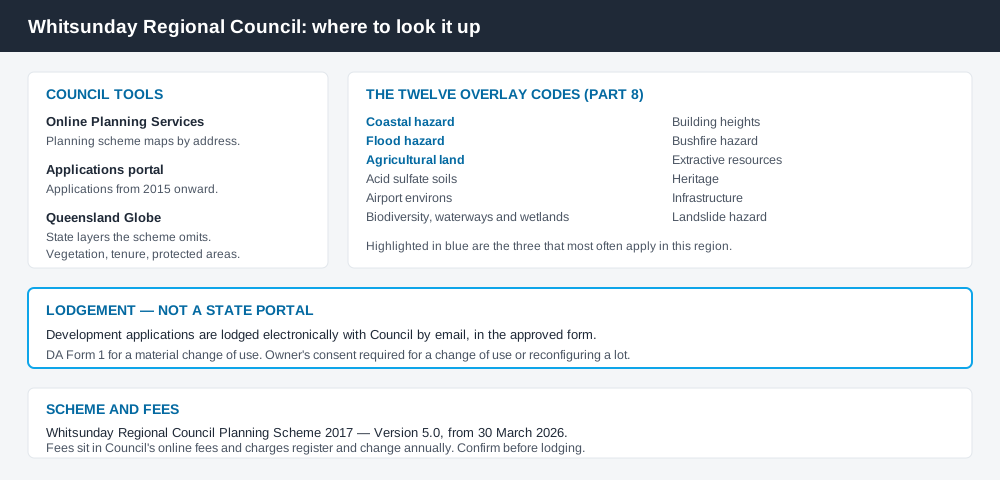
Figure 2: Council's own tools, and the overlays that most often bite here.
Council publishes the scheme in parts, with the maps delivered through its Online Planning Services on the Whitsunday Regional Council planning pages. Applications from 2015 onward can be viewed through Council's applications portal — the fastest way to see what has actually been approved nearby.
For state-administered layers such as vegetation, cross-check the site on the Queensland Globe.
What catches Whitsunday owners out
Coastal hazard. This overlay covers storm tide inundation, wave run-up, erosion prone areas and permanent inundation. Severe Tropical Cyclone Debbie crossed the coast at Airlie Beach on 28 March 2017, devastating Airlie Beach, Proserpine and resort islands including Hamilton and Daydream, with Bowen also significantly damaged. That is why storm tide risk is taken seriously here. Storm tide and coastal hazard covers what it requires.
Agricultural land. The cane and horticultural country around Proserpine and Bowen sits under an agricultural land overlay, and fragmenting it or introducing sensitive uses is a recurring cause of refusals.
The islands. Land above high water on the resort islands sits within the scheme, but works in the water — jetties, pontoons, marinas — are assessed by Commonwealth and State agencies, not Council.
When you will probably need a DA
Anything that changes the use of a property, adds a dwelling, subdivides, involves short-term letting, sits in the coastal or flood hazard overlay, or takes agricultural land out of production is likely to be assessable.
Minor domestic work on an unconstrained lot — a modest shed, a standard fence, internal alterations that do not change floor area or height — is much more often accepted development. What counts as a material change of use explains where the line falls.
What to do next
Identify the zone and every overlay for your address through Council's Online Planning Services, then read the table of assessment for your intended use.
If you'd rather see the zone, the overlays and the likely category of assessment in one place, an instantDA planning report does that for $169 — against the $800–$1,500 a town planner typically charges for a preliminary opinion. You can start a report in a few minutes.
Then confirm with Council. Applications here are lodged electronically by email rather than through a state portal, and fees sit in Council's online fees and charges register and change annually, so check the current amount before you lodge.
Frequently asked questions
Do I need council approval to run an Airbnb in Airlie Beach?
What changed in Version 5.0 of the scheme?
How do I lodge a development application with Whitsunday Regional Council?
What is the planning scheme for the region?
Which overlays matter most here?
Ready to generate your report?
Skip the writing. Get a council-ready planning report in 5 minutes.
Get your report