Key takeaways
- ✓Triage every job at the front end into accepted, accepted subject to requirements, code assessable or impact assessable — only the last two carry real DA risk.
- ✓Building approval and development approval run on different clocks under different Acts, so track them as two separate lines per job.
- ✓The Development Assessment Rules give you the numbers to build a real program: 10 business days to confirm, one information request, 3 months to respond, 35 business days to decide.
- ✓An information request landing while crew is booked is the single most common cause of a blown program.
- ✓Track currency periods across a long pipeline so an approval doesn't lapse before you get to it.
- ✓Queensland planning schemes are not uniform — a solution that worked in one council does not transfer to the next.
Managing Applications Across Multiple Jobs (QLD Builders)
If you're running five or six jobs at once, you'll hear the approval side called everything from "the council paperwork" to "the permit". The formal name in Queensland is a development application, or DA, assessed by council as the assessment manager under the Planning Act 2016. The trouble for a builder isn't any single DA. It's that each job sits in a different council, under a different planning scheme, at a different stage — and they don't queue politely.
Get a council-ready planning report in 5 minutes — no planner, no waiting.
Get your report →The short answer
Triage every job at the front end into accepted, accepted subject to requirements, code assessable or impact assessable. Track building approval and development approval separately, because they run on different clocks. Then build your program off the Development Assessment Rules timeframes rather than off hope.
The failure mode is nearly always the same: an information request arrives on job three while the crew is booked for job three, and everything behind it shunts.
Triage first: which jobs even have a DA risk
Most builders carry a mix where only a minority of jobs need a development application at all. Sorting that out early is the highest-value hour in the whole program.
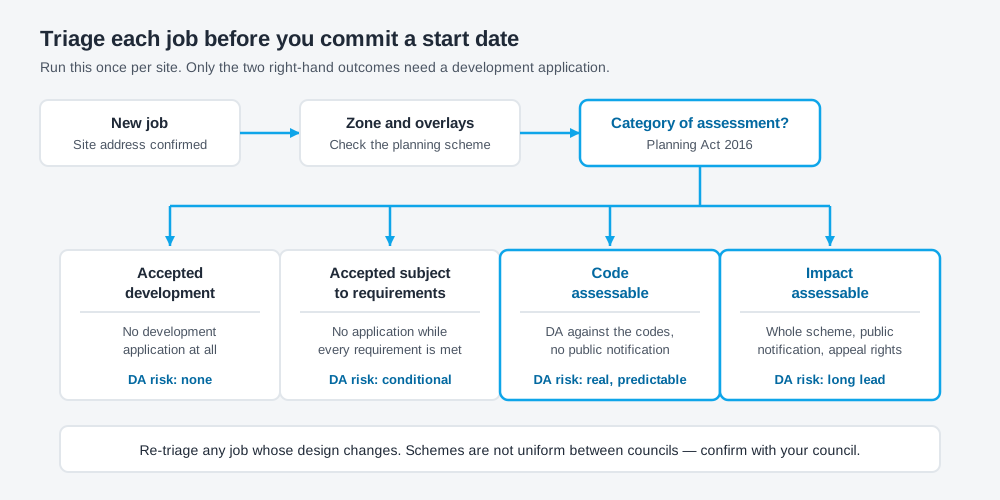
Figure 1: Triaging each job into one of the four categories before you commit a start date.
Accepted development needs no development application at all. Accepted development subject to requirements also needs no application — but only while you meet every requirement written into the scheme. Change a setback, add a metre of height, and it becomes assessable. Those two are routinely treated as the same thing on site, and they are not. The second one is conditional and it can move under you.
Code assessable development needs a DA, assessed against the relevant codes. It isn't publicly notified and there's no third-party appeal right, so it is comparatively predictable. Impact assessable development needs a DA assessed against the whole planning scheme, must be publicly notified, and submitters gain appeal rights. That last category is the one that belongs in a different column of your program entirely.
- ✓Confirm the zone and overlays for each site
- ✓Confirm the category of assessment for the proposed use and works
- ✓Flag any job that is impact assessable as long-lead
- ✓Re-triage any job where the design changes after the first pass
Two approvals, two clocks, one job
Spend 5 minutes, not 3 weeks
instantDA generates a council-ready planning report for Queensland development applications. No town planner. No waiting.
Get your report →The second structural mistake is treating "approval" as one line item. It is two, and they are granted by different people under different Acts.
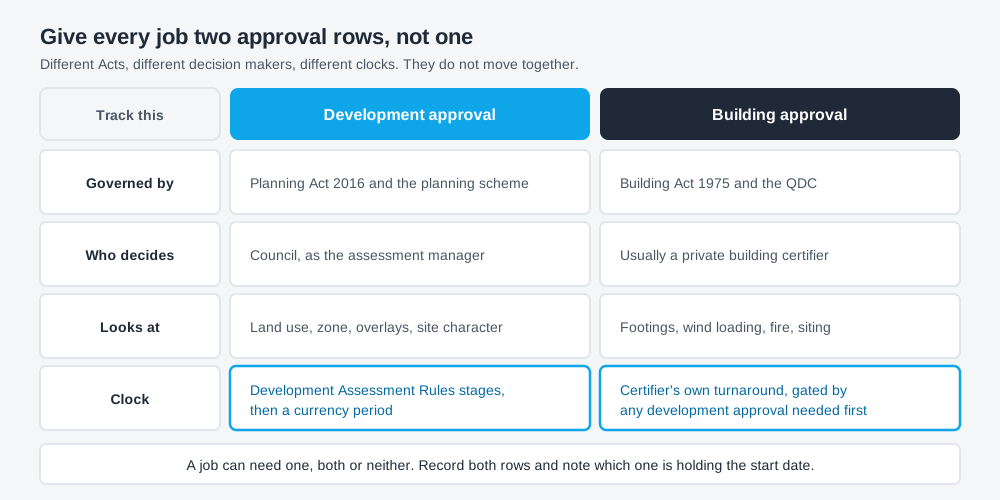
Figure 2: The two approval lines every job needs tracked separately.
Development approval sits under the Planning Act 2016 and the council's planning scheme. Council is the assessment manager. It is about land use, zone, overlays and the character of the site. Building approval sits under the Building Act 1975 and is usually issued by a private building certifier you engage directly. It is about the structure — footings, wind loading, fire separation, siting.
A job can need one, both or neither. Critically, they do not move together. Your certifier can be ready to issue while council is still in its decision period, and a certifier generally cannot issue building approval ahead of a development approval the works depend on. If your job tracker has a single "approval" field, you will find this out the expensive way. Give every job two rows.
Build the program off the DA Rules, not off hope
The Development Assessment Rules set the process timeframes for a development application. They are the only reliable basis for a program, and most builders under-allow against them.
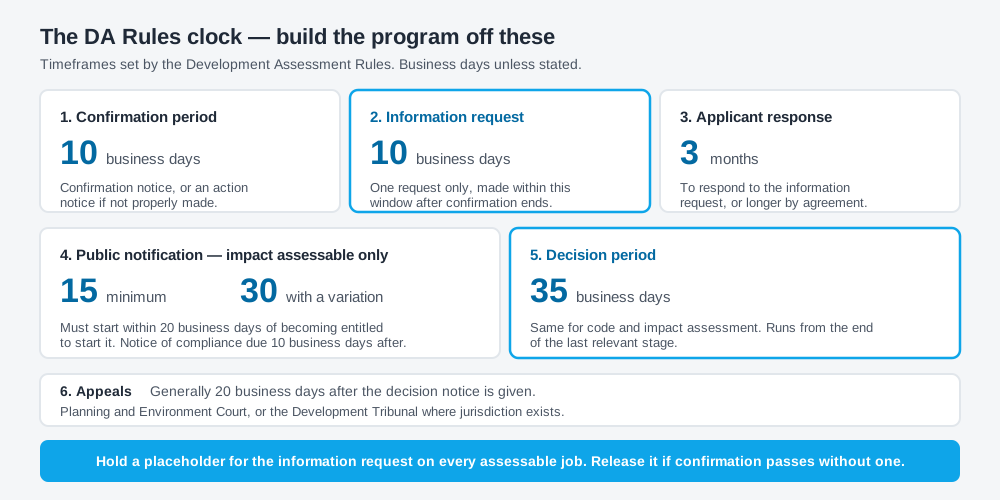
Figure 3: The DA Rules clock, stage by stage, in business days.
The assessment manager has 10 business days to give a confirmation notice, or an action notice if the application is not properly made. The assessment manager may then make one information request, and must do so within 10 business days after the confirmation period ends. Once it lands, the applicant has 3 months to respond, or longer by agreement. The decision period is 35 business days for both code and impact assessment, running from the end of the last relevant stage. For impact assessable applications, public notification runs a minimum of 15 business days, or 30 business days where the application includes a variation request.
Those numbers matter most for the information request. It is a single, predictable event on every assessable job, and it is the one that reliably blows a program because it arrives after you've already scheduled crew off the back of an optimistic lodgement date. Build the window into your program as a placeholder on every code and impact job, then release it when the confirmation period passes without one. Our guides on DA timeframes and responding to an information request go through the sequence stage by stage.
Currency periods: the pipeline risk nobody diaries
On a long pipeline, an approval granted for job two can be quietly ageing while you finish jobs three and four. Section 85 of the Planning Act 2016 sets a currency period, and the approval lapses at the end of it.
Where the approval itself states no period, a material change of use approval runs 6 years from when the approval starts to have effect, within which the first change of use must happen. A reconfiguring a lot approval runs 4 years to give the plan to the local government. Any other part of the approval runs 2 years to substantially start. That two-year figure is the one that catches builders, because it covers the operational works and building work aspects. An extension can be requested, but only before the approval lapses — after that there is nothing to extend. Diary the date the day the decision notice arrives, not the month before you need it. Currency periods explained covers the extension route.
When to bring in a town planner
The front-end triage — zone, overlays, category of assessment — is work an organised builder can do themselves for straightforward jobs, and doing it early is what makes the rest of the program honest. A town planner earns their fee on the jobs that come back impact assessable, involve a variation request, sit under a difficult overlay, or have already attracted an information request you can't answer cleanly.
For the triage itself across a pipeline, an instantDA planning report gives you the zone, the overlays and the likely category of assessment for a specific address for $169, against the $800–$1,500 a town planner typically charges for a preliminary opinion. Run one per site before you commit a start date and you can start a report in a few minutes.
One warning applies to everything above. Queensland's planning schemes follow the Queensland Planning Provisions structure, but each council layers its own codes and overlays on top. They are not uniform. A design that sailed through as accepted development in one council can be code assessable in the next, and the fact that it worked last time is not evidence. Confirm the position with the council governing each site, and check the Development Assessment Rules and Queensland Globe for current process and mapping.
Frequently asked questions
How many information requests can council make on one DA?
Can I lodge development approval and building approval at the same time?
How long is a Queensland development approval valid?
Does an approval from one council mean the same design is approved in another?
When should a builder engage a town planner rather than doing the checks in-house?
What is the fastest way to stop one job's delay spreading through the program?
Ready to generate your report?
Skip the writing. Get a council-ready planning report in 5 minutes.
Get your report